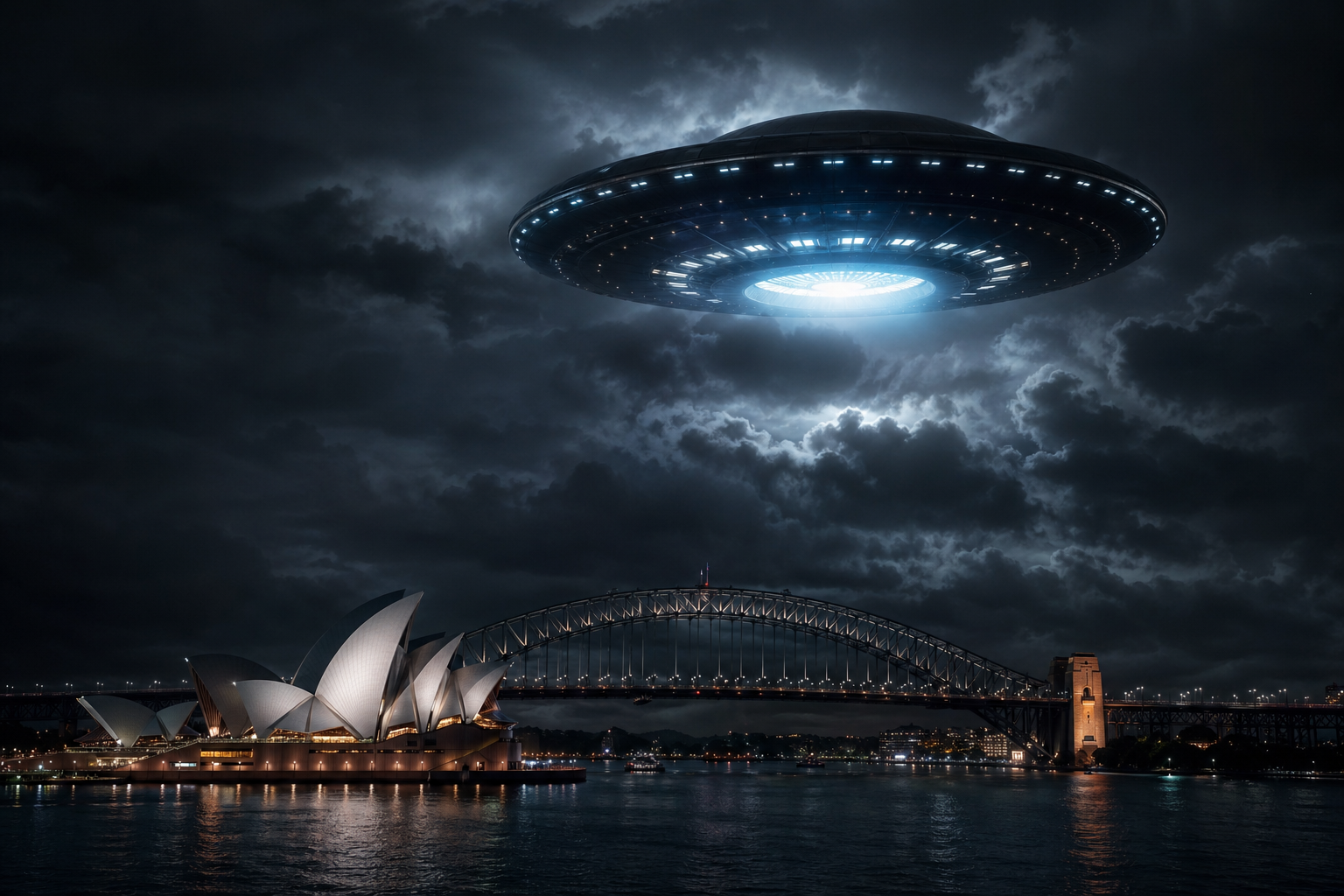
The global landscape of aerial mystery is shifting as former President Donald Trump reportedly issues a directive to the Pentagon to unlock the infamous Black Vault of UFO secrets. While the United States moves toward an era of unprecedented transparency regarding Unidentified Aerial Phenomena (UAP), other nations are finding themselves under the microscope for their continued reticence. In a recent broadcast by 4BC Brisbane Radio, experts and enthusiasts alike raised a pressing question: why is the Australian government remaining silent while its closest ally prepares to spill the truth?
The Opening of the Black Vault
For decades, the term “Black Vault” has been synonymous with the deepest, darkest secrets of the American military-industrial complex. It represents a repository of sightings, radar data, and physical evidence that has been shielded from public view under the guise of national security. However, the political tide in Washington D.C. has turned, with a bipartisan push for disclosure gaining momentum unlike anything seen since the Project Blue Book era of the 1960s.
The directive to declassify these files suggests that the Pentagon may soon be forced to release high-definition imagery and sensor data that could prove the existence of craft exhibiting “trans-medium” capabilities. These objects, often referred to as Tic-Tacs or spheres, have been observed moving from space to the ocean at speeds that defy the known laws of physics. By ordering the opening of these archives, the administration is effectively challenging the intelligence community to justify its long-standing culture of concealment.
This move isn’t just about satisfying curiosity; it is about aviation safety and scientific progress. If these objects represent foreign adversarial technology, the threat is imminent. If they represent something “other,” the implications for humanity are profound. The pressure is now on the Department of Defense to comply with a public that is increasingly skeptical of official denials.
Australia’s Wall of Silence
While the U.S. prepares for a potential “data dump” of extraterrestrial proportions, the situation in Australia remains starkly different. Despite numerous high-profile sightings over the Outback and near sensitive military installations like Pine Gap, the Australian Department of Defence has maintained a policy of “no comment.” This silence was the focal point of the recent 4BC Brisbane report, which highlighted the growing frustration among Australian researchers.
Historically, Australia has been a hotspot for paranormal activity, most notably the 1966 Westall UFO encounter, where hundreds of students and teachers witnessed a craft land in a suburban paddock. Despite the scale of such events, official records are often sparse or redirected to American authorities. Critics argue that the Royal Australian Air Force (RAAF) is essentially outsourcing its UAP investigations to the United States, leaving the Australian public in the dark about what is happening in their own skies.
The contrast between the two nations is jarring. As American pilots like Commander David Fravor testify before Congress, Australian whistleblowers remain hesitant to speak out, fearing professional repercussions. The 4BC broadcast suggests that the Australian government may be bound by Five Eyes intelligence-sharing agreements that prioritize secrecy over public disclosure, even when the “secret” is hovering over a major city.
A Global Shift in the UAP Narrative
The push to open the Black Vault is part of a larger global trend toward UFO disclosure. From the release of the 2021 Preliminary Assessment by the Office of the Director of National Intelligence to the formation of AARO (All-domain Anomaly Resolution Office), the infrastructure for transparency is being built in real-time. This isn’t just a hobby for “tinfoil hat” theorists anymore; it is a serious matter of geopolitical strategy.
Similar cases are popping up across the globe, from the Brazilian Senate holding public hearings on UAPs to the Japanese Ministry of Defense establishing protocols for pilots who encounter unknown craft. The “Black Vault” directive serves as a catalyst, potentially forcing the hands of other Five Eyes nations—including the UK, Canada, and New Zealand—to follow suit. If the U.S. reveals that it possesses “off-world” materials, the diplomatic fallout for countries that claimed ignorance will be severe.
The mystery of the Black Vault isn’t just about what is inside the files, but why it took so long to get the key. As sensor technology becomes more accessible to the civilian population, the government’s monopoly on the truth is evaporating. We are entering an era where “the truth is out there” is no longer a tagline, but a demand for accountability.
As the Pentagon prepares to pull back the curtain on decades of mystery, will the Australian government finally break its silence and join the global conversation? Or will the land down under remain a “black hole” for UAP data while the rest of the world moves toward the light? What do you think is hidden in the deepest levels of the Black Vault that the government is so afraid to reveal?
Recommended Resources
- 🤖 Viktor AI — The autonomous AI platform we use to run our marketing operations. Hire Viktor to handle blogging, lead research, audits, and more.
- 💳 Greenlight — The money app and debit card for kids and teens. Teach your kids to earn, save, and invest. Earn $30 when you sign up.
- ⛏️ GoMining — Earn Bitcoin through cloud mining without the hardware hassle. A passive way to get into crypto.
- 🏦 Mercury — The business banking account built for startups and small businesses. No fees, powerful tools, and easy to set up.
Leave a Reply