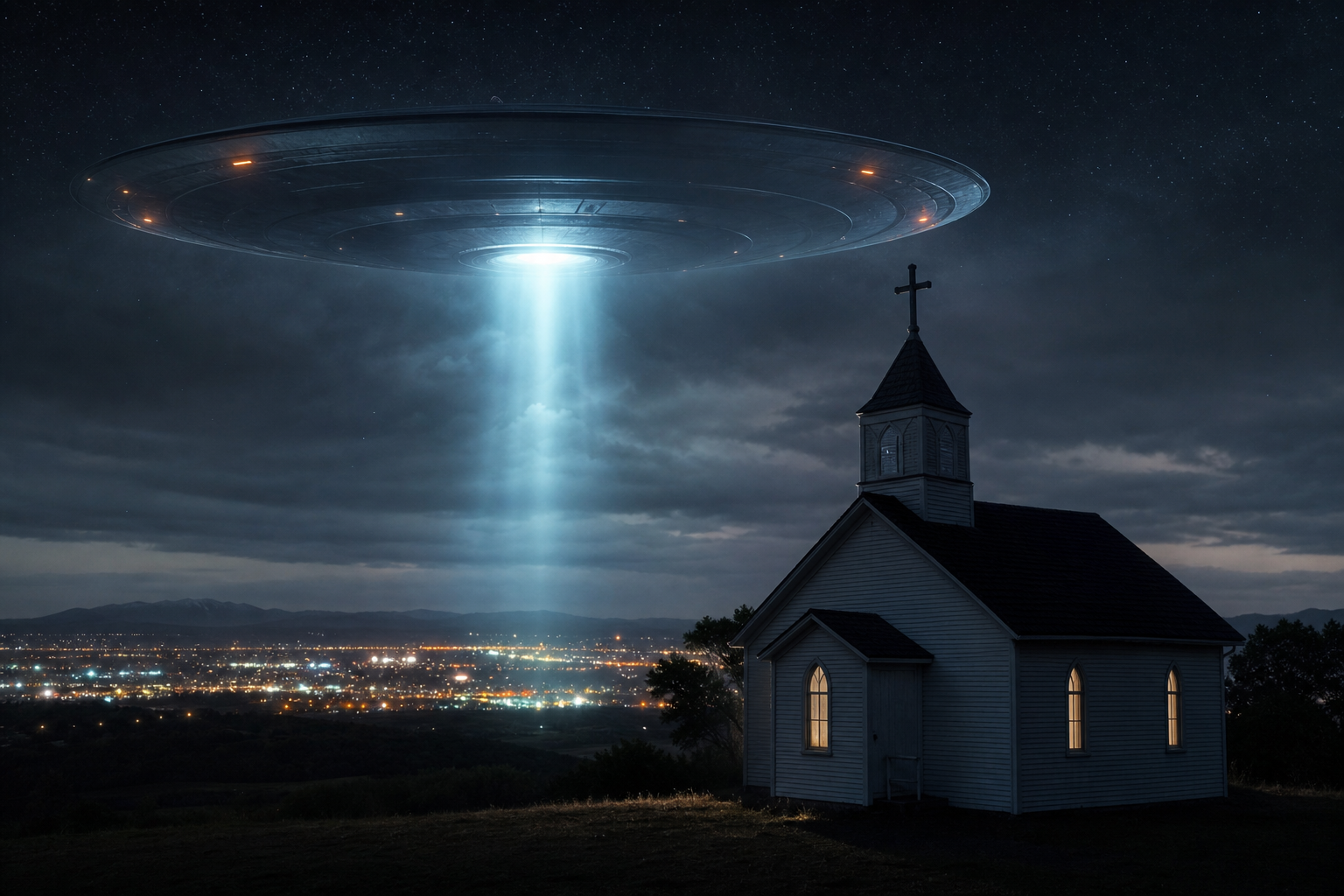
For decades, the intersection of faith and the unexplained has been a battleground of conflicting ideologies. While some view the potential existence of Non-Human Intelligence (NHI) as a threat to traditional religious structures, others see it as a natural extension of a vast, divine creation. Recently, Missouri Congressman Eric Burlison stepped into this fray, offering a perspective that bridges the gap between ancient scripture and modern aerial mysteries.
Burlison, a self-described skeptic from the “Show-Me State,” has become a prominent voice in the ongoing push for UAP Disclosure. As a member of the House Oversight Committee, he has been privy to testimonies that would shake the foundation of many worldviews. Yet, for Burlison, the revelation of craft and entities that defy conventional physics hasn’t led to a crisis of faith, but rather a deeper dive into the texts he holds sacred.
The Skeptic’s Journey into the Unknown
The journey for Burlison began with a healthy dose of Missouri-bred skepticism. In a political landscape often filled with hyperbole, he approached the subject of Unidentified Aerial Phenomena with a critical eye, demanding empirical evidence over anecdotal stories. However, as the evidence mounted and the secrecy surrounding the phenomenon began to crack, he found himself grappling with the implications for his personal beliefs.
“I am a Christian and I believe the only way to salvation is through Jesus Christ, but this has challenged my faith,” Burlison recently shared. This admission highlights a growing sentiment among religious lawmakers who are forced to reconcile their Biblical Worldview with the possibility that humanity is not the only intelligent life in the cosmos. For many, the idea of “aliens” suggests a universe where human divinity is sidelined, but Burlison argues that this is a misunderstanding of the source material.
By focusing on what the Bible actually says rather than modern cultural interpretations, Burlison concluded that the existence of UAPs does not conflict with his faith. He suggests that the “heavens” described in ancient texts are far more complex than a simple blue sky. In his view, the Paranormal and the spiritual are often two sides of the same coin, separated only by our current lack of scientific understanding.
Ancient Texts and Modern Anomalies
Burlison’s perspective echoes a growing movement within theological circles that explores the Interdimensional nature of the phenomenon. Rather than viewing UAPs as biological entities from distant planets, some theorists suggest they may be the “messengers” or “watchers” described in antiquity. This Ancient Astronaut Theory, while often dismissed by mainstream science, finds a strange sort of harmony in Burlison’s call to stick to the literal word of the Bible.
Historically, the church has had a complex relationship with the “plurality of worlds.” From the trial of Giordano Bruno to the Vatican’s modern-day astronomical research, the question of whether God created other sentient beings has been debated for centuries. Burlison’s stance is a modern evolution of this debate, suggesting that if God is truly infinite, then His creation must be equally boundless, potentially including entities that operate outside our three-dimensional reality.
This “grounded” approach to the supernatural allows for a framework where Extraterrestrial life is not a replacement for God, but another facet of a complex, multi-layered reality. By removing the “personal interpretations” that have built up over centuries, Burlison finds a space where faith and the unexplained can coexist without contradiction.
The Crumbling Wall of Government Secrecy
Beyond the spiritual implications, Burlison is focused on the practical reality of government transparency. He notes that the era of hiding the truth behind Classification Walls is rapidly coming to an end. The public’s demand for answers is no longer a fringe movement; it is a bipartisan push for accountability that spans from the halls of Congress to the pews of local churches.
The Congressman’s advocacy for disclosure is rooted in the belief that the truth, no matter how strange, is always preferable to state-sponsored obfuscation. Whether these objects are advanced human technology, Secret Space Programs, or something truly “other,” Burlison believes the American people have a right to know. The dismantling of these secrets is, in his eyes, a necessary step for both scientific progress and spiritual clarity.
As more whistleblowers come forward and more sensor data is released, the conversation is shifting from “if” these objects exist to “what” they are and “where” they come from. For Burlison, the answer doesn’t require a new religion, but perhaps a more expansive understanding of the one he already practices. He remains steadfast in his conviction that the truth of the universe will ultimately align with the truths of his faith.
The intersection of the divine and the Ufological remains one of the most provocative frontiers of the 21st century. As we move closer to a potential “Great Disclosure,” the insights of leaders like Burlison provide a roadmap for how traditional institutions might survive—and even thrive—in a world where we are finally forced to acknowledge we are not alone.
Do you believe that the discovery of non-human intelligence would strengthen or shatter modern religious institutions?
Recommended Resources
- 🤖 Viktor AI — The autonomous AI platform we use to run our marketing operations. Hire Viktor to handle blogging, lead research, audits, and more.
- 💳 Greenlight — The money app and debit card for kids and teens. Teach your kids to earn, save, and invest. Earn $30 when you sign up.
- ⛏️ GoMining — Earn Bitcoin through cloud mining without the hardware hassle. A passive way to get into crypto.
- 🏦 Mercury — The business banking account built for startups and small businesses. No fees, powerful tools, and easy to set up.
Leave a Reply