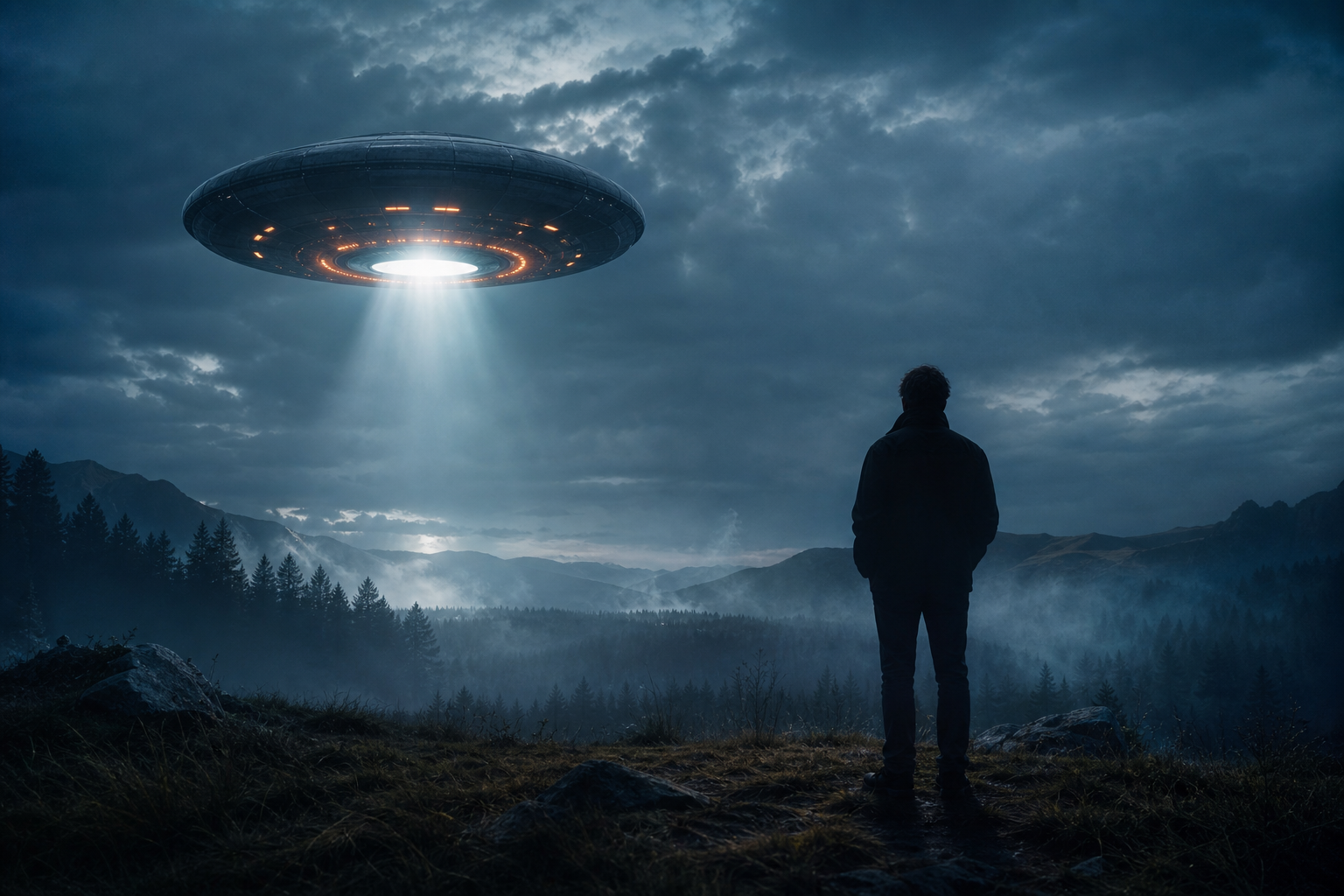
For decades, the silver screen has conditioned us to expect a specific sequence of events when the “saucers” finally arrive. From the terrifying global invasions of Hollywood blockbusters to the benevolent musical tones of classic sci-fi, our cultural imagination is saturated with visions of First Contact. But as the scientific community moves closer to identifying potential life beyond our atmosphere, the question is no longer just “if” they exist, but how we will behave when they get here.
Neil deGrasse Tyson, perhaps the world’s most recognizable astrophysicist, is now weighing in on the logistics of this cosmic meeting. In his latest exploration, “Take Me to Your Leader,” Tyson moves beyond the tropes of cinema to ask a fundamental question: If an advanced civilization actually reached Earth, how would we—and how should we—greet them? It is a conversation that blends hard science with the deep mystery of the unknown, a territory where the paranormal and the empirical often collide.
The Science of First Contact and the Fermi Paradox
The search for Extraterrestrial Intelligence (SETI) has long been a pursuit of the patient. For years, astronomers have scanned the heavens for technosignatures—radio waves or laser pulses that would indicate a civilization using technology similar to our own. Despite the vastness of the universe and the billions of exoplanets residing in the “Goldilocks Zone,” we have met only a “Great Silence,” a phenomenon often referred to as the Fermi Paradox.
Tyson’s perspective suggests that our expectations of an alien arrival might be skewed by our own human ego. We often assume that aliens would want to talk to us, or perhaps conquer us, because that is what humans have done throughout history. However, Tyson posits that a civilization capable of interstellar travel would be so far advanced that we might appear as nothing more than interesting biological specimens, or perhaps even ants on a sidewalk, to them.
This shift in perspective changes the “greeting” entirely. If they are vastly superior, the traditional diplomatic protocols of the United Nations might be entirely irrelevant. We are forced to consider whether we are even capable of communicating with a species that may have evolved in an environment completely alien to our own, utilizing senses we cannot even imagine.
Beyond the “Take Me to Your Leader” Trope
The phrase “Take me to your leader” has become a staple of UFO lore, but Tyson points out the inherent flaw in this request. Earth is a fractured planet with no singular voice or representative. If a craft were to land tomorrow, would the visitors speak to the President of the United States, the Secretary-General of the UN, or perhaps the person who happened to be standing in the field where they touched down?
Tyson explores the idea that mathematics and physics might be the only universal languages. While spoken words and cultural gestures vary wildly even among humans, the laws of astronomy and the properties of the hydrogen atom remain constant throughout the cosmos. A greeting might not involve a handshake or a speech, but rather a demonstration of our understanding of the universe’s fundamental constants.
This echoes the efforts of the Voyager Golden Record, a project led by the late Carl Sagan. Launched in 1977, these records contain sounds and images selected to portray the diversity of life and culture on Earth. It was a “bottle in the cosmic ocean,” a greeting intended for any spacefarer who might find it. Tyson’s modern take updates this sentiment for an era where UAP (Unidentified Aerial Phenomena) are being discussed openly in the halls of Congress.
The Ethics of Cosmic Diplomacy
There is also a darker side to the greeting debate, often discussed in the context of the Dark Forest Theory. This theory suggests that the universe is a dangerous place where civilizations stay silent to avoid being destroyed by predatory neighbors. If this is the case, our attempts to “greet” the stars might be a catastrophic mistake, signaling our location to entities that do not have our best interests at heart.
Tyson, however, tends to lean toward a more optimistic, or at least curious, outlook. He challenges us to think about how we would present the best of humanity while acknowledging our flaws. Would we show them our art and music, or would we lead with our scientific achievements? The way we prepare for an alien encounter says as much about our own self-image as it does about our expectations of the “other.”
As we continue to document ghost sightings, strange lights in the sky, and other paranormal events, the line between what is “out there” and what is “in here” continues to blur. Tyson’s work serves as a bridge, reminding us that while we look for ghosts in the machine, we must also prepare for the very real possibility of neighbors in the stars. The greeting we prepare today may define the survival of our species tomorrow.
If a craft landed in your backyard tonight and the occupants asked to be taken to a leader, who would you choose to represent the human race?
Recommended Resources
- 🤖 Viktor AI — The autonomous AI platform we use to run our marketing operations. Hire Viktor to handle blogging, lead research, audits, and more.
- 💳 Greenlight — The money app and debit card for kids and teens. Teach your kids to earn, save, and invest. Earn $30 when you sign up.
- ⛏️ GoMining — Earn Bitcoin through cloud mining without the hardware hassle. A passive way to get into crypto.
- 🏦 Mercury — The business banking account built for startups and small businesses. No fees, powerful tools, and easy to set up.
Leave a Reply