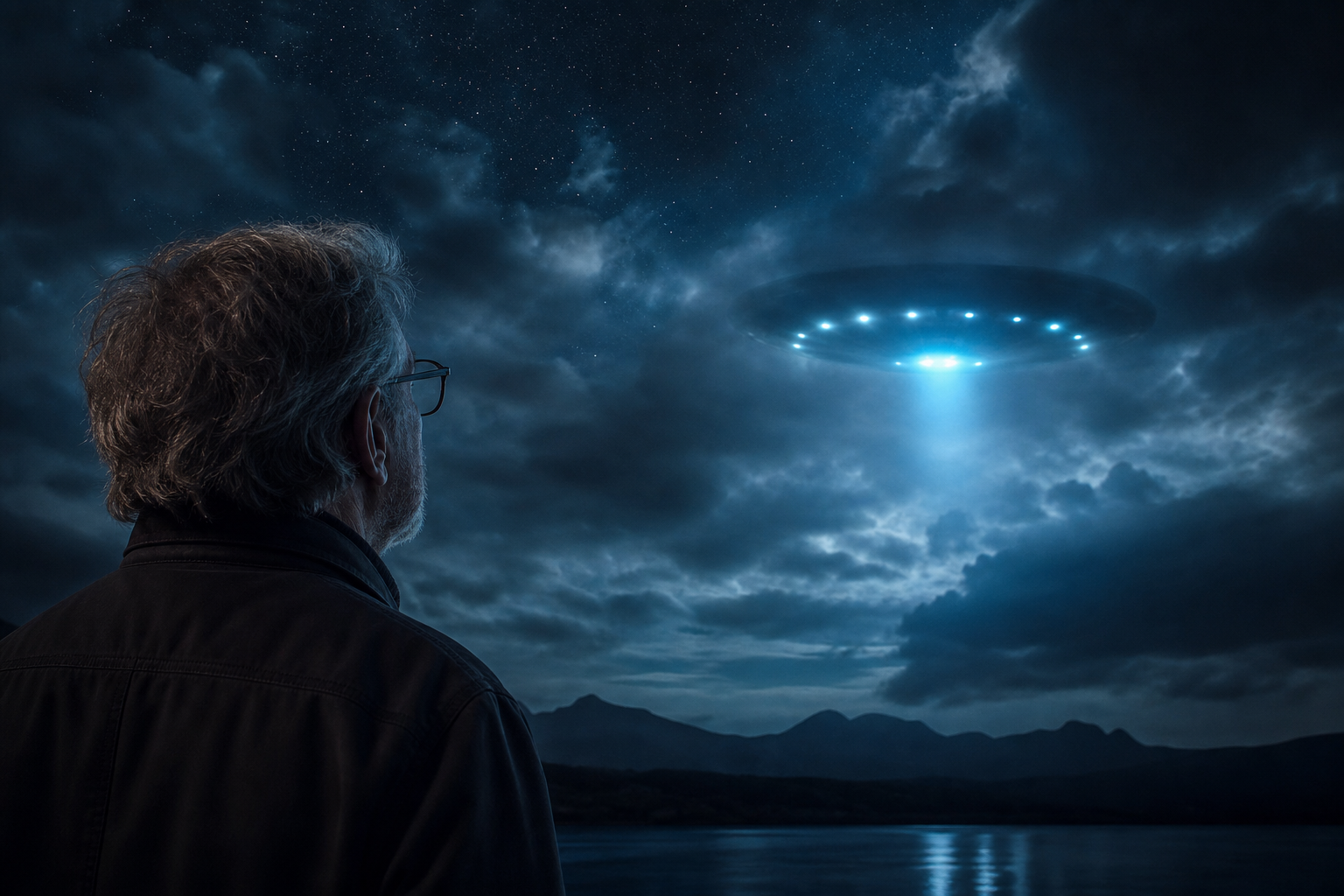
For decades, the name Steven Spielberg has been synonymous with the stars. From the benevolent, glowing visitors of Close Encounters of the Third Kind to the heart-wrenching innocence of E.T. the Extra-Terrestrial, he has shaped how humanity perceives the possibility of life beyond Earth. Now, in a series of candid reflections, the legendary filmmaker is reaffirming his long-held belief that we are far from alone in the vastness of the cosmos.
The Director’s Lifelong Fascination with the Unknown
Spielberg’s connection to the paranormal and extraterrestrial isn’t just a cinematic trope; it is a deeply held conviction. In recent discussions regarding his career and the future of storytelling, the director emphasized that his faith in alien life remains unshaken. He suggests that the sheer mathematical probability of life existing elsewhere is too significant to ignore, echoing the sentiments of many modern astronomers and Ufologists.
This perspective is particularly poignant given the current global climate regarding Unidentified Aerial Phenomena (UAP). As the United States government continues to declassify reports and hold congressional hearings on mysterious sightings, Spielberg’s cinematic visions seem less like science fiction and more like a precursor to a reality we are only beginning to understand. He has often noted that his films were designed to foster a sense of wonder rather than fear, a choice that has defined the “friendly alien” archetype for generations.
The director’s belief system is rooted in the idea of cosmic empathy. He posits that if a civilization is advanced enough to travel across interstellar distances, they likely possess a level of consciousness and empathy that transcends our own primitive instincts. This optimistic view stands in stark contrast to the “hostile invader” narratives that dominated the 1950s, suggesting that Spielberg views the universe as a community waiting to be joined.
From Close Encounters to Modern UAP Disclosures
When Close Encounters of the Third Kind was released in 1977, it was praised for its technical accuracy and its consultation with Dr. J. Allen Hynek, the astronomer who served as a scientific advisor to the U.S. Air Force’s Project Blue Book. Spielberg’s commitment to grounded, realistic depictions of contact has made him a hero within the paranormal community. He didn’t just want to make a movie; he wanted to document a possibility.
Today, as pilots report “tic-tac” shaped objects and the Pentagon establishes the All-domain Anomaly Resolution Office (AARO), Spielberg’s work feels more relevant than ever. He has recently commented on the shift in public perception, noting that the stigma surrounding UFO sightings is finally evaporating. For a man who spent his career looking at the sky through a camera lens, this cultural shift is a validation of the stories he has told for over fifty years.
The director also draws parallels between the mystery of the heavens and the mystery of the human heart. He believes that our desire to find life elsewhere is actually a search for ourselves—a way to understand our place in a universe that often feels cold and indifferent. By projecting our hopes and fears onto the stars, we are forced to confront what it means to be human.
The Future of Cinema and the Power of Empathy
Beyond the stars, Spielberg is deeply concerned with the future of the motion picture industry and how technology affects our ability to empathize with one another. He argues that movies are the ultimate “empathy machines,” allowing audiences to step into the shoes of someone—or something—entirely different. Whether it is a stranded botanist from another planet or a historical figure, the goal remains the same: connection.
In an era dominated by Artificial Intelligence and digital isolation, Spielberg advocates for the preservation of the human touch in storytelling. He believes that the same empathy required to welcome an alien visitor is required to sustain our own society. If we cannot find common ground with our neighbors on Earth, he suggests, we will never be ready for the “first contact” event that he has spent his life imagining.
The intersection of spirituality and science is where Spielberg finds his greatest inspiration. He doesn’t see a conflict between believing in the scientific method and holding a sense of spiritual wonder about the unknown. To him, the discovery of extraterrestrial life would be the ultimate scientific achievement and the ultimate spiritual revelation, proving that the spark of life is a universal constant.
Are We Ready for the Truth?
As we look toward a future where the existence of extraterrestrial intelligence may move from theory to fact, Spielberg’s body of work serves as a roadmap for the soul. He has prepared us for the awe, the confusion, and the ultimate emotional resonance of meeting another species. His enduring faith serves as a reminder that the universe is not just a collection of gas and rock, but a place of infinite potential.
The question remains whether humanity can live up to the optimistic vision Spielberg has presented. Are we capable of the empathy required to bridge the gap between worlds? Or will our own internal divisions prevent us from joining the galactic conversation? As the director himself suggests, the answer may lie in how we treat the “others” already living among us today.
Do you believe that Steven Spielberg’s optimistic view of alien life is realistic, or should we be more cautious about what might be lurking in the deep reaches of space?
Recommended Resources
- 🤖 Viktor AI — The autonomous AI platform we use to run our marketing operations. Hire Viktor to handle blogging, lead research, audits, and more.
- 💳 Greenlight — The money app and debit card for kids and teens. Teach your kids to earn, save, and invest. Earn $30 when you sign up.
- ⛏️ GoMining — Earn Bitcoin through cloud mining without the hardware hassle. A passive way to get into crypto.
- 🏦 Mercury — The business banking account built for startups and small businesses. No fees, powerful tools, and easy to set up.
Leave a Reply