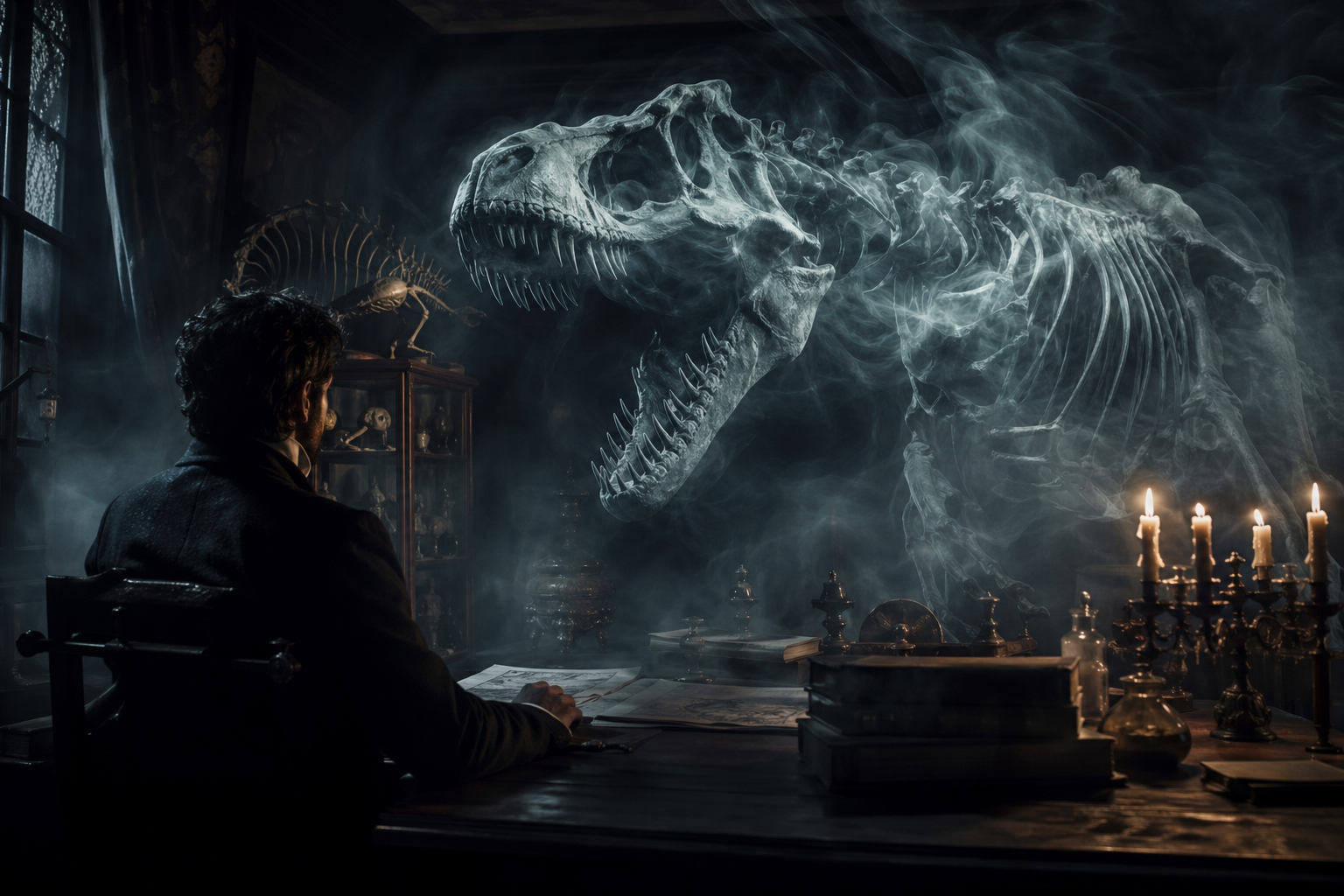
The world of the paranormal is filled with accounts of Victorian ladies gliding through hallways, phantom hitchhikers vanishing from backseats, and even the loyal spirits of deceased family pets returning for one last pat on the head. Yet, a glaring question remains for those who study the afterlife: if the spirits of the dead linger, where are the dinosaur ghosts? Given that these prehistoric titans ruled the Earth for over 165 million years, one might expect the spectral silhouette of a Tyrannosaurus Rex to occasionally stomp through a modern-day suburban backyard.
This intriguing inquiry recently gained traction in paranormal circles, sparking a debate about the “shelf life” of a soul and the nature of residual hauntings. If energy cannot be destroyed, only transformed, then the massive life force of the Mesozoic era must have gone somewhere. The absence of prehistoric apparitions suggests that either spirits eventually fade into the cosmic background, or we are looking for them in all the wrong places.
The Stone Tape Theory and Prehistoric Echoes
One of the most prominent explanations for why we don’t see dinosaurs in our living rooms is the Stone Tape Theory. This hypothesis suggests that minerals in the earth, such as quartz or limestone, can “record” high-energy events and play them back under specific atmospheric conditions. Most reported hauntings involve humans from the last few centuries, perhaps because the “recording” is still fresh and the geological layers are accessible.
Dinosaurs, however, existed in a world that looks nothing like our own. The tectonic plate shifts and millions of years of erosion have buried the “tapes” of the Jurassic and Cretaceous periods miles beneath the surface. If a Brachiosaurus is currently haunting the exact spot where it died, its spirit might be pacing a prehistoric marshland that is now trapped deep within the Earth’s crust, far beyond the reach of human perception.
Furthermore, some researchers suggest that ectoplasm and spiritual manifestations require a certain level of environmental resonance. The world has changed so drastically—from the oxygen levels in the atmosphere to the magnetic poles of the planet—that the ancient energy of a dinosaur may no longer be compatible with our current reality. We may simply be tuned to a different frequency than the ghosts of the deep past.
Is the Loch Ness Monster a Plesiosaur Ghost?
While full-scale dinosaur hauntings are rare, a compelling theory suggests that some of our most famous cryptids might actually be prehistoric spirits. The Loch Ness Monster is the primary candidate for this crossover between cryptozoology and the paranormal. For decades, witnesses have described “Nessie” as resembling a plesiosaur, a marine reptile that supposedly went extinct 66 million years ago.
The “Ghost Nessie” theory solves many of the biological hurdles that skeptics often cite. If the creature is a physical animal, how does it find enough food in the peat-stained waters of the Loch? How has a breeding population survived for millions of years without being detected by modern sonar? If the Loch Ness Monster is a spectral manifestation, it requires no food, no mate, and no oxygen, appearing only when the veil between worlds is thin.
This would categorize the monster as a liminal space entity—a creature that exists between two states of being. Similar reports of “living fossils” in other parts of the world, such as the Mokele-mbembe in the Congo River basin, could also be explained as residual energy from a lost world. These sightings often occur in ancient, undisturbed environments that might act as a battery for prehistoric echoes.
The Evolution of the Afterlife
Another perspective to consider is the evolution of consciousness. Many paranormal investigators believe that hauntings are tied to emotional intelligence and unfinished business. While humans and domesticated animals like dogs and cats possess complex emotional bonds, it is debated whether a dinosaur would have the psychological “grip” required to remain tethered to the physical plane after death.
However, this assumes that all ghosts are sentient. If we look at hauntings as non-intelligent hauntings—essentially just a loop of energy—then the size and power of a dinosaur should have left a massive imprint. Some suggest that we do encounter these energies, but we misidentify them. Perhaps the “unexplained booms” or localized tremors reported in certain wilderness areas aren’t geological, but the auditory ghost of a massive creature from a bygone era.
As we continue to explore the intersection of paleontology and the paranormal, we must remain open to the idea that the past is never truly gone. Whether they are buried deep beneath the soil or manifesting in the misty waters of a Scottish loch, the giants of the past may still be walking among us, invisible to all but those who know how to look.
Do you believe that ancient spirits eventually fade away, or could some of our most famous monster sightings actually be the ghosts of dinosaurs? Let us know your thoughts in the comments below!
Recommended Resources
- 🤖 Viktor AI — The autonomous AI platform we use to run our marketing operations. Hire Viktor to handle blogging, lead research, audits, and more.
- 💳 Greenlight — The money app and debit card for kids and teens. Teach your kids to earn, save, and invest. Earn $30 when you sign up.
- ⛏️ GoMining — Earn Bitcoin through cloud mining without the hardware hassle. A passive way to get into crypto.
- 🏦 Mercury — The business banking account built for startups and small businesses. No fees, powerful tools, and easy to set up.
Leave a Reply