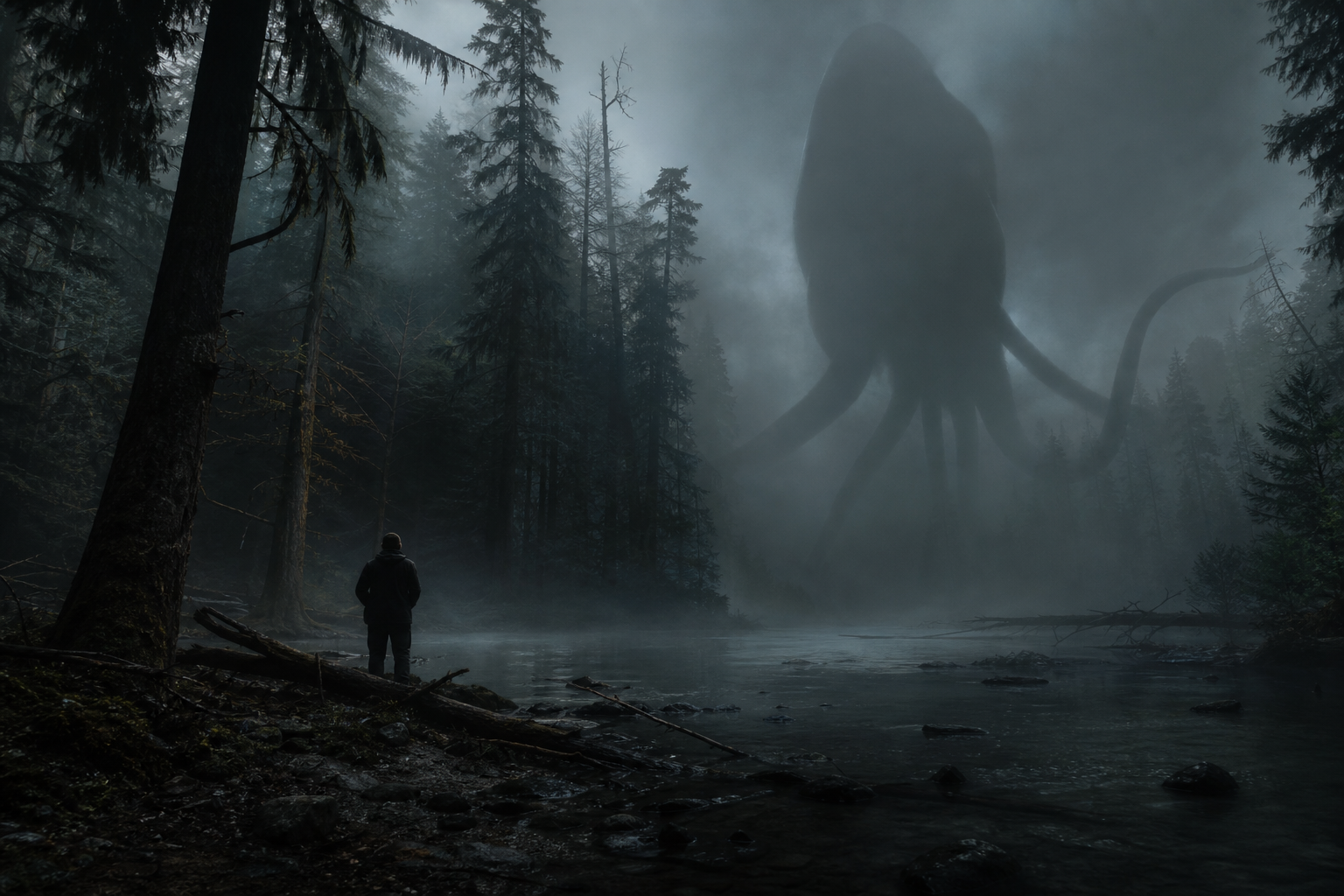
For centuries, the dark, frigid waters of the North Atlantic have harbored secrets that defy conventional science, none more terrifying than the legendary Kraken. While modern skeptics often dismiss this multi-tentacled behemoth as a mere exaggeration of the Giant Squid, a provocative new theory is making waves in the cryptozoology community. Could the monster that haunted Viking longships actually be a surviving relic of the prehistoric past known as Nanaimoteuthis haggarti?
The Norse Legend of the Moving Island
The first written accounts of the Kraken date back to the 13th-century Old Norse manuscript, the Konungs skuggsjá. Sailors described a creature so vast that it was often mistaken for a cluster of islands or a sandbank. When the beast submerged, it created massive whirlpools capable of dragging entire vessels into the abyss. Unlike the streamlined profile of a modern squid, early descriptions often depicted a more robust, crown-like creature with a forest of arms.
By the 18th century, Bishop Erik Pontoppidan of Bergen popularized the Kraken in his natural history writings, describing it as the largest and most frightening sea monster in existence. While Pontoppidan believed the creature was real, he struggled to categorize it within the known animal kingdom. This ambiguity has led modern researchers to wonder if the “Giant Squid” explanation is simply a convenient, but incorrect, placeholder for something far more ancient.
Enter Nanaimoteuthis Haggarti: A Cretaceous Nightmare
The theory gaining traction on platforms like Reddit suggests that the Kraken was not Architeuthis dux (the Giant Squid), but rather a late-surviving instance of Nanaimoteuthis haggarti. This creature was a massive vampyromorph, a group of cephalopods that share characteristics with both octopuses and squids. Fossil evidence from the Late Cretaceous period reveals that these animals were formidable predators with unique anatomical features that set them apart from modern deep-sea dwellers.
Nanaimoteuthis possessed a distinct body shape and a complex arrangement of appendages that might more closely mirror the “island-like” descriptions found in Norse folklore. While the Giant Squid is long and slender, prehistoric vampyromorphs often had broader, more intimidating silhouettes. If a population of these creatures managed to survive the K-Pg extinction event by retreating into the unexplored depths of the ocean, they would have been the perfect candidates for the Kraken of myth.
The Lazarus Taxon: Can Prehistoric Giants Survive?
The idea of a prehistoric cephalopod surviving into the age of the Vikings—or even the modern day—is not as far-fetched as it might seem. Biology frequently encounters what is known as a Lazarus taxon, a species that disappears from the fossil record only to reappear millions of years later. The most famous example is the Coelacanth, a prehistoric fish thought to have gone extinct 66 million years ago until a living specimen was pulled from the water in 1938.
The deep ocean remains one of the least explored frontiers on Earth, with over 80% of the seabed unmapped and unobserved. In the high-pressure, low-temperature environment of the Bathyal zone, evolution moves at a different pace. It is entirely possible that Nanaimoteuthis haggarti, or a direct descendant, found a sanctuary in the deep trenches of the North Sea, occasionally rising to the surface to feed or interact with terrified Norse mariners.
Comparing the Anatomy of Terror
When we look at the specific descriptions of the Kraken’s behavior, the Nanaimoteuthis theory gains even more weight. Norse sagas often mention the creature’s “horns” or “spikes” emerging from the water. While squids have smooth tentacles, many prehistoric cephalopods possessed chitinous hooks or specialized structures for grasping prey. A massive, hooked vampyromorph surfacing near a wooden ship would certainly look more like a mythological demon than a standard squid.
Furthermore, the “ink” of the Kraken was said to turn the sea black and thick. While all cephalopods use ink as a defense, the sheer volume described in ancient texts suggests a creature of immense mass. If Nanaimoteuthis reached sizes comparable to or exceeding the Giant Squid, its defensive capabilities would have been legendary. The transition from a biological reality to a mythological monster is a short leap when the animal in question looks like it belongs in the Mesozoic Era.
As we continue to send submersibles deeper into the midnight zone, we must ask ourselves: are we looking for new species, or are we finally catching up with the survivors of a lost world? The Kraken may not be a myth at all, but a living fossil that has watched humanity from the depths for millennia.
Do you believe the Kraken was a misidentified Giant Squid, or could a prehistoric predator like Nanaimoteuthis still be lurking in the unexplored trenches of our oceans?
Recommended Resources
- 🤖 Viktor AI — The autonomous AI platform we use to run our marketing operations. Hire Viktor to handle blogging, lead research, audits, and more.
- 💳 Greenlight — The money app and debit card for kids and teens. Teach your kids to earn, save, and invest. Earn $30 when you sign up.
- ⛏️ GoMining — Earn Bitcoin through cloud mining without the hardware hassle. A passive way to get into crypto.
- 🏦 Mercury — The business banking account built for startups and small businesses. No fees, powerful tools, and easy to set up.
Leave a Reply