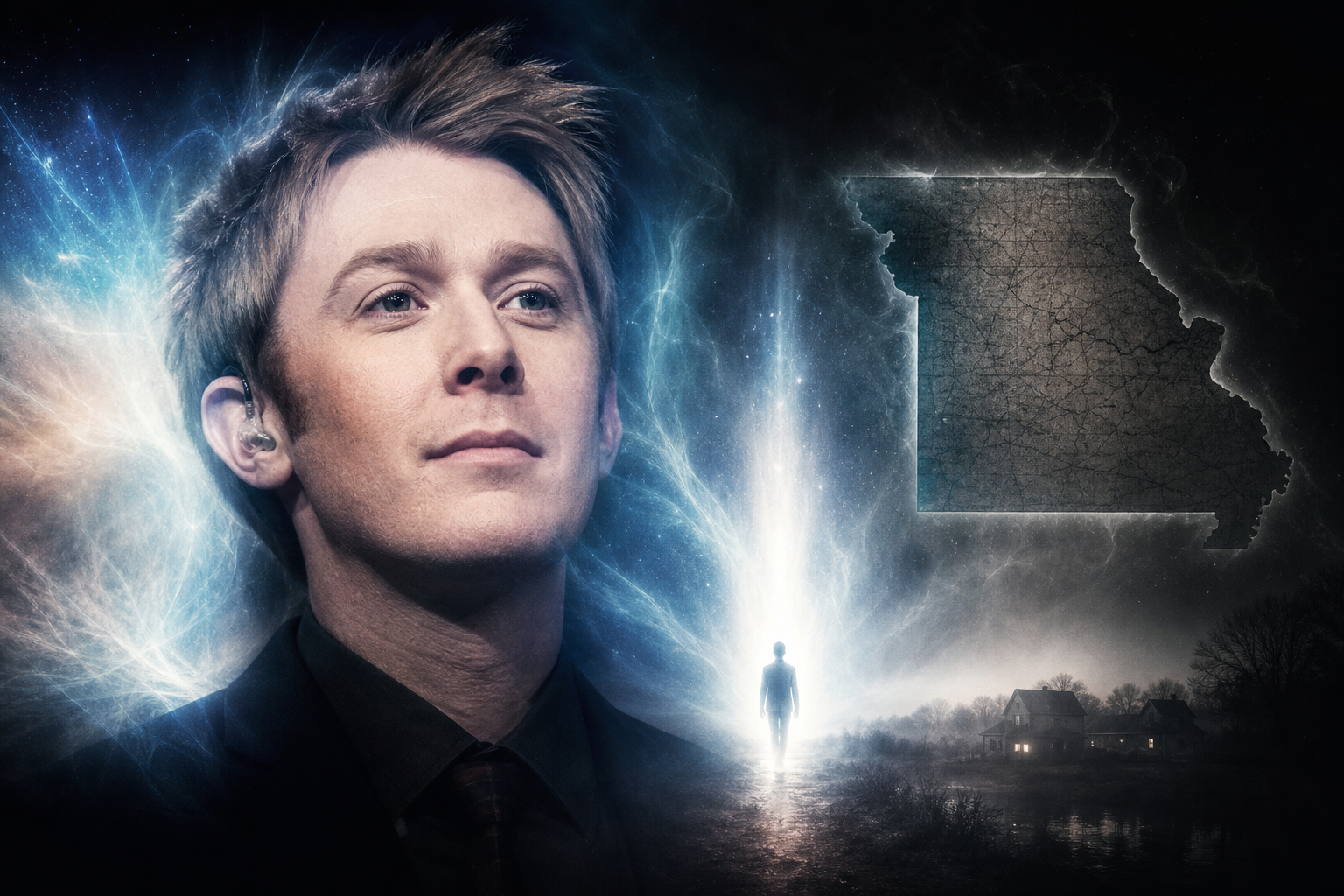
Imagine waking up in a world where a core memory—one shared by your spouse, your parents, and your closest friends—simply never happened according to the history books. This chilling phenomenon, known as the Mandela Effect, has reportedly struck a small community in Missouri, leaving residents questioning the very fabric of their reality.
The latest report comes from a woman who grew up just thirty miles from a town where, in her timeline, Clay Aiken was a local hero and a permanent fixture of the community. For years, she and her family lived with the absolute certainty that the American Idol runner-up had built a lavish home for his parents in their rural Missouri enclave. Her husband, who worked for a local moving company at the time, even recalls delivering their personal belongings to the residence, located off a distinctive half-paved, half-dirt road.
A Local Legend Erased from the Map
In the witness’s memory, Aiken’s presence wasn’t just a rumor; it was a point of intense local pride. The pop star was a “big deal” in the rural area, and his decision to house his family there was common knowledge. However, during a recent conversation, a friend performed a quick search on Google that shattered this lifelong narrative. According to official records, Clay Aiken has never lived in Missouri, nor did he ever build a home for his parents in the state.
The discrepancy is jarring because it isn’t a solitary delusion. The witness’s husband, mother, and best friend all vividly remember the same events. They recall the house, the excitement, and the specific logistics of the move. Yet, when they reached out to other current residents of the town, they were met with blank stares. It appears as though a significant piece of local history has been scrubbed from the collective consciousness of the town, leaving only a small group of “rememberers” behind.
The Mystery of Hannah Harper
As if the disappearance of Clay Aiken’s Missouri roots wasn’t strange enough, the investigation into the town’s history revealed an even more unsettling anomaly. While searching for records of Aiken, the witness discovered that the town did have an American Idol winner in its history books. However, the name listed was Hannah Harper—a name the witness, despite living in the area her entire life, has never heard before.
The strangeness deepens when considering that the witness’s own last name is Harper. In a small, rural community where everyone knows everyone, the sudden appearance of a famous “winner” sharing her surname feels like a glitch in the matrix. How could a local girl win one of the most popular singing competitions in television history without a lifelong resident ever hearing her name? This “replacement” of one celebrity for another is a hallmark of the Mandela Effect, where details of the past seem to shift and realign.
Parallel Universes or False Memories?
The term “Mandela Effect” was coined by paranormal researcher Fiona Broome after she discovered that thousands of people shared a vivid memory of Nelson Mandela dying in prison in the 1980s, despite him actually being released and later becoming the President of South Africa. Since then, hundreds of cases have emerged, ranging from the spelling of the Berenstain Bears to the existence of a 1990s movie titled Shazaam starring the comedian Sinbad.
Skeptics often point to confabulation—a psychological phenomenon where the brain fills in gaps in memory with fabricated or misinterpreted information. They argue that the Missouri witness might be conflating different local celebrities or misremembering a brief visit as a permanent residency. However, proponents of the multiverse theory suggest something far more radical: that our consciousness occasionally slides between parallel realities where minor historical details differ.
The Weight of Shared Testimony
What makes this Missouri case particularly compelling is the corroborative evidence from multiple witnesses. When one person remembers a different past, it is easily dismissed as a mental lapse. When a husband, a mother, and a best friend all share the same “incorrect” memory of a specific house on a specific road and a specific moving job, the explanation of simple forgetfulness begins to feel inadequate.
The witness describes the experience as “breaking her brain,” a common sentiment among those who encounter a reality shift. The cognitive dissonance of holding a physical memory—like delivering furniture—against a digital record that says the event never occurred creates a profound sense of existential dread. If our memories of our own communities can be overwritten, what else about our personal histories might be subject to change?
As we look closer at the fringes of our reality, we must ask ourselves if we are truly living in a stable timeline. Are these instances of the Mandela Effect merely tricks of the mind, or are we witnessing the slow merging of two different worlds?
Have you ever discovered a “fact” about your hometown that completely contradicted your own lived experience? Let us know in the comments below.
Recommended Resources
- 🤖 Viktor AI — The autonomous AI platform we use to run our marketing operations. Hire Viktor to handle blogging, lead research, audits, and more.
- 💳 Greenlight — The money app and debit card for kids and teens. Teach your kids to earn, save, and invest. Earn $30 when you sign up.
- ⛏️ GoMining — Earn Bitcoin through cloud mining without the hardware hassle. A passive way to get into crypto.
- 🏦 Mercury — The business banking account built for startups and small businesses. No fees, powerful tools, and easy to set up.
Leave a Reply