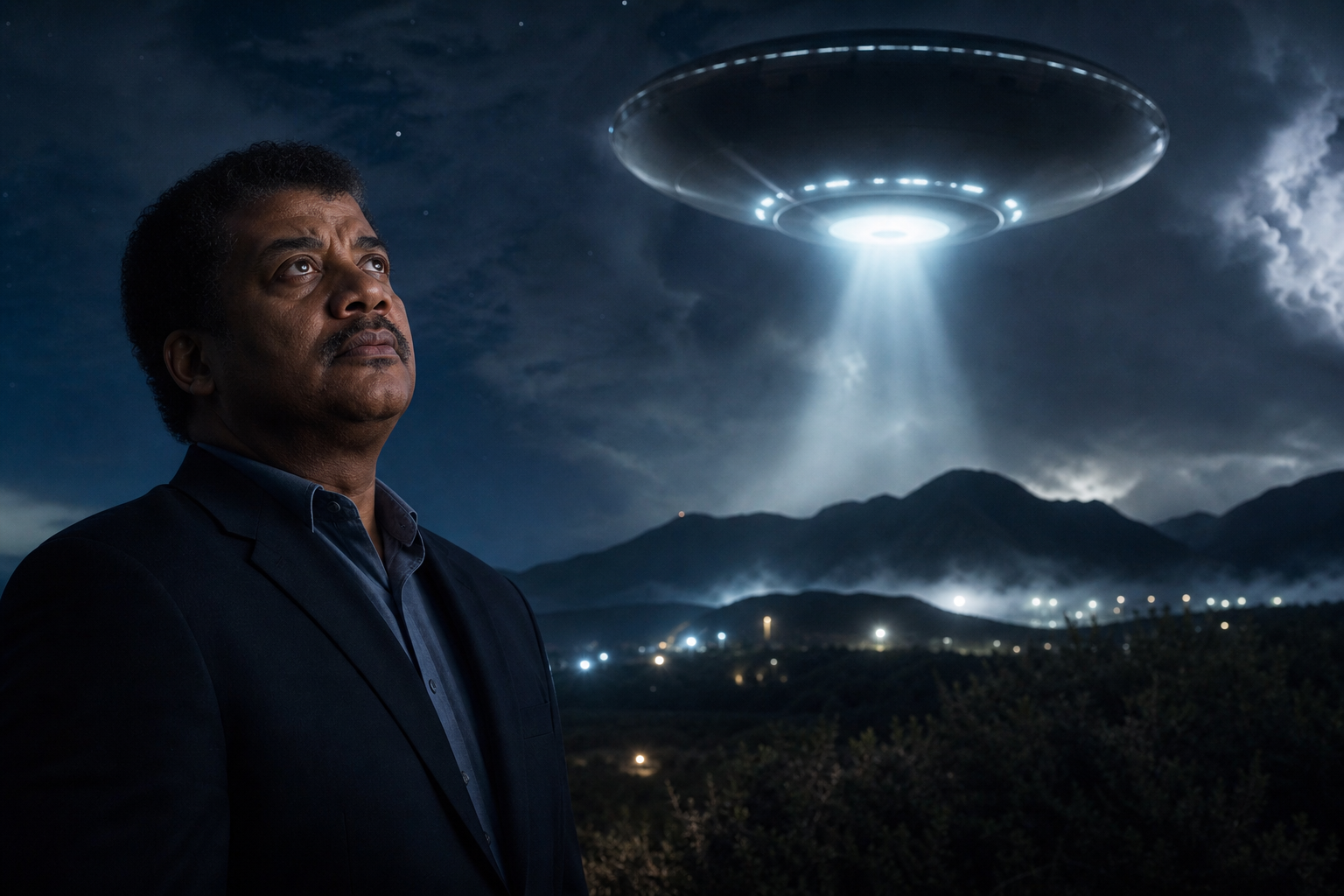
For decades, the night sky has served as a canvas for our deepest mysteries, painted with flickering lights and metallic discs that defy conventional explanation. Yet, as the global conversation surrounding Unidentified Aerial Phenomena (UAP) reaches a fever pitch, one of the world’s most prominent scientific voices is throwing down a gauntlet. Renowned astrophysicist Neil deGrasse Tyson has recently reignited the debate, demanding that the UFO community move past grainy footage and provide the world with something undeniable: the aliens themselves.
In a recent discourse that has sent ripples through the paranormal community, Tyson argues that our current era of high-definition technology should have already solved the mystery. We live in a world where nearly every human being carries a high-resolution camera in their pocket, yet the evidence for extraterrestrial visitation remains frustratingly out of focus. For Tyson, the time for “lights in the sky” has passed, and the time for biological or technological “hardware” has arrived.
The Smartphone Paradox: Why Are UFO Photos Still Blurry?
One of the most compelling points raised by Tyson involves what many call the “Smartphone Paradox.” Since the early 2000s, the number of cameras on Earth has increased exponentially, with billions of people capable of capturing 4K video at a moment’s notice. Despite this, the most famous UFO sightings of the modern era—including the Tic-Tac UFO filmed by Navy pilots—remain monochromatic, low-resolution, and open to interpretation.
Tyson suggests that if these crafts were as common as reports suggest, we should have a library of crystal-clear images by now. In the world of astronomy, data is everything, and the current data set for UFOs is, in his view, “sub-scientific.” He posits that the human eye and brain are notoriously unreliable witnesses, prone to optical illusions, atmospheric reflections, and psychological biases that can turn a weather balloon or a Starlink satellite into an interstellar visitor.
However, many in the paranormal field argue that these crafts may possess low-observable technology or “cloaking” capabilities that interfere with digital sensors. This creates a fundamental divide between the scientific skeptic, who demands a physical specimen, and the investigator, who believes we are dealing with a technology that intentionally evades our current methods of detection.
Beyond Eyewitness Testimony: The Scientific Standard
To understand Tyson’s skepticism, one must understand the scientific method. Science does not thrive on stories; it thrives on reproducible, peer-reviewed data. Tyson’s argument is that eyewitness testimony, even from trained military pilots, is the lowest form of evidence in the halls of academia. He famously quips that he doesn’t want to hear what a pilot saw; he wants to see what the pilot’s sensors captured in a format that can be analyzed by independent laboratories.
This perspective brings us to the Fermi Paradox—the haunting question of why, if the universe is teeming with life, we have yet to find any “smoking gun” evidence. Tyson’s challenge is a call to move the search for alien life out of the shadows of conspiracy theories and into the light of mainstream laboratories. He suggests that until we have a piece of a crashed ship or a biological sample that does not share our DNA, the scientific community will remain rightfully hesitant to declare we are not alone.
This “hardware-first” approach echoes the sentiments of Project Blue Book, the United States Air Force’s systematic study of UFOs that ran from 1952 to 1969. While that project concluded that most sightings were misidentifications of natural phenomena, it left a small percentage of cases “unexplained.” For Tyson, “unexplained” simply means we need better data, not that we should jump to the conclusion of interstellar travel.
A History of Close Encounters and Missed Opportunities
The history of the UFO movement is littered with claims of physical evidence that ultimately vanished or proved inconclusive. From the 1947 Roswell debris to the alleged “memory metal” studied by private aerospace firms, the promise of physical proof has always been just out of reach. Tyson’s critique hits a nerve because it highlights this cycle of “almost-proof” that has characterized the field for over seventy years.
In the 1950s and 60s, the Contactee movement claimed to have physical artifacts from Venusians and Martians, which were later debunked as earthly materials. Even the more recent Pentagon UFO reports, while acknowledging that UAPs are real and pose a flight safety risk, stopped short of attributing them to non-human intelligence. Tyson argues that we are stuck in a loop of “UFO fever” that lacks the nutritional value of actual discovery.
Yet, there is a counter-argument to Tyson’s hardline stance. Organizations like SETI (Search for Extraterrestrial Intelligence) have spent decades listening for radio signals, a method Tyson supports. If we are willing to spend millions of dollars listening for a “hello” from the stars, why is the study of physical anomalies in our own atmosphere treated with such disdain? The gap between astrobiology and ufology is narrowing, but as Tyson points out, the bridge must be built with iron-clad evidence.
The Future of the Search: What Will It Take?
So, what would satisfy the world’s most famous skeptic? Tyson has been clear: he wants an invitation to an alien dinner party, or at least a “fender” from a crashed flying saucer. He wants data that can be poked, prodded, and subjected to isotopic analysis. Until the “aliens” are presented in a way that doesn’t require a leap of faith, he remains a steadfast guardian of the scientific gates.
As we look toward the future, with the James Webb Space Telescope peering into the atmospheres of distant exoplanets, the search for life is becoming more sophisticated. We may find chemical signatures of life trillions of miles away before we ever get a clear photo of a craft in our own backyard. This irony is not lost on the scientific community, which finds it much easier to look at the edge of the universe than to explain a glowing orb over a Midwestern cornfield.
Ultimately, Neil deGrasse Tyson’s “Give Us the Aliens” plea is a demand for the paranormal to become the normal—for the mystery to be solved once and for all. Whether you view him as a cynical gatekeeper or a necessary voice of reason, his challenge remains the ultimate goal for every seeker of the truth.
Do you think the scientific community is being too dismissive of eyewitness accounts, or is Neil deGrasse Tyson right to demand physical “hardware” before we believe?
Recommended Resources
- 🤖 Viktor AI — The autonomous AI platform we use to run our marketing operations. Hire Viktor to handle blogging, lead research, audits, and more.
- 💳 Greenlight — The money app and debit card for kids and teens. Teach your kids to earn, save, and invest. Earn $30 when you sign up.
- ⛏️ GoMining — Earn Bitcoin through cloud mining without the hardware hassle. A passive way to get into crypto.
- 🏦 Mercury — The business banking account built for startups and small businesses. No fees, powerful tools, and easy to set up.
Leave a Reply