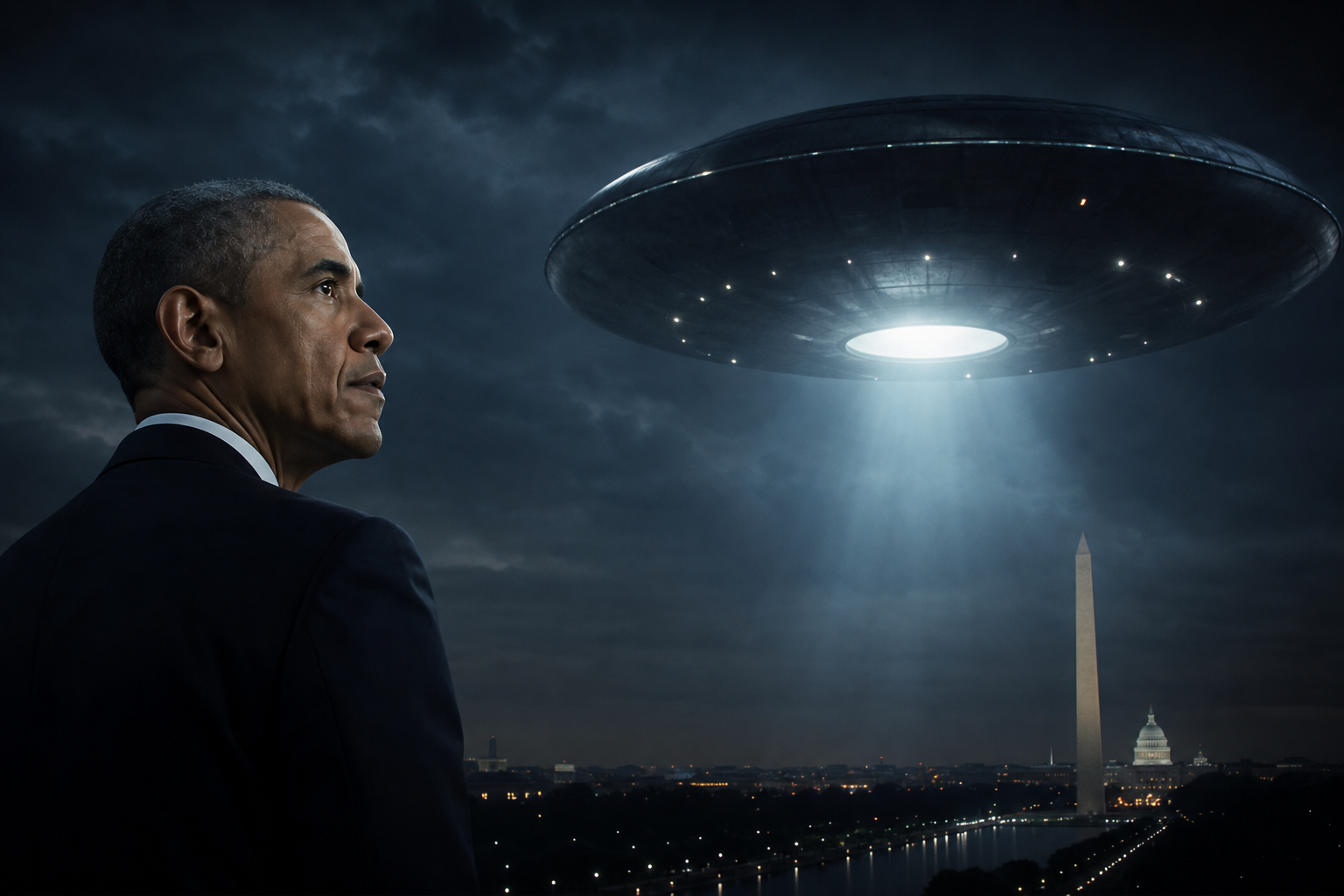
For decades, the halls of power in Washington D.C. have been the subject of intense scrutiny by those seeking the truth about extraterrestrial life. While conspiracy theorists and researchers alike have long suspected that the United States government is harboring wreckage or biological remains from other worlds, a former Commander-in-Chief is now throwing cold water on those burning expectations. Barack Obama, the 44th President of the United States, recently addressed the fever pitch surrounding UFO disclosure, suggesting that the reality of government bureaucracy is far less organized than the public believes.
The “Selfie” Theory: Why Secrets Don’t Stay Hidden
During a high-profile sit-down with Stephen Colbert on The Late Show, Obama was pressed on the persistent rumors regarding “little green men” and hidden hangars. His response was rooted in a pragmatic view of human nature rather than a denial of the cosmic unknown. Obama argued that the federal government is notoriously poor at maintaining absolute secrecy over long periods. He suggested that if the military were truly in possession of alien technology or entities, the evidence would have likely surfaced through unofficial channels long ago.
The former president joked that the desire for social validation would outweigh any security clearance. He posited that if a low-level guard at a top-secret installation like Area 51 encountered an extraterrestrial, the temptation to take a “selfie” to impress a significant other would be insurmountable. In Obama’s view, the lack of such leaks is a strong indicator that the “smoking gun” evidence many are waiting for simply does not exist within the government’s current archives.
This perspective challenges the narrative of a perfectly sealed Deep State capable of hiding world-altering truths for nearly a century. While the government is often criticized for its lack of transparency, Obama’s point highlights a fundamental flaw in massive conspiracies: they require thousands of people to remain silent forever. In an era of smartphones and instant digital communication, the barrier to leaking classified information has never been lower.
Clarifying the “Aliens are Real” Viral Moment
The interview served as a necessary clarification for comments Obama made earlier in the year that sent the UFO community into a frenzy. In previous remarks, he had confirmed that there are “footages and records of objects in the skies that we don’t know exactly what they are.” While many took this as a soft disclosure of alien visitation, Obama used his time with Colbert to refine his stance. He explained that while he believes life likely exists somewhere in the vastness of the universe, first contact on Earth has not yet occurred.
This distinction is vital for those following the UAP (Unidentified Aerial Phenomena) phenomenon. There is a significant difference between acknowledging that the military encounters objects it cannot identify and admitting that those objects are piloted by beings from another star system. Obama’s current stance aligns more with a scientific skepticism—acknowledging the mystery of the sightings while remaining unconvinced of their extraterrestrial origins.
Despite this, the former president’s admission that the government possesses data on unexplained aerial maneuvers remains a cornerstone of modern Ufology. It confirms that the phenomenon is real and physical, even if the “who” and “where” remain unanswered. The shift from “UFO” to “UAP” in official parlance has allowed for a more serious academic and military discussion, even if the executive branch remains tight-lipped about the specifics.
A History of Secrecy and the Disclosure Movement
Obama’s skepticism regarding the government’s ability to keep secrets stands in stark contrast to the history of programs like Project Blue Book or the more recent AATIP (Advanced Aerospace Threat Identification Program). For years, whistleblowers and former officials like Harry Reid and Luis Elizondo have hinted that there is more to the story than what is being shared with the public. They argue that the secrecy is not held by the entire government, but by small, stove-piped “black projects” that operate with little oversight.
The Roswell incident of 1947 remains the gold standard for those who believe a cover-up is possible. While the official explanation shifted from a “flying disc” to a weather balloon and eventually to a high-altitude surveillance project known as Project Mogul, the inconsistencies in the narrative fueled decades of distrust. If the government could successfully pivot the Roswell story in the 1940s, many wonder if they have simply become more sophisticated at managing leaks in the modern age.
Furthermore, the recent push by members of Congress to declassify UAP reports suggests that even within the government, there is a divide. Some lawmakers believe that the executive branch and the Pentagon are withholding information from legislative oversight. This internal friction suggests that while the government as a whole might be “terrible at keeping secrets,” specific factions within the military-industrial complex might be much better at it.
The Future of the Search for Truth
As we move further into an era of increased transparency and advanced civilian sensor technology, the window for government-held secrets may be closing. Whether the truth lies in a crashed craft or simply in the limitations of our own radar technology, the public demand for answers is not going away. Obama’s comments may have dampened the hopes of those expecting an imminent “Independence Day” style announcement, but they have not silenced the debate.
The search for the truth continues to evolve, moving from the fringes of late-night radio into the halls of the Smithsonian and the briefing rooms of the Pentagon. As more pilots come forward and more data is analyzed, the mystery of what is flying in our restricted airspace will eventually be solved—with or without a presidential confirmation.
Do you believe the government is truly incapable of keeping a secret as big as alien life, or is the “leak-proof” nature of top-tier classified projects more robust than Obama suggests?
Recommended Resources
- 🤖 Viktor AI — The autonomous AI platform we use to run our marketing operations. Hire Viktor to handle blogging, lead research, audits, and more.
- 💳 Greenlight — The money app and debit card for kids and teens. Teach your kids to earn, save, and invest. Earn $30 when you sign up.
- ⛏️ GoMining — Earn Bitcoin through cloud mining without the hardware hassle. A passive way to get into crypto.
- 🏦 Mercury — The business banking account built for startups and small businesses. No fees, powerful tools, and easy to set up.
Leave a Reply