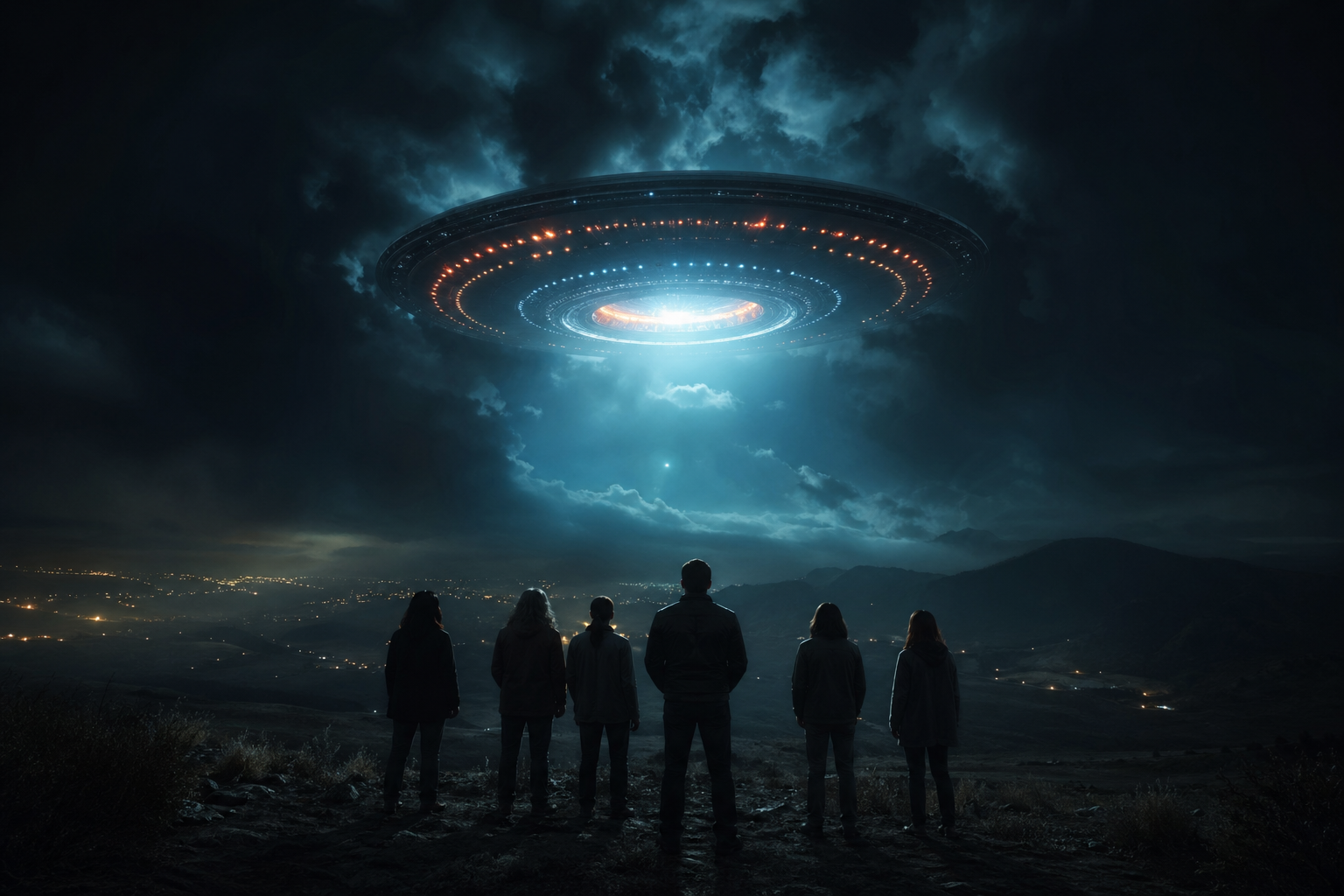
In 1977, a five-tone musical sequence echoed across cinema screens, forever changing the way humanity looked at the stars. Steven Spielberg’s masterpiece, Close Encounters of the Third Kind, didn’t just provide a thrilling night at the movies; it bridged the gap between fringe science and mainstream culture, legitimizing the study of unidentified aerial phenomena for a generation. Decades later, the film remains a cornerstone of Ufology, reflecting a period when the world began to transition from fearing the unknown to seeking a seat at the cosmic table.
The Hynek Connection and the Science of Sightings
While many science fiction films of the era relied on pure fantasy, Spielberg sought a foundation in reality. He famously recruited Dr. J. Allen Hynek, a renowned astronomer and former consultant for the United States Air Force’s Project Blue Book, to serve as a technical advisor. Hynek is the man who actually coined the “Close Encounter” classification system, which categorized sightings based on their proximity and the nature of the interaction. Before the film, these terms were largely confined to academic papers and niche paranormal circles.
A “Close Encounter of the First Kind” involves witnessing an unidentified flying object at close range, while the “Second Kind” includes physical evidence like scorched earth or radio interference. Spielberg’s film focused on the “Third Kind,” which denotes the actual observation of extraterrestrial biological entities. By grounding the narrative in Hynek’s scientific framework, the movie gave the audience a sense that what they were seeing wasn’t just a story, but a dramatization of potential truth. Hynek even made a brief cameo in the film’s climax, standing among the scientists as the massive mothership descends.
Real-Life Inspirations Behind the Screen
The imagery in the film wasn’t pulled out of thin air; many of the most iconic scenes were inspired by actual reports filed during the mid-20th century. The scene where a small child is lured out of his home by glowing lights mirrors several accounts from the 1950s, including the infamous Kelly-Hopkinsville encounter, where a family claimed to have been besieged by small, spindly creatures. Spielberg captured the specific “high strangeness” of these events—the way electronics malfunction and the overwhelming sense of awe and dread that witnesses often describe.
Furthermore, the film’s depiction of the government’s role in managing UFO sightings reflected the growing public distrust of the era. Following the Watergate scandal, audiences were primed to believe that the authorities were hiding the truth about “the visitors.” The film’s secret base at Devil’s Tower in Wyoming became a symbol for the hidden locations where many believe the military-industrial complex conducts back-engineering of alien technology. This narrative thread continues to resonate today as modern whistleblowers testify before Congress about Unidentified Anomalous Phenomena (UAP).
From Invaders to Interstellar Visitors
Before Spielberg, the “alien” in Hollywood was almost exclusively a hostile invader. Films like The War of the Worlds or Earth vs. the Flying Saucers depicted extraterrestrials as a threat to be destroyed. Spielberg took a radical departure, presenting the visitors as curious, non-violent, and perhaps even spiritual. This shift mirrored a change in the paranormal community, where many began to view these encounters as a form of “cosmic consciousness” or an invitation to join a larger galactic community.
The film’s climax, a peaceful exchange of light and sound, suggested that communication was possible through the universal languages of mathematics and music. This optimistic view of First Contact influenced how the public perceived real-world SETI (Search for Extraterrestrial Intelligence) efforts. It moved the conversation away from “how do we fight them?” to “how do we talk to them?” This cultural pivot remains one of the film’s most enduring legacies, shaping the expectations of every skywatcher who hopes to see something unexplainable in the night sky.
The Legacy of the Mothership in the Modern Era
Today, as the Pentagon releases declassified footage of “Tic-Tac” shaped objects and the term UAP replaces the stigma-heavy “UFO,” the themes of Spielberg’s classic feel more relevant than ever. We are living in an era of “slow disclosure,” where the mystery of the skies is being treated with a new level of seriousness by the scientific community. The sense of wonder that Roy Neary felt as he chased the lights across the highway is the same drive that fuels modern researchers looking for the truth behind trans-medium craft and non-human intelligence.
The “Spielberg Kind” of encounter remains the gold standard for what we hope the truth might look like: a moment of profound connection that transcends our earthly limitations. Whether the truth is out there or right here among us, the cinematic vision of 1977 continues to guide our journey into the unknown. As we look toward the future of space exploration and potential contact, we must ask ourselves if we are truly ready for what might be waiting behind the clouds.
Do you believe that Steven Spielberg was privy to classified information when making the film, or was his vision simply a perfect reflection of the era’s growing curiosity about the stars?
“,excerpt:
Recommended Resources
- 🤖 Viktor AI — The autonomous AI platform we use to run our marketing operations. Hire Viktor to handle blogging, lead research, audits, and more.
- 💳 Greenlight — The money app and debit card for kids and teens. Teach your kids to earn, save, and invest. Earn $30 when you sign up.
- ⛏️ GoMining — Earn Bitcoin through cloud mining without the hardware hassle. A passive way to get into crypto.
- 🏦 Mercury — The business banking account built for startups and small businesses. No fees, powerful tools, and easy to set up.
Leave a Reply