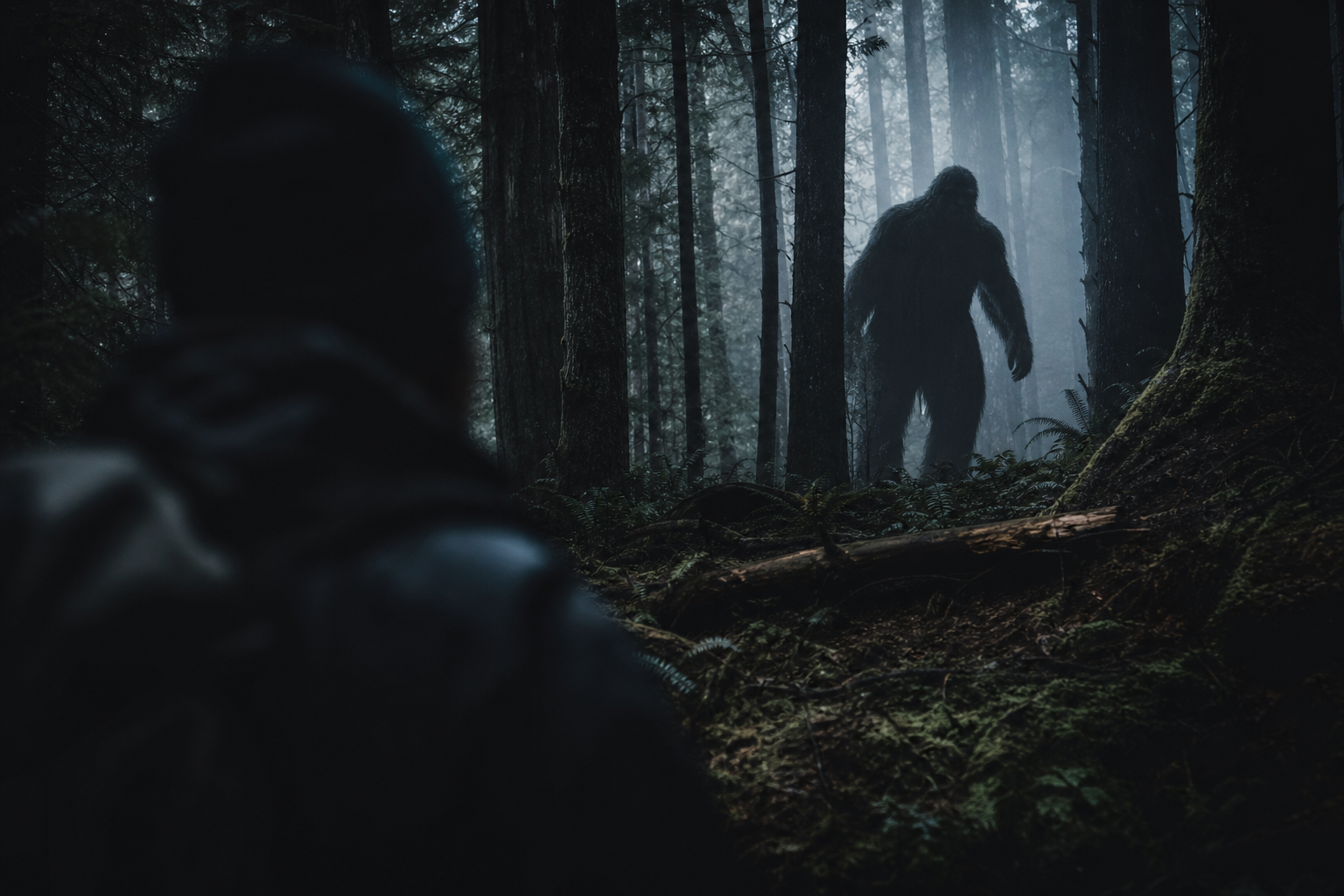
Imagine walking through the dense, silent woods when the smell of damp earth and musk suddenly fills the air, and a massive, hairy figure steps onto the trail just yards away. It is the moment every paranormal enthusiast dreams of and dreads: a face-to-face encounter with a cryptid. While we often discuss these creatures from the safety of our screens, the reality of a physical confrontation raises a profound psychological question: how would you actually react?
The Fight-or-Flight Response to the Unknown
When humans encounter something that defies the laws of known biology, the brain’s amygdala triggers an immediate survival response. For many, the instinctual reaction to seeing a Bigfoot (also known as Sasquatch) would be a frantic retreat. This “flight” response is a biological imperative designed to protect us from apex predators, and in the deep wilderness, anything standing eight feet tall certainly qualifies as a threat.
However, history shows us that not everyone runs. During the famous 1967 filming of the Patterson-Gimlin film at Bluff Creek, Roger Patterson and Bob Gimlin managed to maintain enough composure to pursue the creature with a camera. Their reaction was a rare blend of “fight” (in the form of pursuit) and scientific curiosity. Most modern witnesses report a state of “temporary paralysis,” where the sheer impossibility of the sight causes the mind to freeze while trying to process the visual data.
The Reddit community recently debated this very topic, with many users wondering if they could overcome their fear long enough to establish a peaceful connection. While the idea of befriending a Sasquatch sounds like a scene from a heartwarming film, the reality of standing before a 500-pound primate is a different story entirely. Would you have the presence of mind to stay still, or would your boots be hitting the pavement before you could even grab your phone?
Friendly Giants vs. Malevolent Entities
Our reaction to a cryptid often depends on the “vibe” of the creature in question. There is a long-standing tradition in cryptozoology that suggests some entities are more dangerous than others. For instance, many researchers view Bigfoot as a reclusive, perhaps even spiritual, “forest person” who generally avoids conflict. In these cases, the idea of a peaceful encounter—perhaps even offering food—becomes a tempting thought for the bold explorer.
On the other end of the spectrum are the more malevolent or “violent” cryptids that haunt American folklore. Encountering the Jersey Devil in the Pine Barrens or the Dogman in the Michigan wilds evokes a much sharper sense of dread. These creatures are often described as having an aggressive aura that triggers an immediate “get out now” sensation in the human gut, often referred to as infrasound—a low-frequency sound some believe cryptids emit to disorient prey.
Historical accounts, such as the 1924 Ape Canyon incident, remind us that these encounters can turn hostile. A group of miners claimed they were besieged by “mountain devils” that threw rocks at their cabin throughout the night. In such a scenario, the “befriending” stage is skipped entirely in favor of barricading doors and praying for sunrise. The distinction between a “curious animal” and a “predatory monster” is a line every witness must draw in a split second.
The Ethics of Reporting and Contact
If you were to survive an encounter and perhaps even snap a blurry photo, what comes next? The debate over whether to alert the authorities is a hot topic among paranormal researchers. Some believe that reporting a sighting to local police or the Department of Natural Resources is the responsible thing to do, especially if the creature poses a threat to public safety. Others fear that government involvement would lead to the “containment” or even the destruction of the creature.
Organizations like the BFRO (Bigfoot Field Researchers Organization) provide a platform for witnesses to share their stories without the fear of ridicule. However, the “Men in Black” trope remains a persistent fear in the community. Many witnesses choose to keep their encounters a secret, fearing that their lives will be upended by media scrutiny or government agents looking to suppress the truth about unidentified anomalous phenomena.
There is also the ethical question of “habituating” these creatures. Some researchers, known as habituationists, believe in leaving food out to build trust with local cryptid populations. While this might lead to incredible sightings, it also risks domesticating a wild animal and making it dependent on humans—or worse, making it lose its natural fear of us, leading to dangerous confrontations in the future.
Preparing for the Impossible
So, how should one prepare for a potential cryptid encounter? Experts suggest the same rules apply as with any large predator: do not run, do not make direct eye contact, and back away slowly. Carrying bear spray is a practical precaution for any hiker, whether they believe in monsters or not. But beyond the physical tools, there is the mental preparation of accepting that the world is much stranger than we are taught.
Whether you view these beings as undiscovered biological species, interdimensional travelers, or modern myths, the way we react to them says more about us than it does about them. Our fear, curiosity, and desire for connection are all part of the human experience when faced with the Great Unknown. The woods are vast, and the shadows are long; it is only a matter of time before the next hiker finds themselves staring into a pair of glowing eyes.
If you were standing ten feet away from a Sasquatch in the middle of the woods, would you reach for your camera, your bear spray, or a peace offering?
Recommended Resources
- 🤖 Viktor AI — The autonomous AI platform we use to run our marketing operations. Hire Viktor to handle blogging, lead research, audits, and more.
- 💳 Greenlight — The money app and debit card for kids and teens. Teach your kids to earn, save, and invest. Earn $30 when you sign up.
- ⛏️ GoMining — Earn Bitcoin through cloud mining without the hardware hassle. A passive way to get into crypto.
- 🏦 Mercury — The business banking account built for startups and small businesses. No fees, powerful tools, and easy to set up.
Leave a Reply