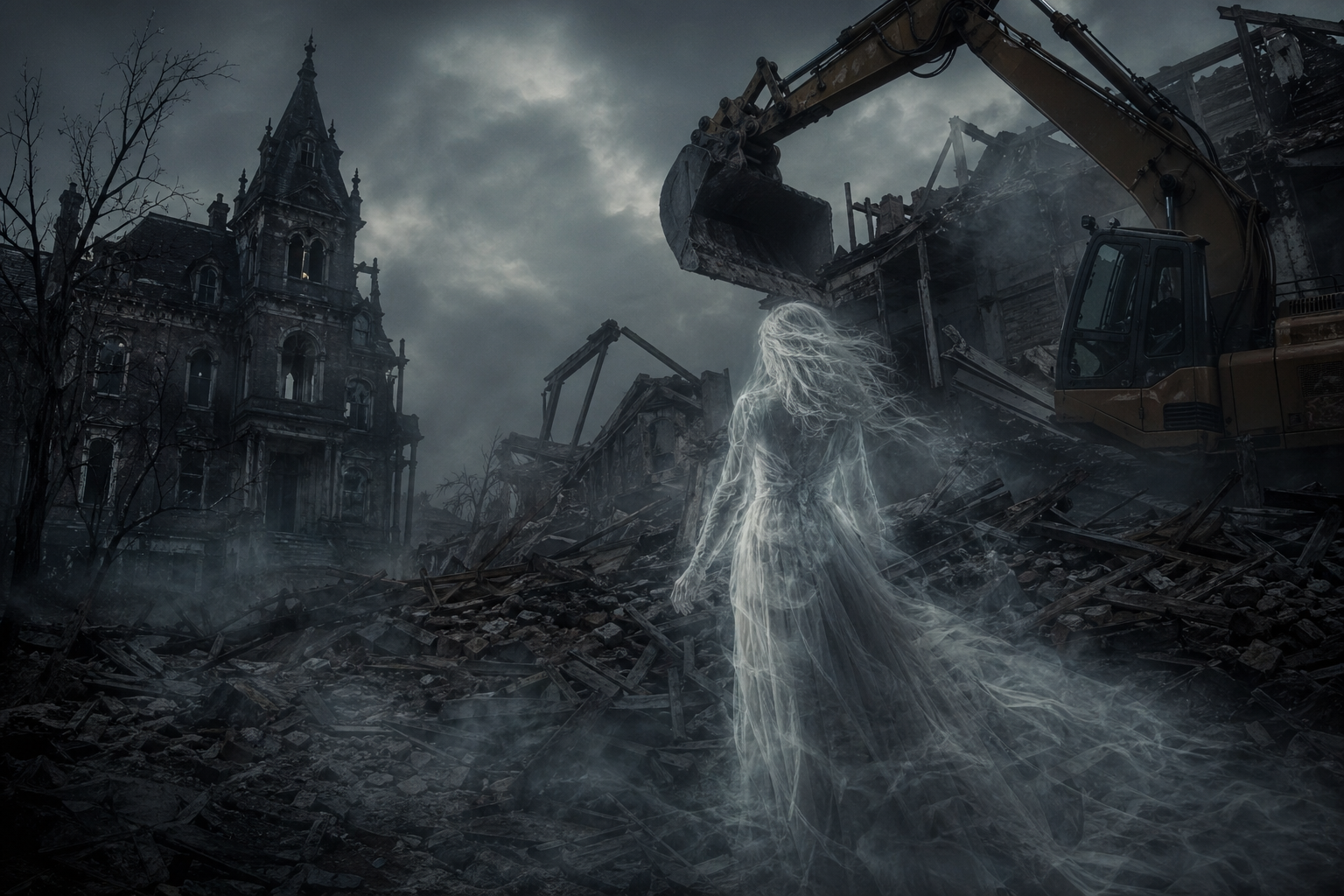
When the wrecking ball swings and the dust of a century-old structure finally settles, a chilling question remains for paranormal investigators and enthusiasts alike. If a location is confirmed to be haunted, what happens to the spirits when their physical anchor is reduced to rubble? This mystery has long been a subject of debate within the paranormal community, touching on the very nature of how spirits interact with our three-dimensional world.
The Stone Tape Theory and Residual Energy
To understand what happens during a demolition, we must first look at the Stone Tape Theory. This hypothesis suggests that minerals within a building’s walls—such as quartz or limestone—can “record” high-energy emotional events, playing them back like a loop of film. In these cases of residual hauntings, the “ghost” isn’t a conscious entity but rather a psychic footprint left behind in the environment.
When a building is demolished, this physical medium is destroyed. Many researchers believe that once the stone and wood are broken apart, the “recording” is effectively erased. However, others argue that the energy doesn’t simply vanish; it may bleed into the ground itself. If the geology of the site is particularly conductive, the haunting might persist even after the foundation is cleared, leading to reports of phantom sounds or sightings in the empty lot where the building once stood.
This phenomenon suggests that the land, rather than the architecture, serves as the primary battery for paranormal activity. If a site sits atop ley lines or underground water sources, the energy may remain anchored to the coordinates regardless of what structures are built or destroyed above them.
Intelligent Hauntings and the Trauma of Displacement
The situation becomes significantly more complex when dealing with an intelligent haunting. Unlike a residual loop, an intelligent spirit is believed to be a conscious personality that can interact with the living. For these entities, a building often represents a place of comfort, trauma, or unfinished business. When the walls come down, these spirits may experience a form of supernatural displacement.
Some investigators theorize that demolition acts as a “release” for spirits who were trapped by their own attachment to a location. The destruction of the physical site might provide the necessary catalyst for them to finally cross over to the other side. Without the familiar hallways and rooms to tether them, the spirit may find the strength to move on from the earthly plane.
Conversely, there are numerous accounts of spirits becoming agitated or “homeless” following a demolition. In these instances, the entity may attach itself to the new construction that rises from the ruins. This is often cited as the reason why modern apartment complexes or shopping centers built on the sites of former asylums or prisons frequently report high levels of poltergeist activity shortly after opening.
Construction as a Catalyst for Activity
It is a well-known trope in paranormal circles that renovation and demolition “stir up” the ghosts. Contractors often report strange occurrences—tools moving, disembodied voices, or a feeling of being watched—the moment they begin tearing down walls. This suggests that the act of destruction itself acts as a massive energy trigger.
From a psychological perspective, the disruption of a long-standing environment creates a high-stress atmosphere that some believe spirits feed upon. From a metaphysical perspective, breaking open old structures might release trapped energy that has been dormant for decades. This sudden surge of power can make a previously quiet haunting suddenly become vivid and aggressive.
Historical cases, such as the demolition of the infamous Newgate Prison in London, showed that while the building was gone, the “black dog” and other spectral entities were reported in the Old Bailey courthouse built in its place. This reinforces the idea that the spirit’s connection is often to the geographic location or the “memory of the space” rather than the specific bricks and mortar.
Do Spirits Follow the Debris?
One of the more fascinating theories involves the transference of hauntings via salvaged materials. In the world of architectural salvage, it is common for old doors, mantels, and floorboards to be sold and installed in new homes. Paranormal researchers have documented cases where a haunting seemingly “follows” a specific object to a new location, a phenomenon known as an attached haunting.
If a spirit is deeply connected to a specific staircase or a bedroom door, the demolition of the building doesn’t necessarily end the haunting. Instead, the spirit may remain tethered to the physical material. When that material is moved, the ghost goes with it, effectively “infecting” a new, unrelated building with the energy of the old one. This makes the process of psychometry—the ability to read the history of an object through touch—a vital tool for those moving into homes filled with reclaimed antiques.
Ultimately, whether a ghost crosses over, stays with the land, or follows the wreckage depends on the nature of the spirit itself. The demolition of a haunted house is rarely the end of the story; more often, it is simply the beginning of a new, more unpredictable chapter in the site’s paranormal history.
Have you ever lived in a new building that felt like it held the secrets of whatever stood there before? Do you believe ghosts are tied to the bricks, or to the earth beneath them?
Recommended Resources
- 🤖 Viktor AI — The autonomous AI platform we use to run our marketing operations. Hire Viktor to handle blogging, lead research, audits, and more.
- 💳 Greenlight — The money app and debit card for kids and teens. Teach your kids to earn, save, and invest. Earn $30 when you sign up.
- ⛏️ GoMining — Earn Bitcoin through cloud mining without the hardware hassle. A passive way to get into crypto.
- 🏦 Mercury — The business banking account built for startups and small businesses. No fees, powerful tools, and easy to set up.
Leave a Reply