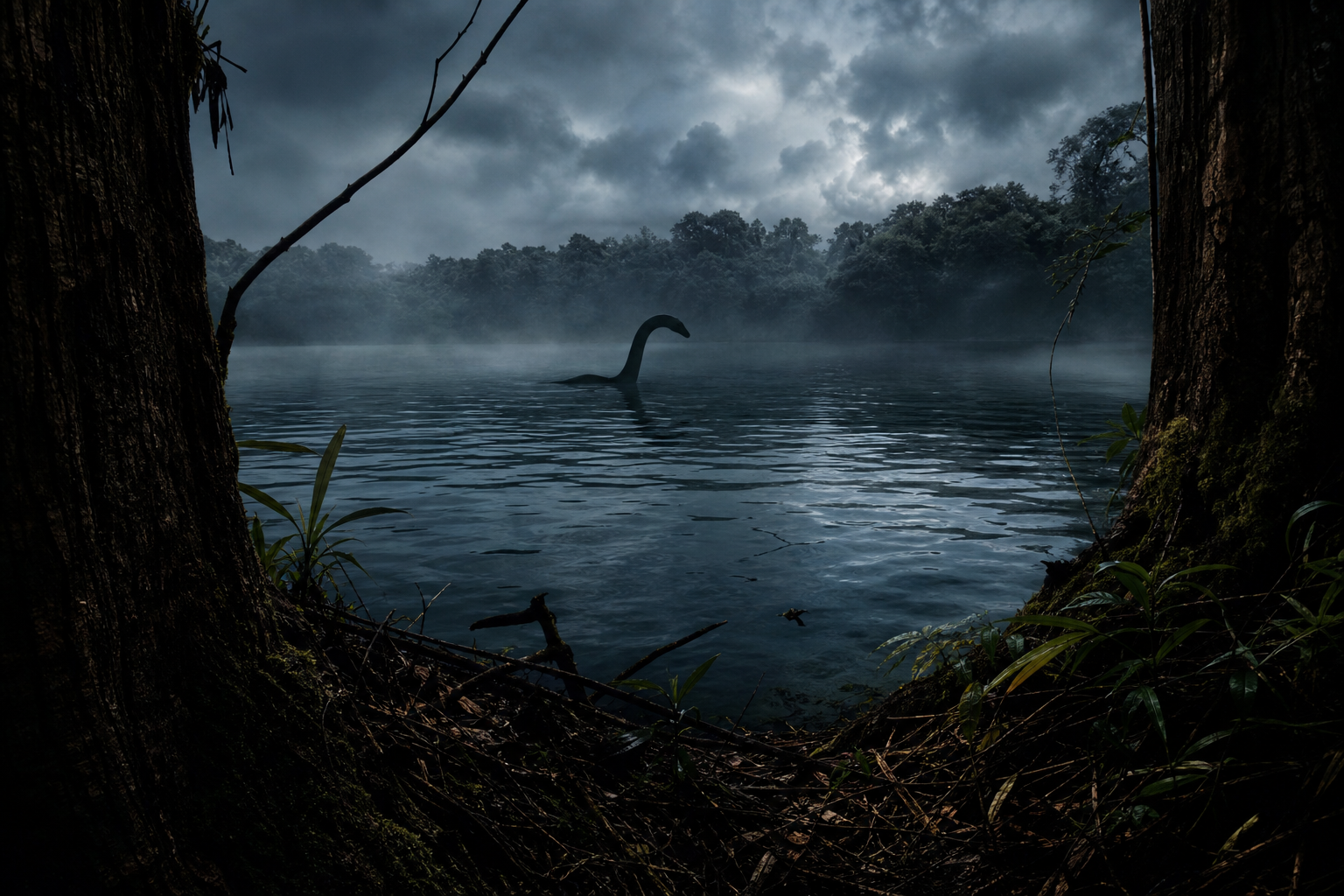
Deep within the lush, rolling hills of Minas Gerais, Brazil, lies a body of water that holds a secret far older than the city surrounding it. While the region is famous for its thermal springs and volcanic history, locals and cryptozoologists alike have long whispered about a prehistoric inhabitant lurking beneath the surface of Represa Bortolan. Since the late 1980s, accounts of a long-necked creature have transformed this scenic reservoir into a hotspot for those searching for the impossible.
The 1987 Sighting and the Birth of a Legend
The mystery of the Bortolan Lake Monster truly began to capture the public imagination in 1987. During this time, the first documented reports of a Plesiosaur-like creature emerged, described by witnesses as having a serpentine neck and a massive, dark body that broke the surface of the water before silently submerged. Unlike many urban legends that fade with time, the story of the “Bortolan Beast” has persisted for decades, passed down through generations of residents in Poços de Caldas.
Witnesses from the initial 1987 encounter described a sense of profound stillness before the creature appeared. The water, usually rippled only by the wind or local fishing boats, suddenly churned as a large, dark shape rose several feet into the air. For those who saw it, the image was unmistakable: it looked exactly like the prehistoric marine reptiles that supposedly went extinct 66 million years ago. This sparked an immediate comparison to the world’s most famous lake inhabitant, the Loch Ness Monster.
Since that first sighting, sporadic reports have continued to trickle in. Boaters have claimed to see large wakes following their vessels when no other craft were nearby, and shore-side observers have occasionally photographed strange “humps” in the distance. While photographic evidence remains grainy and inconclusive, the consistency of the descriptions has kept the flame of the Cryptid community burning bright in South America.
A Prehistoric Survivor in a Volcanic Crater?
What makes the sightings at Lake Bortolan particularly intriguing is the unique geology of the region. Poços de Caldas is situated within a massive Alkaline Caldera, the remains of an ancient, collapsed volcano. This geological anomaly has created a landscape rich in minerals and thermal activity, leading some theorists to wonder if the unique environment could support a relict population of ancient creatures.
The idea of a “living fossil” surviving in a secluded lake is a cornerstone of Cryptozoology. Proponents of the plesiosaur theory suggest that these creatures may have survived the mass extinction event by retreating into deep, underwater caverns or adapting to freshwater environments. If Lake Bortolan sits atop a network of flooded volcanic tubes, it could theoretically provide a hiding place for a large aquatic animal to remain undetected by modern sonar and satellite imaging.
However, skeptics point out that a breeding population of large reptiles would require a massive amount of food and would likely be seen more frequently. They suggest that the “monster” might actually be a misidentified Anaconda or perhaps a large South American Tapir swimming across the reservoir. Yet, for those who have seen the towering neck of the Bortolan creature, a simple snake or mammal doesn’t seem to fit the scale of what they witnessed.
South America’s Rich History of Lake Monsters
The Bortolan monster is not alone in the annals of South American mystery. The continent has a long history of “Cuero” or “Lake Hide” sightings, particularly in the glacial lakes of the Andes. Most notably, Nahuelito, the resident monster of Lake Nahuel Huapi in Argentina, shares striking similarities with the creature reported in Minas Gerais. Both are described as plesiosaur-like entities that inhabit deep, cold waters and have been sighted consistently since the early 20th century.
In Brazil, folklore is often intertwined with the natural world, featuring entities like the Boitatá—a giant, glowing serpent that protects the forests. Some researchers believe that modern sightings of lake monsters are simply the latest evolution of these ancient myths, adapted for a world that has traded campfire stories for internet forums. Whether the Bortolan creature is a biological reality or a cultural manifestation, it serves as a reminder that the natural world still holds pockets of the unknown.
The Represa Bortolan remains a popular destination for tourists, many of whom visit for the water sports and scenic views, unaware that they might be sharing the water with a prehistoric giant. The local government and tourism boards have largely treated the legend as a charming piece of local lore, but for the “believers,” every ripple on the lake is a potential encounter with history.
Science vs. Mystery: What Lies Beneath?
As technology advances, the window for these creatures to hide is closing. Environmental DNA (eDNA) testing, which has been used in Loch Ness to search for traces of unknown species, has yet to be conducted in the waters of Poços de Caldas. Until such a study is performed, the Bortolan monster remains in the realm of the Paranormal—a mystery that defies conventional biology but thrives in the hearts of those who seek wonder.
Is it possible that a remnant of the Mesozoic era is navigating the volcanic waters of Minas Gerais? Or is the human mind simply wired to find monsters in the deep, dark corners of our world? Until the creature makes a definitive appearance, the legend of the Bortolan plesiosaur will continue to haunt the shores of Poços de Caldas, waiting for the next witness to look out at the water at just the right moment.
Do you believe a prehistoric creature could survive undetected in a modern reservoir, or is the Bortolan monster simply a trick of the light and imagination?
Recommended Resources
- 🤖 Viktor AI — The autonomous AI platform we use to run our marketing operations. Hire Viktor to handle blogging, lead research, audits, and more.
- 💳 Greenlight — The money app and debit card for kids and teens. Teach your kids to earn, save, and invest. Earn $30 when you sign up.
- ⛏️ GoMining — Earn Bitcoin through cloud mining without the hardware hassle. A passive way to get into crypto.
- 🏦 Mercury — The business banking account built for startups and small businesses. No fees, powerful tools, and easy to set up.
Leave a Reply