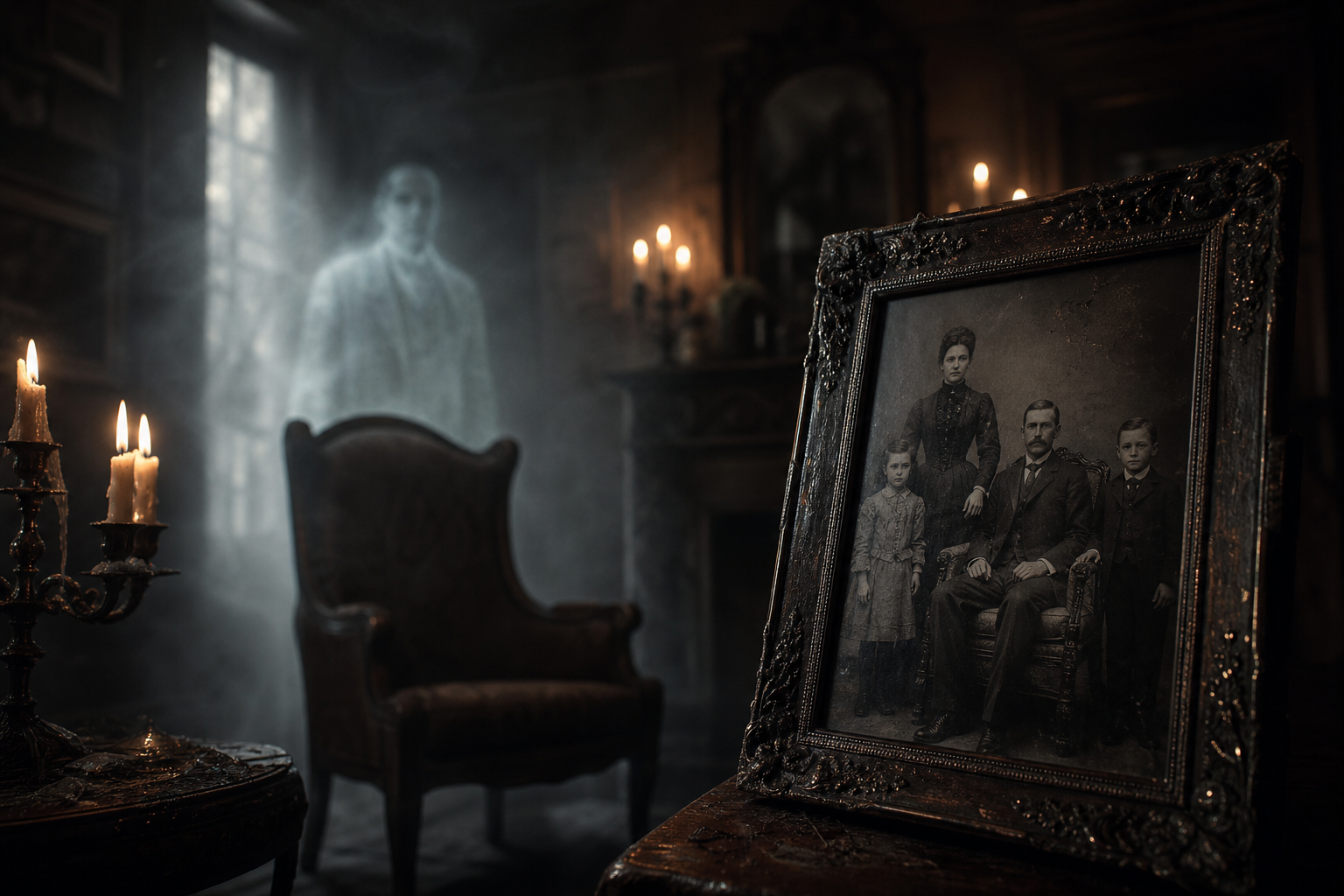
In the quiet corners of our childhood homes, the line between imagination and reality often blurs, leaving behind memories that haunt us well into adulthood. For one witness, a series of terrifying encounters in 2003 remained an unsolved mystery for nearly a decade, until a single photograph changed everything. What began as a childhood nightmare evolved into a profound example of post-mortem visitation, challenging our understanding of how the deceased interact with the living.
The Silent Specter Behind the Chair
The year was 2003, and the witness was just eight years old, living in a home filled with the typical comforts of the era. The setting for the haunting was specific and vivid: a room dominated by a sofa bed adorned with a “Groovy Chick” duvet, a staple of early 2000s youth culture. In the corner of this room sat a chair belonging to the witness’s mother, which became the focal point for a paranormal manifestation that would last for years.
From behind that chair, a man would frequently appear, peeking out at the young child. He never spoke a word, maintaining a heavy, eerie silence that amplified the child’s dread. Instead of vocalizing, the figure would pull strange faces and wave his hands, seemingly desperate to capture the child’s attention. To an eight-year-old, these gestures weren’t seen as friendly; they were perceived as the erratic behavior of a shadow figure or a malevolent intruder.
The psychological toll was immediate and long-lasting. The witness recalls being absolutely petrified, a fear that was only compounded by the skepticism of adults. Like many children who report supernatural encounters, the witness was told by their mother that they were simply being “silly” or that their imagination was running wild. This dismissal forced the child to carry the burden of the “man behind the chair” alone, leading to a deep-seated fear of being left solitary in the house.
A Revelation in the Attic
For eight years, the memory of the waving man remained a source of trauma, a dark secret tucked away in the back of the witness’s mind. The sightings eventually stopped, but the fear of his return lingered. It wasn’t until nearly a decade later, while rummaging through old family belongings in the loft, that the truth finally surfaced. While looking through vintage photographs with an aunt, the witness was confronted with a face they thought they would never see again.
The aunt pointed to a man in a faded photograph and casually identified him as her father—the witness’s grandfather. The reaction was instantaneous and visceral. The witness froze, recognizing the exact facial features, the specific expressions, and the overall presence of the man who had haunted their childhood. It was the man from behind the chair. The revelation was made even more staggering by one crucial fact: the grandfather had passed away long before the witness was born.
The witness had never seen a photograph of this man in their entire life. There were no portraits on the walls or digital albums to subconsciously influence a child’s dreams. This suggests a veridical hallucination—a sighting where the witness perceives details about a deceased person that they could not have known through normal means. Once the identity was confirmed and the “ghost” was recognized as family, the sightings never occurred again.
The Phenomenon of Ancestral Guardians
This case fits into a broader category of paranormal research known as ancestral visitations. In many cultures, it is believed that deceased relatives act as guardians, watching over the younger generations of their bloodline. While the witness felt terror, paranormal investigators often suggest that spirits of grandfathers or grandmothers may not understand how frightening their presence can be to a sensitive child.
Similar cases often involve children describing “imaginary friends” who bear striking resemblances to long-dead ancestors. Researchers in the field of thanatology and parapsychology note that children are often more “tuned in” to these frequencies before the social conditioning of adulthood closes their minds to the possibility of the afterlife. The fact that the spirit in this story was waving and making faces suggests an attempt at playfulness or recognition, rather than a threat.
The sudden cessation of the activity after the photograph was discovered is also a common trope in haunting cases. Some believe that once a spirit is “acknowledged” or their message is received, they are able to move on or retreat from the physical plane. In this instance, the grandfather may have simply wanted to be known by his grandchild, reaching across the veil to establish a connection that the living world had denied him.
Do you believe that deceased family members watch over us, or could these childhood sightings be a trick of a developing mind? Have you ever recognized a “ghost” in an old family photo?
Recommended Resources
- 🤖 Viktor AI — The autonomous AI platform we use to run our marketing operations. Hire Viktor to handle blogging, lead research, audits, and more.
- 💳 Greenlight — The money app and debit card for kids and teens. Teach your kids to earn, save, and invest. Earn $30 when you sign up.
- ⛏️ GoMining — Earn Bitcoin through cloud mining without the hardware hassle. A passive way to get into crypto.
- 🏦 Mercury — The business banking account built for startups and small businesses. No fees, powerful tools, and easy to set up.
Leave a Reply