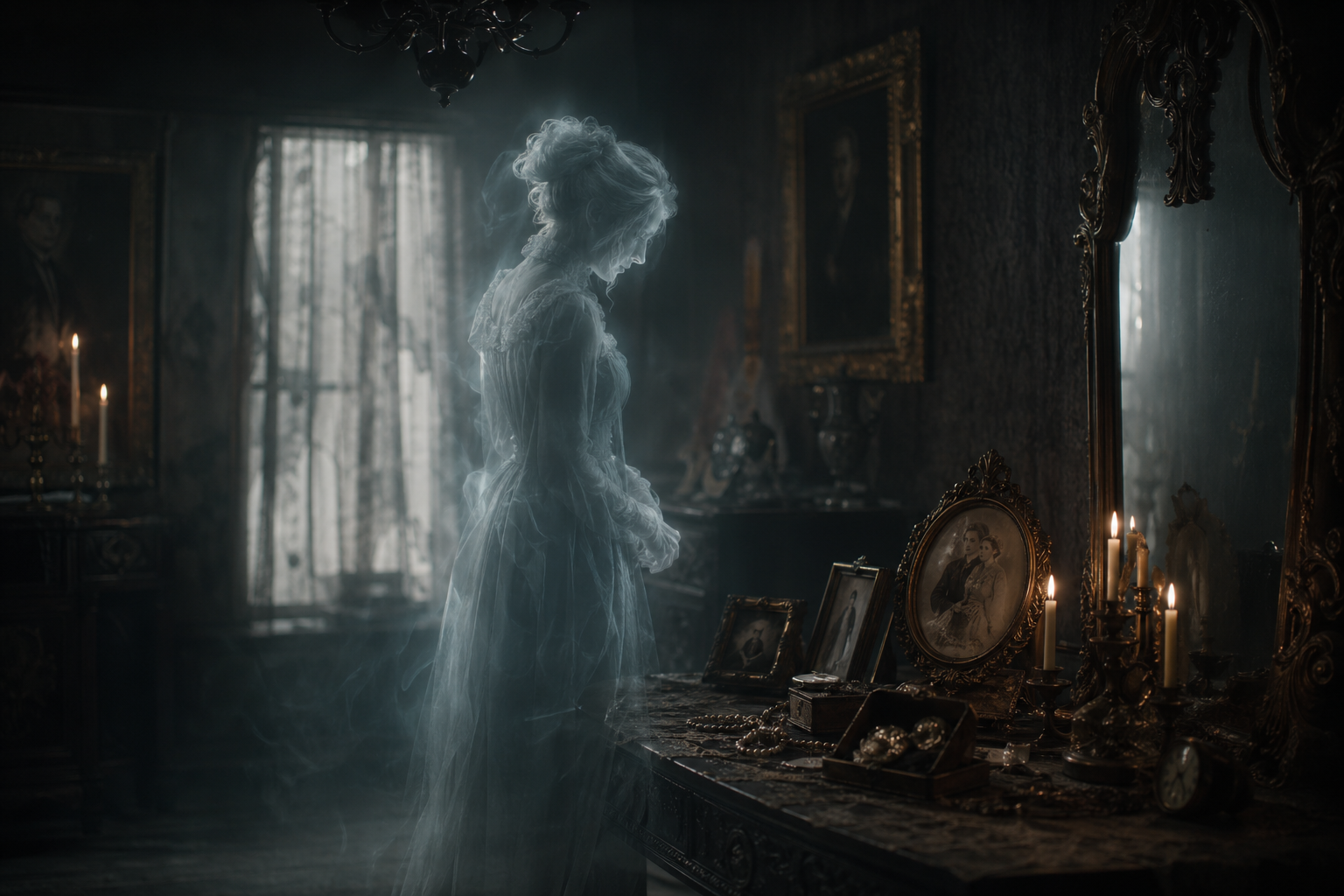
Imagine walking into your childhood home, reaching for a favorite book on the shelf, only to find your hand passing through thin air. For those who study the paranormal, one of the most enduring questions isn’t just whether spirits exist, but how they perceive the physical world we leave behind. Do ghosts see the modern renovations of their former dwellings, or are they trapped in a visual loop of the past, surrounded by belongings that have long since turned to dust?
The Echo of the Past: Do Spirits Live in a Time Slip?
One of the most compelling theories in ghost hunting is the concept of the Stone Tape Theory. This hypothesis suggests that minerals within the walls of a building—such as quartz or limestone—can “record” high-energy events and play them back like a film strip. In these instances, the “ghost” isn’t a conscious entity but a residual haunting. If this is the case, the spirit isn’t “seeing” anything at all; it is merely a projection of a past moment where the belongings were still present.
However, for those who believe in intelligent hauntings, the situation becomes much more complex. An intelligent spirit is thought to be self-aware and capable of interacting with the living. If a spirit is tethered to a location, they may experience a phenomenon known as a time slip, where their perception of reality is layered. To them, the Victorian velvet curtains might still hang in the window, even if the current homeowners have installed modern blinds.
Researchers often report spirits appearing confused when furniture is moved or walls are knocked down. There are countless accounts of ghosts walking through walls where a door used to be, suggesting that they are navigating a spatial memory of the environment as it existed during their lifetime. To these entities, their belongings aren’t gone; they are simply part of the permanent landscape of their afterlife.
Haunted Objects and the Power of Psychometry
The connection between a spirit and their possessions often goes beyond mere visual perception. In the field of parapsychology, the study of psychometry suggests that objects can retain the emotional energy of their owners. This is why certain items, such as jewelry, mirrors, or old dolls, are frequently cited as the centerpieces of hauntings. A spirit may not just “see” their belongings; they may be energetically anchored to them.
When a person dies with a strong emotional attachment to an object—whether it’s a wedding ring or a favorite rocking chair—that item can become a vessel for their consciousness. If that object is moved to a museum or a new home, the spirit may follow. This raises the chilling possibility that ghosts don’t just see their belongings; they feel a proprietary need to remain near them, regardless of where those items end up in the physical world.
Consider the famous case of the Dybbuk Box or various “haunted” items found in the Warren’s Occult Museum. In these instances, the spirits associated with the objects seem acutely aware of the item’s presence and react aggressively when the object is handled or disrespected. This suggests a level of awareness that transcends time, focusing entirely on the “signature” of the belonging itself.
The Disorientation of the Modern World
If a spirit is conscious and perceives the world as it is today, the experience must be profoundly disorienting. Imagine a ghost from the 1800s manifesting in a modern living room filled with electromagnetic frequencies (EMF) from Wi-Fi routers and smart televisions. Some researchers believe that spirits use this ambient energy to manifest, but the lack of familiar physical markers—their bed, their hearth, their tools—might lead to a state of paranormal distress.
This distress often manifests as poltergeist activity. When a spirit realizes their belongings are gone, they may move modern objects in an attempt to “reclaim” their space or express their frustration. This behavior suggests that while they may see the new items, they do not recognize them as belonging in their home. They are essentially “squatters” in a timeline that no longer matches their internal map of reality.
Some mediums suggest that spirits eventually “fade” as the last of their physical belongings are destroyed or lost to time. This theory posits that our items act as batteries or anchors; once the anchor is gone, the spirit is finally forced to move on from the earthbound plane. It paints a lonely picture of a spirit clinging to the last remnants of a world they once understood.
The Mystery of Spiritual Perception
Ultimately, we cannot know for certain if a ghost sees a 21st-century smartphone or the 19th-century quill they used in life. The veil between our world and the next remains thin but opaque. Whether they are living in a perpetual “now” or are forever looping through a cherished past, their connection to the material world remains one of the most fascinating aspects of ghost lore.
Do you believe that spirits are trapped in a visual loop of the past, or are they watching us move through their homes, wondering what happened to their favorite things? Join the conversation in the comments below.
Recommended Resources
- 🤖 Viktor AI — The autonomous AI platform we use to run our marketing operations. Hire Viktor to handle blogging, lead research, audits, and more.
- 💳 Greenlight — The money app and debit card for kids and teens. Teach your kids to earn, save, and invest. Earn $30 when you sign up.
- ⛏️ GoMining — Earn Bitcoin through cloud mining without the hardware hassle. A passive way to get into crypto.
- 🏦 Mercury — The business banking account built for startups and small businesses. No fees, powerful tools, and easy to set up.
Leave a Reply