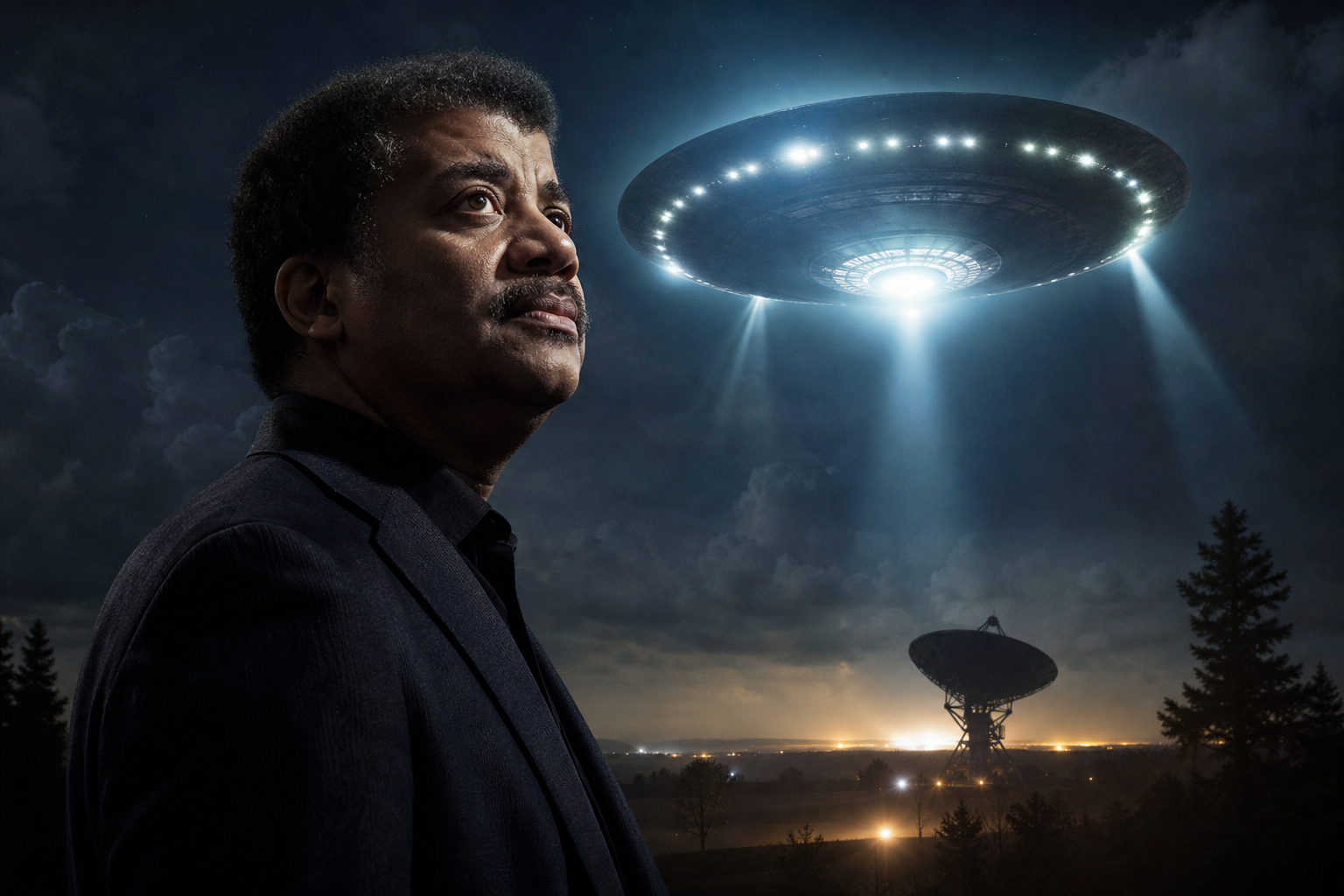
For decades, the search for extraterrestrial life has been a tug-of-war between those who witness the unexplained and those who demand laboratory-grade proof. While the public’s fascination with UAPs (Unidentified Aerial Phenomena) has reached a fever pitch, some of the scientific community’s most prominent voices remain firmly grounded in skepticism. This intellectual divide was recently highlighted by the critical reception of Neil deGrasse Tyson and his latest perspectives on our place in the cosmos.
The Great Divide: Skepticism vs. Experience
Neil deGrasse Tyson has long been the gatekeeper of mainstream astrophysics, often acting as the voice of reason in a world obsessed with alien abductions and silver discs in the sky. However, his recent “ode to aliens” and general stance on the subject have left many in the paranormal community feeling unheard. While Tyson argues from a position of cosmic perspective—the idea that we are too insignificant or biologically different for aliens to care about—thousands of credible witnesses, including military pilots, suggest that something is already here.
The friction lies in the definition of evidence. For a scientist like Tyson, a blurry video or a firsthand account is merely an “anecdote,” the lowest form of data. Yet, for those who have tracked Tic-Tac UFOs over the Pacific or witnessed orbs performing physics-defying maneuvers, these experiences are undeniable realities. This clash of worldviews raises a haunting question: Is science equipped to study a phenomenon that doesn’t want to be caught in a test tube?
Historical Precedents and the “Silly Season”
This isn’t the first time the scientific establishment has tried to downplay the possibility of non-human intelligence. During the 1950s and 60s, the United States Air Force conducted Project Blue Book, an initiative designed to investigate UFO sightings while simultaneously calming public anxiety. Much like the modern skeptical movement, the goal was often to find “prosaic explanations” for the extraordinary, such as swamp gas or weather balloons.
However, even within the hallowed halls of academia, there have been rebels. The late Dr. J. Allen Hynek, an astronomer who initially worked for the Air Force to debunk sightings, eventually realized that the data couldn’t be ignored. He famously broke away from the skeptical narrative to form the Center for UFO Studies (CUFOS), proving that a scientific mind can—and should—remain open to the paranormal. Today, figures like Tyson represent the old guard, while a new generation of scientists is beginning to look at the Pentagon’s UAP reports with fresh eyes.
The Failure of the “Starry Messenger” Approach
Critics of Tyson’s recent work suggest that his approach fails to “launch” because it ignores the visceral reality of the modern disclosure movement. We are no longer living in an era where “little green men” are the stuff of B-movies. With the 2017 release of the FLIR1 video and subsequent Congressional hearings, the conversation has shifted from “if” to “what.” When science communicators lean too heavily on dismissive humor, they risk becoming irrelevant to a public that is seeing the evidence with their own eyes.
The Fermi Paradox—the contradiction between the high probability of extraterrestrial civilizations and the lack of contact—is often cited by skeptics to suggest we are alone. But what if the contact has already happened, and we simply lack the multidimensional sensors to understand it? By focusing only on radio signals and biological markers, mainstream science may be looking for a flashlight in a world illuminated by lasers.
A New Era of Investigation
As we move further into the 21st century, the gap between paranormal research and mainstream science is slowly narrowing. Projects like the Galileo Project, led by Harvard’s Avi Loeb, are bypassing the traditional gatekeepers to search for physical artifacts of alien technology. This “boots on the ground” approach to the stars is exactly what the paranormal community has been advocating for decades.
While Neil deGrasse Tyson’s skepticism provides a necessary check and balance, it should not be the final word on the mystery of the universe. The history of science is littered with “impossible” things that turned out to be true, from germ theory to the existence of black holes. The next great discovery may not come from a textbook, but from a grainy radar track or a silent craft hovering over a lonely highway.
Do you believe that mainstream scientists like Neil deGrasse Tyson are helping or hindering the search for the truth about aliens?
Recommended Resources
- 🤖 Viktor AI — The autonomous AI platform we use to run our marketing operations. Hire Viktor to handle blogging, lead research, audits, and more.
- 💳 Greenlight — The money app and debit card for kids and teens. Teach your kids to earn, save, and invest. Earn $30 when you sign up.
- ⛏️ GoMining — Earn Bitcoin through cloud mining without the hardware hassle. A passive way to get into crypto.
- 🏦 Mercury — The business banking account built for startups and small businesses. No fees, powerful tools, and easy to set up.
Leave a Reply