Mirror-Gazing 'Ghost' Study: 24 of 30 Volunteers Sensed a Presence
In a small new study, 30 people gazed into a tilted mirror after recalling someone who died. Most sensed a presence. What the paper does and doesn't show.
Science: research findings and proposed natural explanations
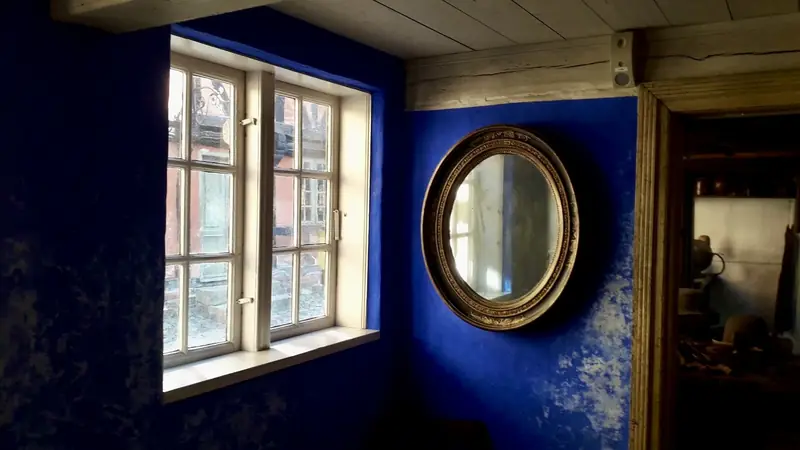
Sit in a dark room, think hard about someone who has died, then stare into a tilted mirror for 45 minutes. A small study published in October tried exactly that with 30 volunteers, and most of them came out saying they had sensed a presence. The paper is careful about what that does and doesn't mean, and so are we.
What a psychomanteum is
The idea is borrowed from antiquity. In a 1992 paper in the Journal of Near-Death Studies (opens in a new tab), Raymond Moody wrote that the ancient Greeks built psychomanteums, "or oracles of the dead," where people could consult spirits of the deceased, and he described his own modern attempt to recreate one.
The new paper calls the modern version a form of scrying (opens in a new tab): gazing at a shiny surface, combined with suggestion, the intention to meet a deceased loved one, and a mild altered state that comes from relaxing in a darkened chamber. The mirror is tilted at 45 degrees, so people look into it without seeing their own face.
How the study worked
The study, "An Exploratory Study into the Correlates of Exceptional Experiences in the Psychomanteum," (opens in a new tab) appeared on October 6, 2026, in the Journal of Anomalous Experience and Cognition. Its authors (opens in a new tab) are from the University of West Georgia and Northwest Missouri State University. Fifteen of the 30 volunteers have synesthesia, a condition in which one sense automatically triggers another.
According to ScienceAlert's report (opens in a new tab), each person first spent 15 minutes remembering someone who had died: their appearance, voice, movements and personality. Then came 45 minutes of mirror gazing. The full paper (opens in a new tab) describes the chamber as electromagnetically shielded and sound-attenuated, with black velvet on the walls and ceiling, a dimmable lamp at the back, and pink noise playing to block outside sounds. Volunteers pressed a button whenever they sensed a presence or had strong visual imagery.
The researchers also recorded (opens in a new tab) heart rate variability, local electromagnetic readings, the output of a random number generator, and infrared video of the mirror. Geomagnetic data for each session were downloaded afterward from a NOAA calculator.
What people reported
On the post-session questionnaire, 24 of the 30 said they had sensed a presence, ScienceAlert reported (opens in a new tab). Some described a smell, a touch, or picturing someone they had lost. "Oftentimes, these experiences were highly emotional but in a positive manner," lead author Christine Simmonds-Moore told the outlet. One woman felt someone stroking her hair; to her, it was a loved one who had died.
The paper adds a more cautious count. When a research associate coded the session and interview transcripts, presence themes turned up in 17 of the 30 sessions (opens in a new tab) (9 of 15 among synesthetes, 8 of 15 among the others).
The team expected synesthetes to have stronger experiences. They didn't: according to the abstract (opens in a new tab), the two groups did not differ on reported presences or on how vivid, real or space-filling the experiences felt. What did stand out was creativity. People who scored higher on a "creative fantasy" scale rated their experiences as more vivid and more real; a separate "imaginative fantasy" scale showed no such link. That is a correlation, not proof that creativity caused anything. Simmonds-Moore told ScienceAlert (opens in a new tab) that a strong tendency toward fantasy "contributes toward the recipe for ghosts."
The specks on the camera
The infrared camera picked up small specks both in empty-room baseline recordings and during sessions, with no significant difference in how often they appeared overall, per the paper (opens in a new tab). An extra analysis, run after the researchers looked at the data, linked sessions with specks to different random-number output. Simmonds-Moore called it "an intriguing post hoc finding" (opens in a new tab) that needs replication, and the generator's overall output did not differ from chance.
The team tried to recreate the specks (opens in a new tab) by tugging the velvet, copying participants' movements, moving the lamp and blowing dust at the lens. Only shifting or swinging the mirror produced specks, and those were fainter and smaller than the originals. The authors write that, given the small numbers, the anomalies are likely to have a normal explanation such as dust and other airborne particles (opens in a new tab).
The limits
The authors call the work exploratory and underpowered. The study was not pre-registered (opens in a new tab), and they estimate they would need to double the sample size to properly test their main question about synesthesia. ScienceAlert (opens in a new tab) adds that many statistical comparisons raise the risk of chance findings, that many participants had prior ghost experiences, and that the findings "don't demonstrate communication with the dead or establish a treatment for grief."
Results from earlier psychomanteum studies vary widely. The paper notes that 50% of participants in Moody's study (opens in a new tab) reported a strong encounter, compared with 22% in a 2004 pilot study, while four of seven people in a 1996 study reported mild apparitional experiences.
Takeaway
Put people in a dark, quiet room, prime them to remember someone they loved, and give them a mirror to stare into, and most will feel something. This study suggests personality, especially creative imagination, shapes how real that feels. It doesn't show that anyone was actually there. According to ScienceAlert (opens in a new tab), the team next plans related work with a "wind phone," an unconnected telephone people use to speak to loved ones who have died.
Sources
- An Exploratory Study into the Correlates of Exceptional Experiences in the Psychomanteum (Simmonds-Moore, O'Gwin, Steder & Mayfield), Vol. 6, No. 2, pp. 159-186 (opens in a new tab), Journal of Anomalous Experience and Cognition, published 2026-10-06. Accessed 2026-11-13.
- Full text (PDF) of the psychomanteum study (opens in a new tab), Journal of Anomalous Experience and Cognition, published 2026-10-06. Accessed 2026-11-13.
- Scientists Used a 'Psychomanteum' to Summon Ghostly Encounters. Then It Got Weird. (opens in a new tab), ScienceAlert, published 2026-11-07. Accessed 2026-11-13.
- Family Reunions: Visionary Encounters with the Departed in a Modern-Day Psychomanteum (Raymond A. Moody Jr.), Journal of Near-Death Studies 11(2), 1992 (opens in a new tab), UNT Digital Library, published 1992. Accessed 2026-11-13.
This article is an original summary written from the sources above. Quotes are short and attributed. Paranormal claims are reported as claims and have not been independently verified. Spotted an error? See our contact page.
Keep reading
Visits from Beyond? Why So Many Grieving People Sense a Loved One Who Has Died
Feeling, seeing or hearing someone who has died is common after a loss. What a landmark 1971 study and later research say about these experiences.
3 sources · 3 min read
Why Are Houses Haunted? The 1921 Case That Traced a 'Haunting' to a Broken Furnace
A family's footsteps, apparitions and dread stopped after a doctor found their furnace leaking carbon monoxide. The case, and why it still matters for ghost hunters.
3 sources · 3 min read
The 'Ghost in the Machine': How a 19 Hz Sound Wave Explained One Lab's Haunting
In 1998 engineer Vic Tandy published how an extractor fan's inaudible 19 Hz standing wave may have produced a 'ghost' in his lab. Here's what the paper actually says.
2 sources · 2 min read