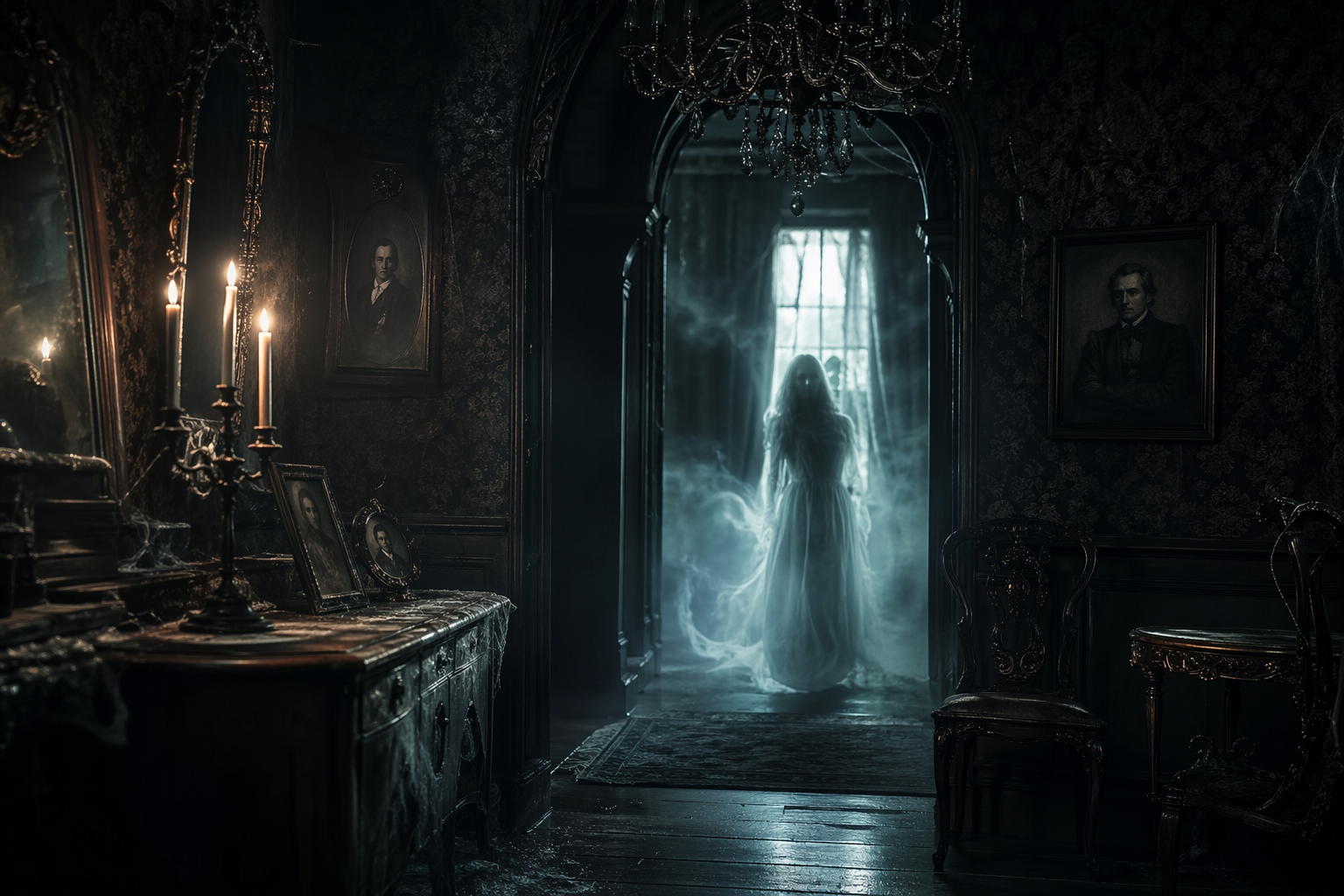
For centuries, the image of the haunted house has been a staple of folklore, literature, and late-night campfire tales. From the rhythmic thumping of unseen footsteps to the chilling sensation of a cold spot in a locked room, these experiences feel undeniably real to those who witness them. However, as modern technology advances, researchers are finding that the “ghosts” we fear may not be spirits of the dead, but rather fascinating quirks of physics and human biology.
The Ghost in the Machine: Infrasound and the Fear Frequency
One of the most compelling scientific explanations for paranormal activity involves infrasound—sound waves that vibrate at a frequency lower than 20Hz, which is below the threshold of human hearing. Even though we cannot hear these sounds, our bodies can certainly feel them. Research has shown that infrasound can trigger a physiological “fear response,” leading to feelings of intense anxiety, sorrow, and even the sensation of being watched.
The discovery of this phenomenon is often attributed to engineer Vic Tandy, who noticed a “gray ghost” in his peripheral vision while working in a supposedly haunted laboratory. He eventually realized that a vibrating extractor fan was emitting a frequency of exactly 18.9Hz. This specific frequency is known to cause the human eyeball to resonate, which can result in visual distortions and hallucinations. When the fan was turned off, the “ghost” disappeared, providing a groundbreaking link between acoustics and the supernatural.
Magnetic Mysteries: How EMFs Trick the Human Brain
Another leading theory focuses on Electromagnetic Fields (EMFs). Paranormal investigators often use EMF meters to detect spirits, believing that ghosts emit energy. However, scientists like the late neuroscientist Michael Persinger suggested the opposite: that high levels of environmental EMFs actually cause the brain to create the ghost. Persinger’s famous “God Helmet” experiments demonstrated that stimulating the brain’s temporal lobes with magnetic fields could induce a “sensed presence.”
In many older buildings, faulty wiring or proximity to power lines can create localized “hot spots” of electromagnetic activity. When a person enters these fields, their brain may misinterpret the external stimuli as a sentient being standing nearby. This sensed presence effect is often accompanied by a “fight or flight” adrenaline rush, reinforcing the belief that something malevolent is lurking in the shadows. What we perceive as a haunting may simply be our neurons reacting to an invisible magnetic pull.
Toxic Shadows: Carbon Monoxide and Mold Contamination
Sometimes, the explanation for a haunted house is far more dangerous than a spirit. In 1921, a medical journal published a case study of the “H Family,” who moved into a house and soon began hearing footsteps, seeing apparitions, and feeling physically drained. It was eventually discovered that a faulty furnace was leaking carbon monoxide into the home. This colorless, odorless gas causes oxygen deprivation, leading to symptoms like fatigue, confusion, and vivid hallucinations.
Similarly, researchers have investigated the link between toxic mold and hauntings. Certain types of fungi, such as Stachybotrys chartarum (black mold), can cause neurological symptoms, including mood swings and altered perceptions. Many “haunted” locations are old, damp, and poorly ventilated—the perfect breeding ground for mold. While the mold itself isn’t a ghost, the toxins it releases can certainly make a person feel like they are losing their mind in a house that has “gone bad.”
The Power of Suggestion and Pareidolia
The human brain is a master of pattern recognition, a trait known as pareidolia. This is the same psychological phenomenon that causes us to see faces in clouds or on the surface of Mars. In a dark, creepy environment, our brains are primed to find threats. A coat hanging on a door becomes a shadowy figure, and the random creaking of floorboards—caused by thermal expansion—is interpreted as a deliberate footstep.
Furthermore, the power of suggestion plays a massive role in how we experience the paranormal. If a person is told a building is haunted before they enter, they are significantly more likely to report strange occurrences. This “expectancy effect” creates a feedback loop where every cold draft or flickering light is cataloged as evidence of the afterlife. Our expectations act as a filter, turning mundane environmental factors into a terrifying narrative of the supernatural.
While science provides rational answers for many hauntings, does it truly explain every shadow in the corner of the room? Do you believe these scientific theories cover all paranormal encounters, or are there some things that logic simply cannot reach?
Recommended Resources
- 🤖 Viktor AI — The autonomous AI platform we use to run our marketing operations. Hire Viktor to handle blogging, lead research, audits, and more.
- 💳 Greenlight — The money app and debit card for kids and teens. Teach your kids to earn, save, and invest. Earn $30 when you sign up.
- ⛏️ GoMining — Earn Bitcoin through cloud mining without the hardware hassle. A passive way to get into crypto.
- 🏦 Mercury — The business banking account built for startups and small businesses. No fees, powerful tools, and easy to set up.
Leave a Reply