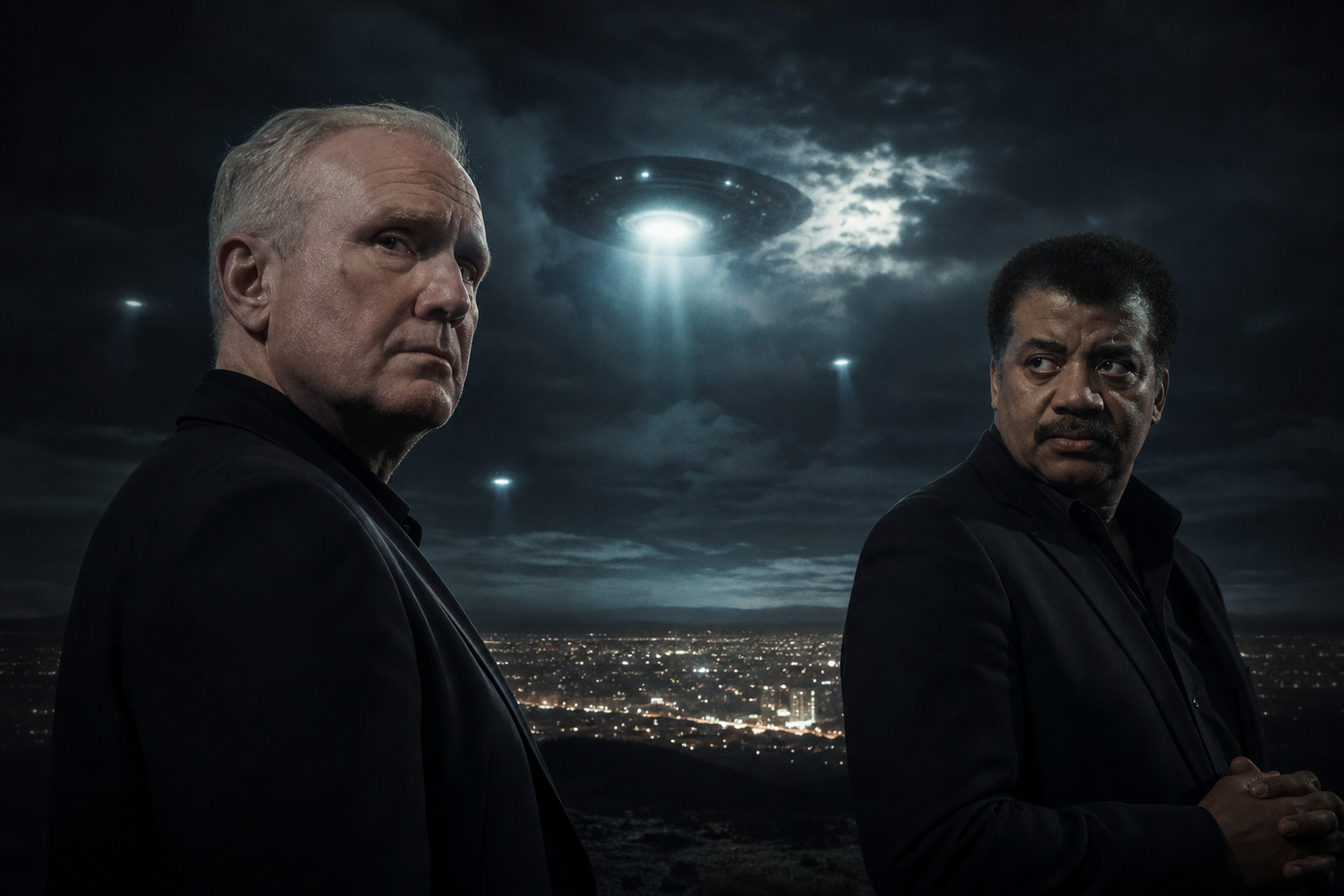
The battle for the truth behind Unidentified Anomalous Phenomena (UAP) has moved from the fringes of the internet to the center of a heated public debate between investigative journalism and establishment science. Investigative reporter Ross Coulthart has recently leveled a scathing critique against world-renowned astrophysicist Neil deGrasse Tyson, accusing him of maintaining a stance that is both hypocritical and fundamentally unscientific. As the momentum for government disclosure grows, the friction between those demanding transparency and those demanding “extraordinary evidence” has reached a breaking point.
The Stigma of Ridicule in Modern Science
For decades, the study of UFOs—now rebranded as UAPs—was relegated to the realm of science fiction and conspiracy theories. Ross Coulthart argues that this marginalization was not an accident but a result of a concerted effort by high-profile figures to mock and belittle witnesses. According to Coulthart, Neil deGrasse Tyson has been a primary architect of this stigma, using his massive media platform to dismiss credible reports from military pilots and radar operators as mere “glitches” or human error.
Coulthart suggests that Tyson’s approach violates the very core of the scientific method, which should begin with an open-minded observation of data. Instead of investigating the anomalies, Coulthart claims Tyson has spent years ridiculing those who come forward. This behavior, Coulthart asserts, has created a chilling effect, preventing other scientists from engaging with the subject for fear of professional suicide or public mockery. The journalist insists that Tyson should be “ashamed” for his role in suppressing a serious inquiry into what could be the most significant discovery in human history.
The Weight of Evidence vs. The Establishment
The crux of the argument lies in what constitutes “evidence.” While Tyson often demands a physical piece of a spacecraft or an alien “cell phone” to be brought into a lab, Coulthart points to the overwhelming weight of evidence provided by high-ranking whistleblowers. These are not anonymous internet posters, but individuals with high-level security clearances who have testified under oath about the existence of a legacy retrieval and reverse engineering program.
Coulthart’s reporting, which gained international attention through his interviews with whistleblower David Grusch, suggests that the United States government has been in possession of non-human craft for decades. By ignoring these firsthand accounts and the corroborating sensor data from advanced military platforms, Coulthart argues that establishment scientists are failing their duty. He posits that Tyson has unwittingly become a tool for a cover-up, providing intellectual cover for a secretive military-industrial complex that wishes to keep these technologies hidden from the public eye.
A History of Scientific Resistance
This clash is not unique to the 21st century; history is littered with examples of the scientific establishment rejecting paradigm-shifting ideas. From Galileo Galilei being silenced for suggesting the Earth revolves around the sun to the initial dismissal of plate tectonics, the “gatekeepers” of knowledge have often been the last to accept new realities. Coulthart views Tyson as a modern-day gatekeeper, clinging to a worldview that refuses to acknowledge the possibility of a non-human intelligence operating in our airspace.
Similar cases of scientific pushback occurred during the Project Blue Book era, where Dr. J. Allen Hynek—initially a skeptic hired by the Air Force to debunk sightings—eventually realized that the phenomena were real and deserved serious study. Hynek eventually broke away from the establishment to form his own research center, a path that Coulthart seems to be urging today’s scientists to follow. The journalist believes that the sheer volume of multi-sensor data—including radar, infrared, and visual sightings—makes the “nothing to see here” narrative increasingly untenable.
The Call for a New Scientific Paradigm
As the U.S. Congress continues to hold hearings and push for the UAP Disclosure Act, the pressure on the scientific community to pivot is mounting. Coulthart’s call-out of Tyson serves as a rallying cry for a more transparent and courageous approach to the unknown. He argues that if science is to remain relevant, it must be willing to look through the telescope, even if what it sees challenges our fundamental understanding of physics and our place in the universe.
The debate is no longer just about “lights in the sky” but about the integrity of our institutions. If the government is indeed hiding exotic technology, the silence of the scientific elite becomes a matter of public concern. Coulthart’s challenge to Tyson is a challenge to all of us: to stop laughing and start looking at the data with the seriousness it deserves. The era of ridicule may be coming to an end, replaced by an era of uncomfortable, yet necessary, discovery.
Do you believe that mainstream scientists like Neil deGrasse Tyson have a responsibility to investigate UAP claims, or are they right to demand physical proof before engaging?
Recommended Resources
- 🤖 Viktor AI — The autonomous AI platform we use to run our marketing operations. Hire Viktor to handle blogging, lead research, audits, and more.
- 💳 Greenlight — The money app and debit card for kids and teens. Teach your kids to earn, save, and invest. Earn $30 when you sign up.
- ⛏️ GoMining — Earn Bitcoin through cloud mining without the hardware hassle. A passive way to get into crypto.
- 🏦 Mercury — The business banking account built for startups and small businesses. No fees, powerful tools, and easy to set up.
Leave a Reply