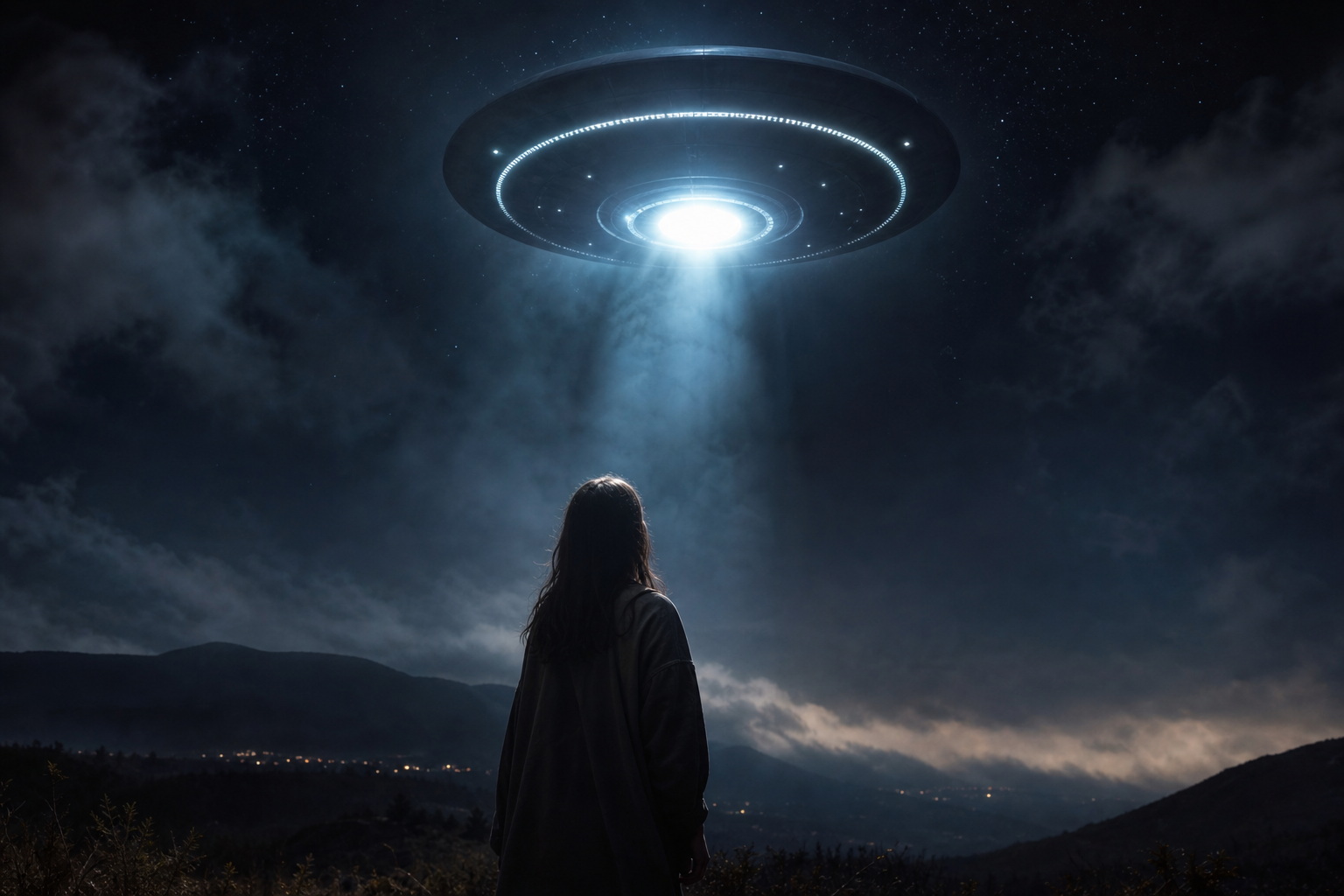
For decades, the narrative surrounding Alien Abduction has been one of clinical terror, bright lights, and invasive procedures. But a new wave of cultural interest is shifting the perspective, asking a provocative question: What if the visitors from the stars aren’t just captors, but a way out of a world that feels increasingly broken? This theme is at the heart of the new novel Take Me With You, a witty exploration of extraterrestrial contact that mirrors a growing sentiment in the paranormal community.
The Shift from Terror to Transcendence
In the early days of modern Ufology, accounts were dominated by the harrowing experiences of individuals like Betty and Barney Hill. Their 1961 encounter set the gold standard for the “Grey” alien archetype—silent, clinical, and frighteningly indifferent to human emotion. For years, the idea of being taken was a nightmare scenario that left witnesses with deep psychological scars and a lingering fear of the night sky.
However, as our own world becomes more complex and exhausting, the “fear factor” of the Close Encounter is beginning to evolve. We are seeing a resurgence of the 1950s Contactee movement, where figures like George Adamski claimed to have friendly, philosophical interactions with “Space Brothers.” These beings weren’t here to experiment; they were here to warn us about our own destructive tendencies and offer a path to a higher state of consciousness.
Today, this desire for transcendence is manifesting in a unique way. Rather than fearing the beam of light, some people are actively looking for it. The modern “abductee” is sometimes less of a victim and more of a volunteer, looking for an escape from the digital noise and societal pressures of the 21st century.
Modern Burnout and the Extraterrestrial Escape
The concept of “Earth fatigue” is a real phenomenon discussed in paranormal circles. With the rise of Starseeds—individuals who believe their souls originate from other planets or dimensions—the idea of leaving Earth behind has become a form of spiritual aspiration. For those who feel like “misfits” on their own planet, the arrival of a UFO represents a homecoming rather than a kidnapping.
This psychological shift is what makes stories like Take Me With You so resonant. It taps into the collective exhaustion of a generation that feels trapped by late-stage capitalism and environmental anxiety. When the world feels like it’s spinning out of control, the prospect of Interdimensional Travel or living among a more advanced civilization becomes an attractive alternative to the daily grind.
Researchers often point to the Oz Effect, a term coined by Jenny Randles to describe the eerie silence and sense of isolation that precedes a paranormal event. While this was once seen as a precursor to a terrifying event, many modern experiencers describe it as a peaceful detachment from a chaotic reality. It is in this silence that the invitation to “go with them” feels most compelling.
Historical Precedents of Voluntary Departure
The idea of humans willingly leaving with extraterrestrials isn’t just a modern literary trope; it has roots in several famous cases. In the 1950s, the Friendship Case in Italy involved a large group of people who claimed to have ongoing, friendly contact with a group of aliens known as the W56. These witnesses didn’t report trauma; they reported a sense of community and a shared mission to save the planet.
Similarly, the Aetherius Society, founded by George King, suggested that highly evolved “Cosmic Masters” were guiding humanity from afar. These movements suggest that the human psyche has long harbored a desire for a “cosmic parent” or a celestial exit strategy. When the terrestrial authorities fail to provide security or meaning, we naturally look to the stars for a higher authority.
Even in more “traditional” abduction cases, such as those documented by Harvard psychiatrist John Mack, many experiencers eventually moved past their initial fear. They often reported a sense of expanded awareness and a renewed concern for the Earth’s ecology. For some, the “abduction” was the catalyst for a profound personal transformation that made them feel more connected to the universe than to their fellow humans.
The Ethics of the Cosmic Invitation
If a craft were to land in your backyard tonight and a hatch opened, would you step inside? This question is no longer just the province of science fiction. As Unidentified Aerial Phenomena (UAP) gain mainstream credibility through declassified government videos and congressional hearings, the reality of “the others” is becoming harder to ignore.
The allure of the unknown is a powerful force. While the risks of stepping into a Flying Saucer are mathematically impossible to calculate, the risks of staying on a planet facing unprecedented challenges are well-known. This creates a “cosmic FOMO” (fear of missing out) where the potential for a better life elsewhere outweighs the safety of the familiar.
Ultimately, the fascination with “voluntary abduction” tells us as much about our own society as it does about the potential visitors. We are a species looking for a way to belong, and if we can’t find that belonging here on Earth, we will continue to look toward the horizon, hoping for a ride to the stars.
If you were given the chance to leave everything behind and join an extraterrestrial civilization, would you take the leap, or is there still enough here on Earth to keep you grounded? Let us know in the comments below!
Recommended Resources
- 🤖 Viktor AI — The autonomous AI platform we use to run our marketing operations. Hire Viktor to handle blogging, lead research, audits, and more.
- 💳 Greenlight — The money app and debit card for kids and teens. Teach your kids to earn, save, and invest. Earn $30 when you sign up.
- ⛏️ GoMining — Earn Bitcoin through cloud mining without the hardware hassle. A passive way to get into crypto.
- 🏦 Mercury — The business banking account built for startups and small businesses. No fees, powerful tools, and easy to set up.
Leave a Reply