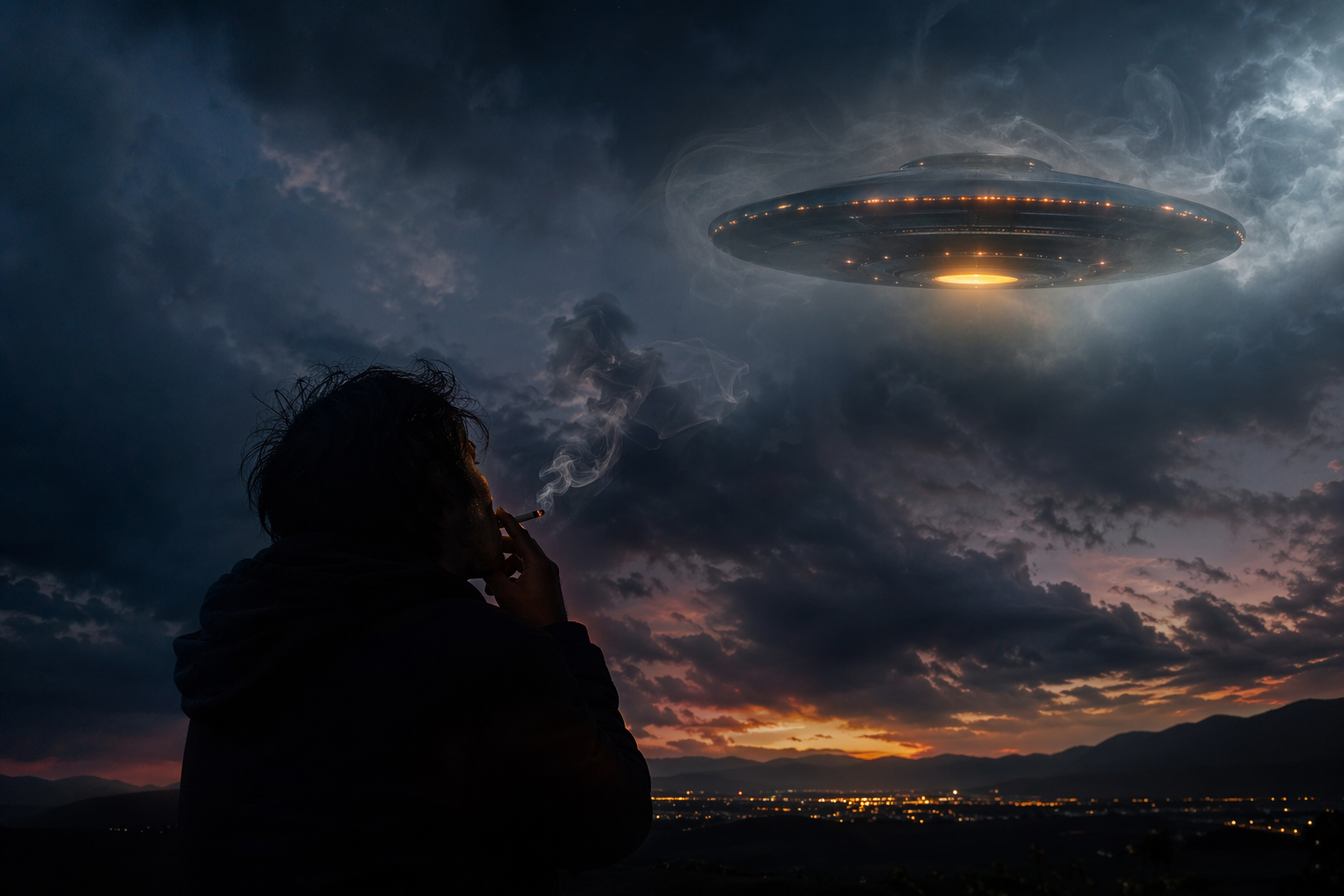
The sun dips below the horizon, the neighborhood settles into a quiet hum, and thousands of people step onto their porches for a final moment of reflection before the day ends. For many, this ritual involves a quiet cigarette or a breath of fresh air, but for a surprising number of observers, it results in a life-changing encounter with the unknown. Recent data suggests that a significant portion of Unidentified Flying Objects (UFO) reports originate not from professional astronomers, but from ordinary citizens taking a routine evening smoke break.
The Anatomy of a Casual Encounter
The phenomenon of the “evening smoke” sighting highlights a fascinating intersection between human habit and celestial observation. When an individual steps outside to smoke, they inadvertently engage in the perfect behavior for spotting Unidentified Aerial Phenomena (UAP). They are stationary, their eyes are adjusted to the low light, and they are often looking upward into the vast expanse of the night sky for several minutes at a time.
According to researchers and investigative bodies like the Mutual UFO Network (MUFON), the majority of sightings are reported during the “witching hours” of 8:00 PM to midnight. This coincides perfectly with the time many people are winding down their day. While a person walking to their car might be focused on their keys or the pavement, the person standing still on a balcony is far more likely to notice a light that moves with “non-ballistic” patterns or a craft that defies the known laws of physics.
This trend suggests that the “observer effect” in Ufology is heavily dependent on being still. In our fast-paced, screen-dominated world, the act of simply standing outside and looking up has become a rarity. Consequently, those who maintain this habit—even for a few minutes—become the primary sentinels for the anomalous objects that may be traversing our atmosphere undetected by the general public.
Patterns in Modern UAP Reporting
The shift in how we categorize these sightings has moved from “flying saucers” to the more clinical UAP, a term now favored by the Pentagon and NASA. However, the data remains consistent: the casual observer is the backbone of the field. In countries like Germany and France, where organizations such as GEIPAN (the Group for the Study and Information on Unidentified Aerospace Phenomena) track these events, the “evening smoke” demographic remains a constant source of high-quality reports.
These witnesses often describe objects that exhibit “the five observables,” a set of characteristics identified by former intelligence officer Luis Elizondo. These include sudden instantaneous acceleration, hypersonic velocities without a sonic boom, and low observability. When a witness is standing in the quiet of their backyard, the absence of sound from a rapidly moving craft becomes even more jarring and memorable.
Furthermore, the rise of Starlink satellites has added a layer of complexity to these reports. Many evening observers now report “trains” of lights moving in perfect synchronization. While these are easily explained, they serve to keep the public’s eyes on the skies, making them more likely to spot something truly inexplicable that doesn’t follow a straight, orbital path.
Historical Context: From Porches to the Pentagon
The history of Ufology is filled with instances where ordinary people, caught in a moment of stillness, witnessed the extraordinary. During the Phoenix Lights incident of 1997, thousands of people were outside, many on their patios, when a massive, V-shaped craft drifted silently over the city. It wasn’t just the sheer size of the object that shocked them, but the absolute silence it maintained while moving over a major metropolitan area.
Similarly, the Belgian UFO Wave of the late 1980s saw hundreds of reports from citizens who were simply out for an evening stroll or standing in their gardens. These historical cases reinforce the idea that the most credible evidence often comes from multiple, independent witnesses who have no prior interest in the paranormal but happen to be in the right place at the right time.
Today, the integration of smartphone technology and high-definition cameras has changed the game. An observer on a smoke break can now transition from witness to documentarian in a matter of seconds. However, experts argue that the human eye remains a superior sensor for detecting subtle movements and depth that digital sensors often struggle to capture in low-light environments.
The Future of Citizen Science in Ufology
As the stigma surrounding UFOs continues to evaporate, more people are feeling comfortable coming forward with their stories. The realization that many sightings occur during mundane moments—like an evening smoke—humanizes the phenomenon. It suggests that the “others,” whatever they may be, are operating in the periphery of our daily lives, visible only to those who take a moment to pause and look up.
Government transparency initiatives, such as the All-domain Anomaly Resolution Office (AARO), are now looking closer at civilian data to find patterns. By analyzing the geographic and temporal clusters of these “backyard sightings,” researchers hope to identify corridors of activity that might point toward the origin or intent of these mysterious visitors.
The next time you find yourself standing outside in the cool night air, take a moment to scan the horizon. You don’t need a telescope or a degree in astrophysics to contribute to the greatest mystery of our time; you just need a bit of patience and a clear view of the stars. The truth, it seems, is often found in the quietest moments of our routine.
Have you ever spotted something in the night sky that you couldn’t explain while you were just stepping out for a breath of air?
Recommended Resources
- 🤖 Viktor AI — The autonomous AI platform we use to run our marketing operations. Hire Viktor to handle blogging, lead research, audits, and more.
- 💳 Greenlight — The money app and debit card for kids and teens. Teach your kids to earn, save, and invest. Earn $30 when you sign up.
- ⛏️ GoMining — Earn Bitcoin through cloud mining without the hardware hassle. A passive way to get into crypto.
- 🏦 Mercury — The business banking account built for startups and small businesses. No fees, powerful tools, and easy to set up.
Leave a Reply