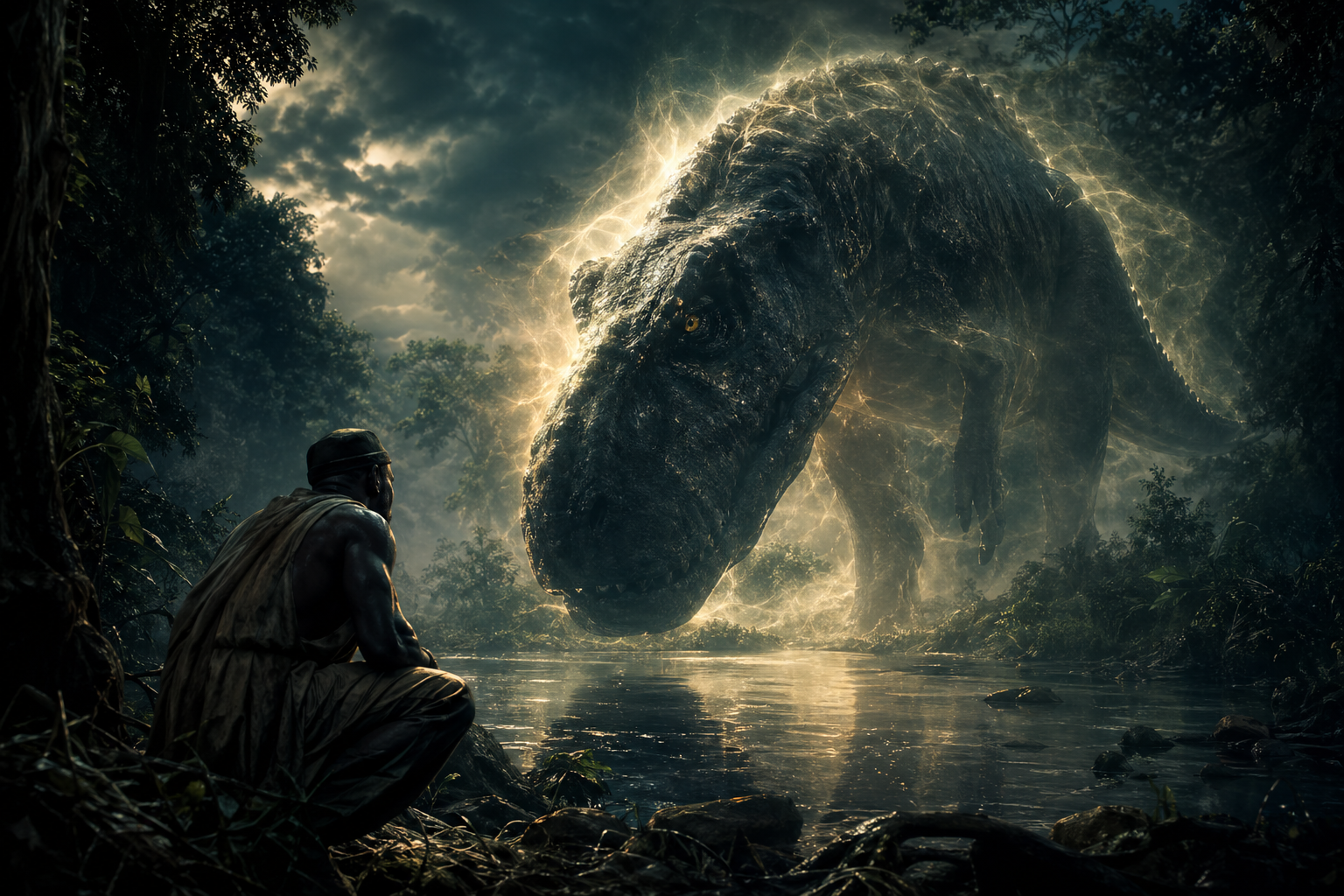
The 1932 Encounter That Shocked the World
The legend of the Kasai Rex first clawed its way into the public consciousness in 1932. According to reports from the time, a Swedish plantation owner named John Johnson was traveling through the Kasai Valley in the Belgian Congo (now the Democratic Republic of the Congo) with a servant. The pair was reportedly hunting when they stumbled upon a scene that defied the laws of modern biology. They claimed to see a massive, reptilian creature feasting on the carcass of a rhinoceros.
Johnson described the beast as being roughly 40 feet long, with a dark, reddish-brown hide and thick black stripes running down its back. Its snout was long and filled with rows of serrated teeth, reminiscent of a theropod dinosaur from the Late Cretaceous period. Terrified, Johnson and his companion fled the scene, but the story quickly spread through colonial outposts and eventually reached the international press, sparking a frenzy of interest in the possibility of a “living fossil.”
While the 1932 account remains the most famous, it wasn’t the only one. Local tribes had long spoken of a creature they called the “mountain-diver” or “swamp-dweller,” a predator that sat at the very top of the food chain. These indigenous accounts often described a creature that was far more aggressive than any known crocodile or monitor lizard, capable of taking down the largest mammals in the jungle with ease.
Anatomy of a Prehistoric Predator
When cryptozoologists analyze the descriptions of the Kasai Rex, the parallels to the Tyrannosaurus Rex or the Tarbosaurus are impossible to ignore. The creature is consistently described as bipedal, though some accounts suggest it could drop to all fours to navigate the thick underbrush of the African rainforest. Its coloration—a deep red with black markings—suggests an evolutionary adaptation for camouflage within the dappled light and shadows of the jungle floor.
The cryptid is said to possess powerful hind legs and smaller, though still functional, forelimbs. Its tail is described as heavy and muscular, used for balance while pursuing prey. Unlike the sluggish depictions of dinosaurs found in early 20th-century textbooks, the Kasai Rex was reported to be a fast, agile hunter. This aligns more closely with modern paleontological views of theropods as active, warm-blooded predators rather than cold-blooded, swamp-dwelling lizards.
However, the lack of physical evidence remains the biggest hurdle for researchers. No bones, scat, or clear photographs have ever been verified by the scientific community. Two photographs did surface in the mid-20th century claiming to show the beast, but they were quickly debunked as hoaxes, appearing to be nothing more than cutouts of a monitor lizard placed over a picture of a dead rhino. Despite these setbacks, the sheer consistency of the eyewitness descriptions keeps the legend alive.
The Congo: A Cradle for Living Fossils
The Democratic Republic of the Congo is often referred to as the “Green Abyss,” a vast expanse of unexplored wilderness that remains one of the most biologically diverse places on Earth. It is the same region that birthed the legend of the Mokele-mbembe, a sauropod-like creature said to inhabit the Likouala swamp. The idea that a prehistoric remnant could survive here is bolstered by the fact that the Congo Basin has remained climatically stable for millions of years.
In the world of cryptozoology, the Congo represents the ultimate frontier. If a dinosaur were to survive anywhere on the planet, it would be in these impenetrable forests where human footprints are rare. Other cryptids, such as the Emela-ntouka (the “elephant killer”) and the Nguma-monene (a giant serpentine lizard), further suggest that the region may harbor species unknown to Western science. The Kasai Rex fits perfectly into this “Lost World” narrative.
Skeptics, however, offer more grounded explanations. They suggest that witnesses may be seeing a monitor lizard that has grown to an exceptional size due to a lack of competition, or perhaps a misidentified Nile crocodile seen from a strange angle. Others believe the legend is a psychological manifestation of the “dinosaur mania” that gripped the world following the discovery of major fossil beds in the early 1900s. Yet, for those who have seen something moving through the trees, these explanations feel hollow.
The Enduring Mystery of the African Tyrant
Today, the Kasai Rex lives on primarily in the digital age, through artistic reconstructions and discussions on platforms like Reddit. A recent illustration shared in the r/Cryptids community has reignited interest in the beast, showcasing its terrifying profile and vibrant colors. These modern interpretations help keep the mystery relevant, bridging the gap between 1930s colonial adventure stories and 21st-century paranormal investigation.
Whether the Kasai Rex is a genuine biological anomaly, a relic of a bygone era, or a tall tale born of jungle fever, it continues to haunt the imagination. The thought that a prehistoric predator could still be stalking the shadows of the Congo is both terrifying and exhilarating. It reminds us that despite our satellites and advanced technology, the Earth still holds secrets that we have yet to uncover.
As we continue to explore the furthest reaches of our planet, we must ask ourselves: are we truly alone at the top of the food chain, or is there something much older and much hungrier waiting for us in the dark?
Do you believe a prehistoric predator like the Kasai Rex could truly survive undetected in the modern world, or is it simply a myth born of the deep jungle?
Recommended Resources
- 🤖 Viktor AI — The autonomous AI platform we use to run our marketing operations. Hire Viktor to handle blogging, lead research, audits, and more.
- 💳 Greenlight — The money app and debit card for kids and teens. Teach your kids to earn, save, and invest. Earn $30 when you sign up.
- ⛏️ GoMining — Earn Bitcoin through cloud mining without the hardware hassle. A passive way to get into crypto.
- 🏦 Mercury — The business banking account built for startups and small businesses. No fees, powerful tools, and easy to set up.
Leave a Reply