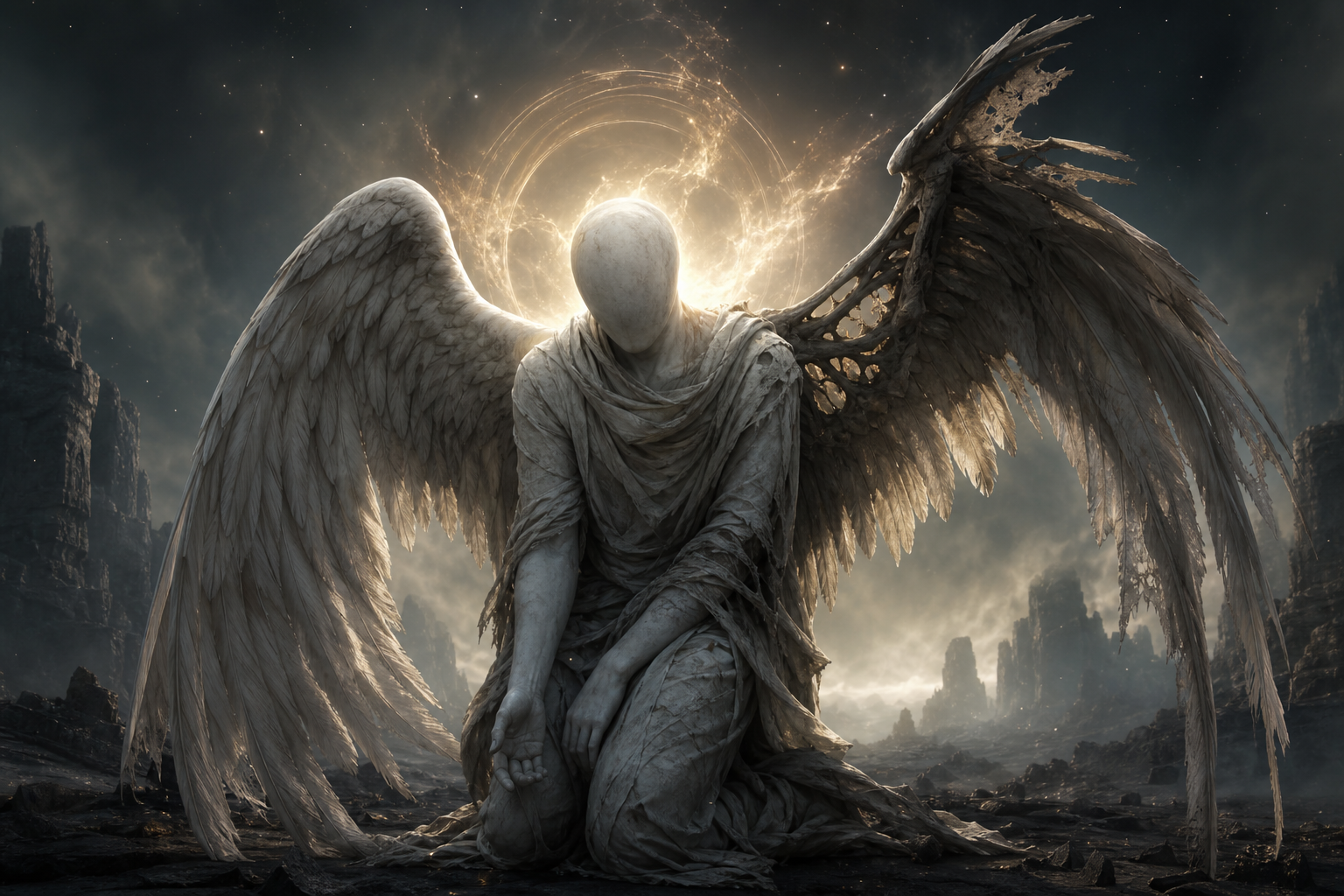
Across the digital landscape of the paranormal community, a curious phenomenon has begun to emerge, blending the lines between modern fandom and ancient spiritual lore. It started with a simple sketch of the Angel of Thursday, known to many as Castiel, depicted with a hauntingly realistic broken wing. However, the artist’s hesitation to render the entity’s face has sparked a deeper conversation about the psychological and supernatural barriers we face when attempting to visualize the divine.
The Enigma of the Faceless Celestial
In the realm of paranormal art, there is a long-standing tradition regarding the “unseeable” nature of high-ranking celestial beings. Throughout history, witnesses of angelic visitations often describe a sense of overwhelming light or a “terrible beauty” that defies human features. When a modern artist expresses a fear of “ruining” a divine face by drawing it, they may be tapping into an ancestral memory or a psychic block that has protected human sanity for millennia.
The specific mention of Castiel—a figure popularized by television but rooted in deeper Enochian lore—brings up the concept of the Tulpa. A Tulpa is a paranormal entity created through collective thought and focused energy. As millions of people visualize this specific angel, some researchers believe a thought-form is generated in the astral plane. When an artist feels an internal resistance to completing the face, is it merely a lack of technical skill, or is it a subconscious recognition that a true celestial form cannot be contained by pencil and paper?
Similar cases have been reported in automatic writing and spirit photography. Mediums often report that while they can capture the essence or the “aura” of a spirit, the facial features remain blurred or shifting. This “facelessness” serves as a reminder that these entities exist outside our three-dimensional understanding of anatomy. By leaving the face blank, the artist inadvertently creates a more accurate representation of a higher-dimensional being than a detailed portrait ever could.
The Symbolism of the Broken Wing
The image of the broken wing is perhaps the most poignant element of this recent artistic manifestation. In demonology and angelology, a damaged wing signifies a loss of grace, a forced grounding, or a sacrifice made to protect humanity. It represents a bridge between the perfect celestial realm and our own fractured, physical world. When we see these images appearing in the paranormal community, they often coincide with periods of great global unrest, as if reflecting a collective spiritual wounding.
Historically, the “Wounded Angel” motif has appeared in various cultures, often as a precursor to significant supernatural events. In 1914, shortly before the outbreak of the Great War, several sightings of “shattered” light beings were reported across Europe. These entities were described as having tattered wings and sorrowful countenances. The modern obsession with a broken-winged Castiel might be a contemporary echo of these omens, suggesting that our protectors are as weary as the people they watch over.
Furthermore, the broken wing serves as a powerful metaphor for the fallen angel narrative. However, unlike the malevolent connotations usually associated with the “fallen,” this specific imagery suggests a celestial soldier who has stayed too long in the trenches of human conflict. The physical trauma depicted in the art suggests that the veil between worlds is thinning, allowing the “scars” of the spirit world to become visible to those with the gift of sight.
Art as a Gateway to the Unknown
We must consider the possibility that paranormal news isn’t just found in grainy photos of UFOs or EVP recordings in haunted basements. Sometimes, the most profound evidence of the supernatural is found in the creative impulse itself. When an artist feels “driven” to draw a specific entity but finds themselves stopped by an invisible wall at the neck, we are witnessing a metaphysical interaction. The artist becomes a conduit for an energy they do not fully understand.
This phenomenon is not limited to drawings of angels. In the 1960s, artists attempting to sketch the Mothman of Point Pleasant often reported a similar “mental fog” when trying to detail the creature’s head, focusing instead on the wings and the glowing red eyes. It seems that certain cryptids and extra-dimensional beings have a natural defense mechanism—a “perceptual filter”—that prevents us from capturing their true likeness. The artist’s struggle is, in fact, a validation of the entity’s power.
As we continue to explore the intersection of pop culture and the paranormal, we must ask ourselves if we are the ones creating these beings, or if they are simply using our modern myths to find a way into our reality. The faceless angel with the broken wing stands as a silent sentinel at the edge of our imagination, reminding us that some things are meant to be felt, not seen. Whether it is a divine intervention or a manifestation of the collective unconscious, the mystery remains etched in every stroke of the pen.
Do you believe that certain entities prevent us from drawing their faces to protect our minds, or is the “faceless angel” simply a reflection of our own spiritual uncertainty? Share your thoughts and your own mysterious art experiences in the comments below.
Recommended Resources
- 🤖 Viktor AI — The autonomous AI platform we use to run our marketing operations. Hire Viktor to handle blogging, lead research, audits, and more.
- 💳 Greenlight — The money app and debit card for kids and teens. Teach your kids to earn, save, and invest. Earn $30 when you sign up.
- ⛏️ GoMining — Earn Bitcoin through cloud mining without the hardware hassle. A passive way to get into crypto.
- 🏦 Mercury — The business banking account built for startups and small businesses. No fees, powerful tools, and easy to set up.
Leave a Reply