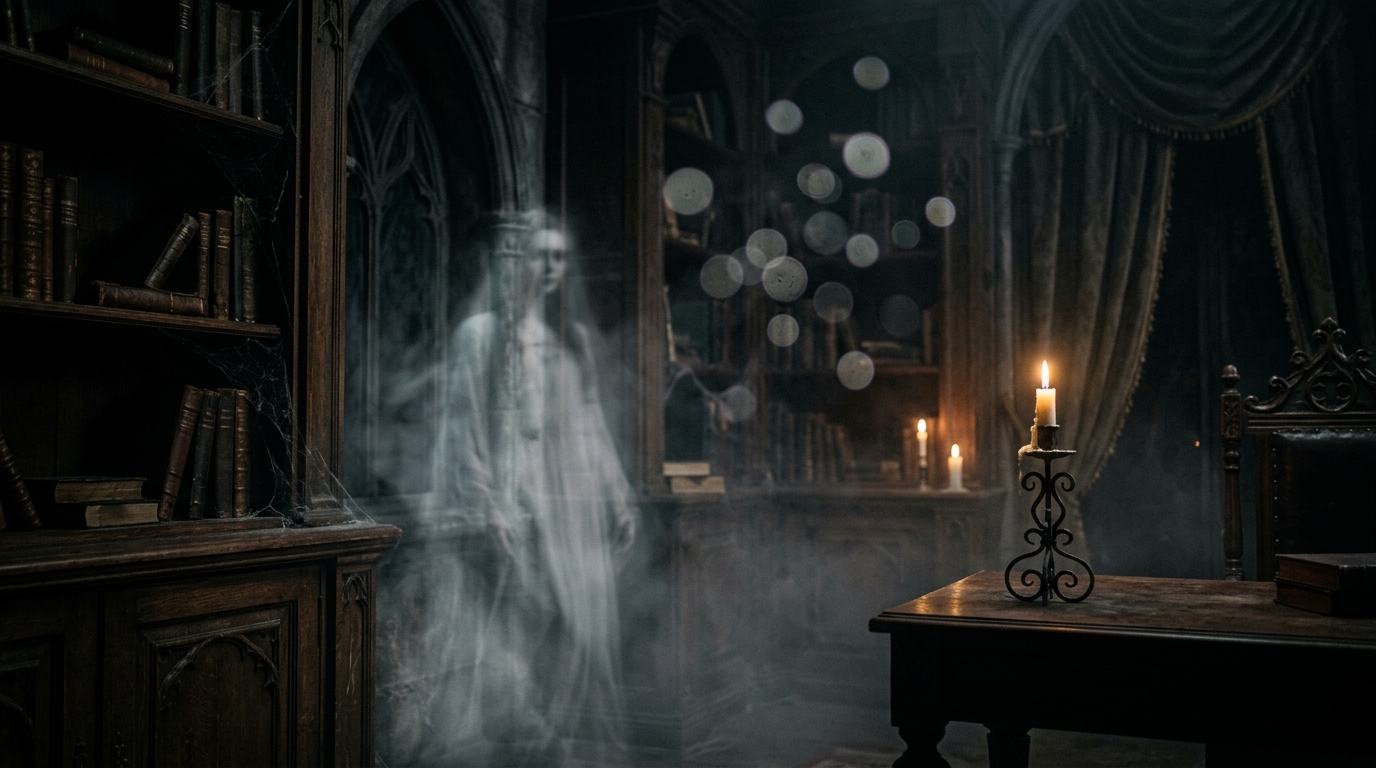
For decades, the “orb” has remained one of the most controversial and frequently captured phenomena in the world of ghost hunting. While many investigators believe these floating spheres of light represent the energy of a departed soul, a growing movement within the paranormal community is calling for a much more critical eye. As digital cameras and home security systems become more sensitive, the line between a genuine supernatural manifestation and a simple speck of household dust has become increasingly blurred.
The Science of Backscatter: Why Your Camera Sees Ghosts
The primary culprit behind the vast majority of orb sightings is a photographic phenomenon known as backscatter, or near-camera reflection. This occurs when a light source—most commonly a camera flash or an infrared LED on a security camera—reflects off a tiny particle situated very close to the lens. Because the particle is out of the camera’s depth of field, it appears as a large, translucent, and often glowing circle. To the untrained eye, this looks like a sentient ball of energy moving through a room, but to a photographer, it is simply physics in action.
Common household elements like dust mites, pet dander, and even microscopic moisture droplets can create these effects. In outdoor settings, small insects are often the culprits; their wings can catch the light in a way that makes them appear to pulsate or change shape as they fly. When these objects move across the frame, they often follow the air currents of the room, mimicking the “intelligent” movement that many researchers look for when identifying a true haunting.
The Rise of the Ring Camera and Digital Artifacts
With the explosion of smart home technology, paranormal investigators have seen a massive influx of “orb” videos captured on doorbell cameras and indoor security monitors. These devices are particularly prone to creating false positives because they rely heavily on infrared (IR) illumination. IR light is invisible to the human eye but highly reflective to small particles. When a piece of lint floats inches from an IR-enabled lens, it glows with an intensity that can seem otherworldly, often appearing to disappear and reappear as it moves in and out of the light’s focal point.
Furthermore, digital compression can add to the mystery. When a security camera records motion, it often uses software to “fill in” pixels, which can result in digital artifacts. These artifacts can make a simple moth look like a shimmering, translucent entity or a “rod-like” creature. Understanding the limitations of your hardware is the first step in becoming a credible researcher. Without a basic grasp of how light play and focusing issues affect filmography, a well-meaning enthusiast can easily mistake a mundane cleaning issue for a poltergeist.
Separating the Supernatural from the Mundane
So, how can a serious researcher tell the difference between a dusty room and a spirit manifestation? Historically, the most compelling orb cases are those that are accompanied by other forms of evidence. If an orb is captured at the exact moment a digital voice recorder picks up an EVP (Electronic Voice Phenomenon), or if a sudden temperature drop is recorded simultaneously, the case for a paranormal origin becomes much stronger. An orb that emits its own light—rather than merely reflecting the camera’s flash—is also considered a “holy grail” in the field.
Many veteran investigators now use a “three-point” rule of validation. They look for anomalous movement that defies air currents, such as sharp 90-degree turns or sudden acceleration. They also look for luminosity; a true spirit orb should theoretically be visible to the naked eye, not just through a camera lens. By applying these rigorous standards, the community can move away from the “dust parade” and focus on the rare, truly inexplicable events that suggest a life beyond our own.
The Importance of Skepticism in Ghost Hunting
The goal of modern paranormal research isn’t just to find ghosts; it’s to find the truth. By ruling out the 99% of sightings that are caused by lens flares, insects, and debris, we give more weight to the 1% that cannot be explained. This “skeptical approach” protects the integrity of the field and prevents researchers from being ridiculed by the scientific community. When we stop labeling every floating speck as a spirit, we create space for the genuine mysteries to be taken seriously.
Before you upload your next video to a forum or social media group, take a moment to clean your lens and check your surroundings. Is there a vent blowing nearby? Is the room particularly dusty? By educating ourselves on the mechanics of photography and filmography, we become better advocates for the spirits we are trying to document. The paranormal world is full of wonders, but it is our job to ensure we aren’t just chasing shadows in the light.
Do you believe that some orbs are truly sentient energy, or has modern technology made it too easy to mistake dust for the departed?
“,excerpt:
Recommended Resources
- 🤖 Viktor AI — The autonomous AI platform we use to run our marketing operations. Hire Viktor to handle blogging, lead research, audits, and more.
- 💳 Greenlight — The money app and debit card for kids and teens. Teach your kids to earn, save, and invest. Earn $30 when you sign up.
- ⛏️ GoMining — Earn Bitcoin through cloud mining without the hardware hassle. A passive way to get into crypto.
- 🏦 Mercury — The business banking account built for startups and small businesses. No fees, powerful tools, and easy to set up.
Leave a Reply