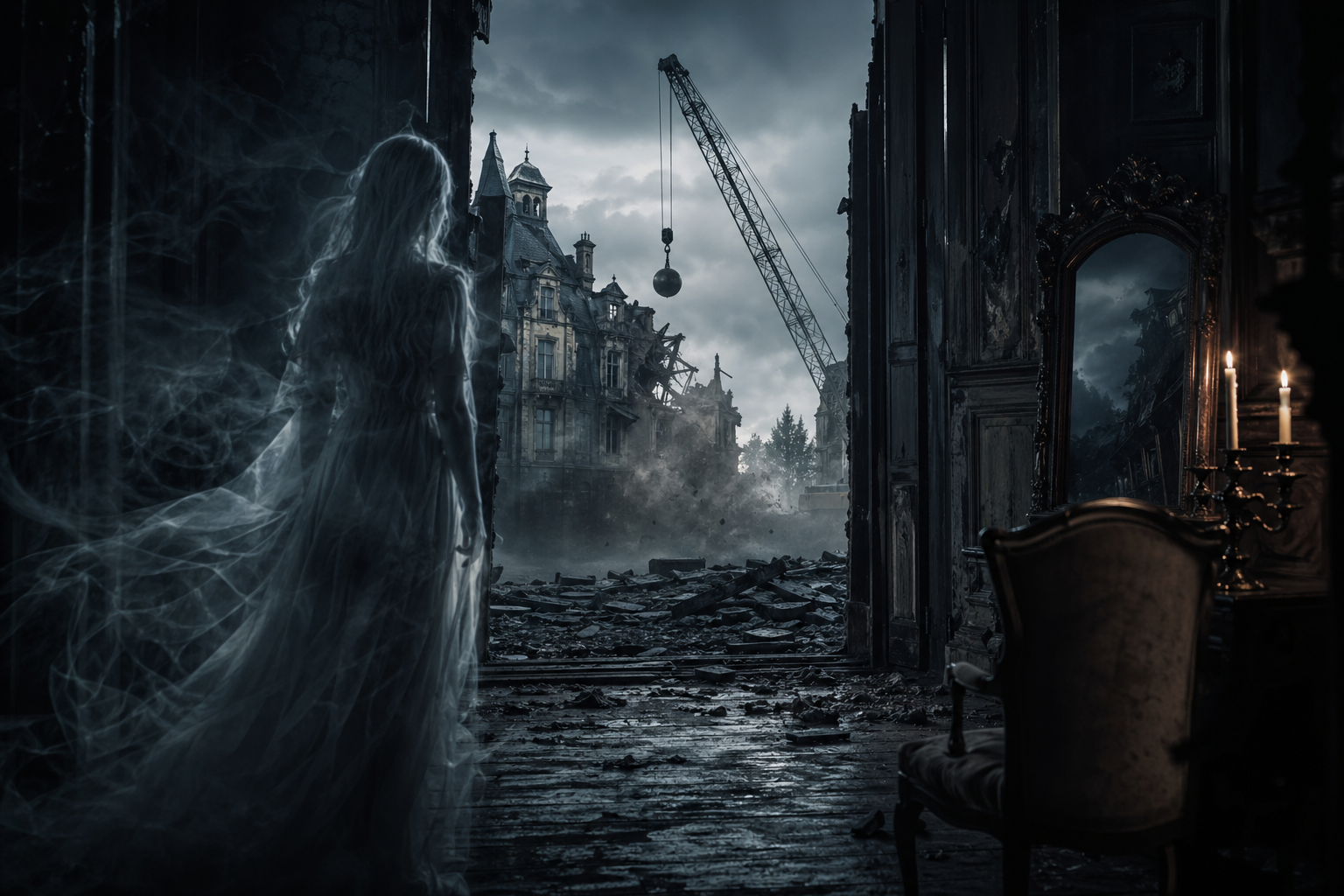
When the heavy iron of a wrecking ball swings into the side of a derelict asylum or a crumbling Victorian manor, it does more than just shatter brick and mortar. For decades, paranormal investigators and enthusiasts have debated a chilling question: what happens to the spirits when their physical anchors are reduced to dust? Does the destruction of a haunted site provide a final release for trapped souls, or does it merely set them loose upon the surrounding landscape?
The Stone Tape Theory and Residual Energy
To understand the impact of demolition on the supernatural, we must first look at the Stone Tape Theory. This hypothesis suggests that minerals within a building’s walls—such as quartz or limestone—can “record” high-energy emotional events, replaying them like a loop of film under certain atmospheric conditions. This is known as a residual haunting, where the “ghost” is not a conscious entity but rather a psychic footprint left behind in the environment.
When a building tied to residual energy is demolished, many researchers believe the haunting simply ceases to exist. If the “tape” is smashed into rubble, the recording can no longer play. However, some accounts suggest that the energy doesn’t vanish; instead, it becomes fragmented. There are numerous reports of haunted debris, where individuals who salvaged wood or bricks from a demolished site found that the paranormal activity followed the materials into their own homes.
Intelligent Hauntings and the Trauma of Displacement
The situation becomes significantly more complex when dealing with an intelligent haunting. Unlike residual energy, an intelligent spirit is a conscious entity capable of interacting with the living. These spirits are often tethered to a location due to unfinished business, emotional trauma, or a refusal to acknowledge their own death. For these entities, the demolition of their “home” can be a secondary trauma that triggers a period of paranormal displacement.
Paranormal experts often compare this to a human being losing their house in a natural disaster. A displaced spirit may become confused, agitated, or even aggressive. Without the familiar hallways and rooms to inhabit, these entities may attach themselves to the land itself or migrate to the nearest structure. This phenomenon is frequently cited in cases where modern housing developments are built atop the sites of former hospitals or prisons, leading to immediate reports of poltergeist activity in brand-new homes.
The Concept of Haunted Land
History is filled with examples where the building was gone, but the horror remained. One of the most famous instances of geographical haunting is the site of the former Black Hope community in Texas. After a housing development was built over a forgotten cemetery, residents reported terrifying encounters despite the original structures being long gone. This suggests that the “haunting” is often tied to the soil and the ley lines of the earth rather than the architecture sitting on top of it.
In some cultures, the act of demolition is seen as a way to “cleanse” a site, but spiritualists warn that without a proper clearing ritual, the energy remains stagnant. If a spirit is tied to the ground because of a tragic event, removing the walls does nothing to address the underlying spiritual anchor. In fact, the chaos of a construction site—with its noise, vibration, and shifting earth—is often thought to “recharge” latent spirits, leading to a spike in sightings during the rebuilding phase.
Do Spirits Finally Cross Over?
There is a more hopeful theory that suggests demolition acts as a catalyst for crossing over. Some believe that spirits remain in a state of liminality, stuck between worlds because they are fixated on the physical environment they once knew. When that environment is destroyed, the spirit is forced to let go of its earthly attachment. The sudden absence of the physical anchor may provide the necessary push for the soul to finally move toward the light.
However, this remains one of the great mysteries of the afterlife. Whether a ghost is a recording in the stone, a conscious soul in mourning, or an energy tied to the very dirt beneath our feet, the wrecking ball is rarely the end of the story. As urban sprawl continues to replace the old with the new, we may find that we are simply building over a past that refuses to stay buried.
Have you ever lived in a new building that felt like it had an old soul, or witnessed activity after a nearby demolition? Do you believe ghosts are tied to the bricks or the ground they stand on?
Recommended Resources
- 🤖 Viktor AI — The autonomous AI platform we use to run our marketing operations. Hire Viktor to handle blogging, lead research, audits, and more.
- 💳 Greenlight — The money app and debit card for kids and teens. Teach your kids to earn, save, and invest. Earn $30 when you sign up.
- ⛏️ GoMining — Earn Bitcoin through cloud mining without the hardware hassle. A passive way to get into crypto.
- 🏦 Mercury — The business banking account built for startups and small businesses. No fees, powerful tools, and easy to set up.
Leave a Reply