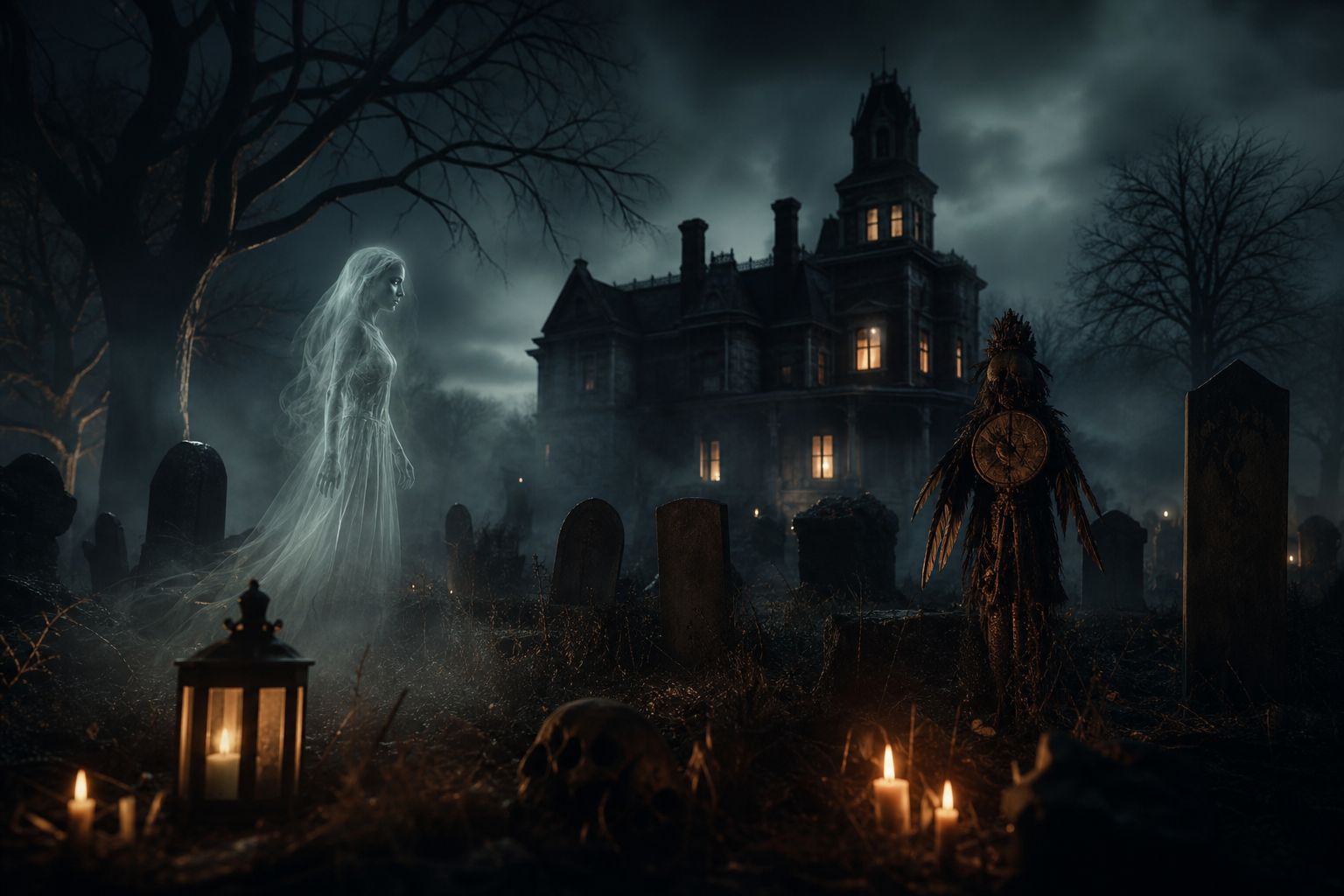
For decades, the image of a suburban home built atop an ancient, forgotten cemetery has served as the ultimate catalyst for cinematic terror. From the flickering television screens of Poltergeist to the reanimated horrors of Pet Sematary, the Indian Burial Ground trope has become a cornerstone of American paranormal lore. But as a curious investigator recently asked on social media, is this narrative rooted in genuine indigenous history, or is it merely a convenient invention of Hollywood screenwriters?
The Cinematic Origins of the Sacred Curse
The concept of the “cursed” indigenous site didn’t emerge from a vacuum; it exploded into the mainstream during the late 1970s and early 1980s. While ghost stories have existed for millennia, the specific idea that disturbing Native American remains triggers a localized haunting became a pop-culture phenomenon. Stephen King famously utilized this theme in his 1983 novel Pet Sematary, where a “Micmac” burial ground possessed the power to bring the dead back to life—albeit in a twisted, malevolent form.
Perhaps the most iconic example is the 1982 film Poltergeist. In the movie’s climax, it is revealed that the Cuesta Verde housing development was built over a relocated cemetery, but the headstones were moved while the bodies were left behind. While the film doesn’t explicitly state the graves were Native American in the original script, the public consciousness quickly merged the “built on a graveyard” trope with the “sacred Indian ground” mythos, creating a singular, enduring legend.
Colonial Guilt and the Psychology of the Haunting
Paranormal researchers and cultural historians often point to a deeper, more psychological reason for the prevalence of this narrative. The trope may serve as a manifestation of colonial guilt. As settlers moved westward across North America, thousands of indigenous sacred sites and burial mounds were leveled, farmed over, or built upon. The “curse” narrative acts as a metaphorical acknowledgment that the land was taken by force and that the spirits of the displaced may still hold a claim to the soil.
In this context, the paranormal activity reported in these stories—the bleeding walls, the moving furniture, and the spectral voices—represents the past refusing to stay buried. It is a haunting of the conscience as much as it is a haunting of a physical structure. By framing the land as “cursed,” the stories reflect an underlying anxiety about the foundations upon which modern American society was constructed.
Real-Life Cases: The Black Hope Curse
While Hollywood certainly embellished the details, there are real-world accounts that fueled the fire of this legend. One of the most famous is the Black Hope Curse in Newport, Texas. In the early 1980s, residents of a new housing development reported terrifying phenomena, including shadow figures, unexplainable illnesses, and pets acting in a state of constant agitation. It was later discovered that the homes were built directly over the Old Baptist Cemetery, a burial site for formerly enslaved people.
Though not a Native American site, the Black Hope case reinforced the terrifying idea that building over any forgotten grave leads to spiritual unrest. Similarly, in various parts of the Midwest, the destruction of Mississippian culture burial mounds has long been associated with local legends of bad luck and strange sightings. These accounts suggest that while the “Indian Burial Ground” is a specific trope, the fear of desecrating the dead is a universal human anxiety.
Indigenous Perspectives and Spiritual Reality
It is important to distinguish between Hollywood’s “vengeful ghosts” and the actual spiritual beliefs of indigenous nations. For many tribes, burial sites are not places of “curses” or “evil,” but are instead sacred landscapes that require deep respect and quietude. The idea of a spirit “attacking” a homeowner because of a fence post is often seen as a caricature of complex spiritual traditions.
In 1990, the United States passed the Native American Graves Protection and Repatriation Act (NAGPRA), a landmark piece of legislation designed to protect these sites and return remains to their rightful descendants. This law was a response to the very real, non-supernatural “curse” of grave robbing and archaeological desecration that had persisted for centuries. To many indigenous people, the real horror isn’t a ghost in the attic—it’s the historical lack of respect for their ancestors’ final resting places.
The Evolution of the Legend
Today, the trope is evolving. Modern horror is moving away from the “cursed burial ground” cliché, recognizing it as a tired and often culturally insensitive plot device. However, the fascination with liminal spaces and the energy left behind by those who came before us remains as strong as ever. Whether it is a residual haunting or a psychological projection, the idea that the land remembers what happened upon it continues to captivate the paranormal community.
The “Indian Burial Ground” narrative is a complex tapestry woven from threads of genuine history, cultural anxiety, and cinematic imagination. It reminds us that every piece of earth has a story, and sometimes, those stories aren’t finished being told. As we continue to explore the mysteries of the unexplained, we must ask ourselves: are we afraid of the spirits themselves, or are we afraid of what they represent about our own history?
Do you believe that certain patches of land can hold onto the energy of the past, or is the “cursed ground” narrative simply a product of our own guilty imaginations?
Recommended Resources
- 🤖 Viktor AI — The autonomous AI platform we use to run our marketing operations. Hire Viktor to handle blogging, lead research, audits, and more.
- 💳 Greenlight — The money app and debit card for kids and teens. Teach your kids to earn, save, and invest. Earn $30 when you sign up.
- ⛏️ GoMining — Earn Bitcoin through cloud mining without the hardware hassle. A passive way to get into crypto.
- 🏦 Mercury — The business banking account built for startups and small businesses. No fees, powerful tools, and easy to set up.
Leave a Reply