Faith Without Church: UK Study Links Religious Belief to the Paranormal
A new survey study of 2,100 UK adults finds belief in angels and demons goes with paranormal belief, while regular churchgoing goes the other way.
Science: research findings and proposed natural explanations
Britain has been leaving its churches for decades, yet researchers see signs of growing interest in the paranormal (opens in a new tab) there, especially in ghost belief and paranormal-themed tourism. A new peer-reviewed study asks how those two trends fit together. Its answer: it depends on which part of religion you measure. Believing in angels and demons goes along with more paranormal belief. Going to church and praying regularly goes along with less.
The study
The paper, "Unbounded Affinity: Religiosity and the Paranormal in the United Kingdom," was published online on November 6, 2026 (opens in a new tab) in the Journal for the Scientific Study of Religion. Its authors are Joseph O. Baker, Christopher D. Bader, Tom Clark of the University of Sheffield and M. A. Fahim. The details below come from the accepted manuscript posted by the University of Sheffield (opens in a new tab), which is open access.
The data come from the Chapman and Sheffield Paranormal and Religion Survey (CASPAR) (opens in a new tab), collected by Ipsos from its UK KnowledgePanel between August 31 and September 1, 2021. The final sample was 2,100 adults, weighted to be nationally representative.
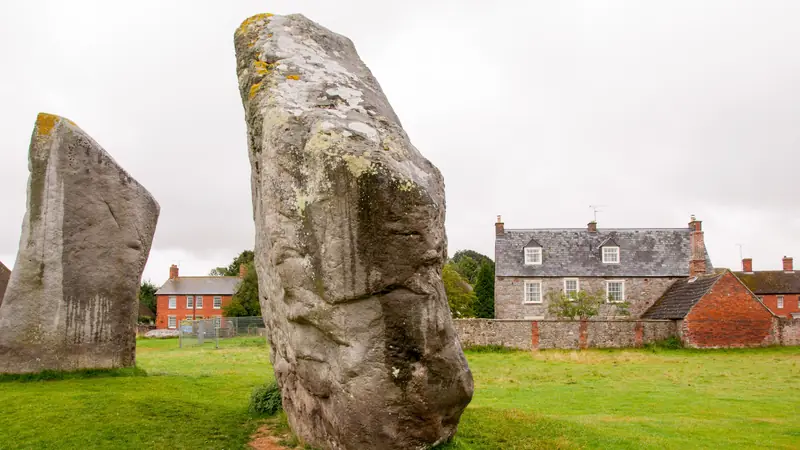
The paper opens in Avebury, the Wiltshire village (opens in a new tab) built in and around a prehistoric henge, where two shops sell crystals and books on UFOs and crop circles, and a sign on the Anglican church door reads: "Welcome pilgrims of all faiths & none." The authors use it as a small picture of a wider shift. They cite figures showing that two-thirds (66%) of UK citizens reported a religious affiliation in 1984 (opens in a new tab), compared with less than half (47%) by 2018.
How much of Britain believes
An earlier paper by Clark, Baker and Bader, using the same 2021 survey of 2,100 adults and published in The Sociological Quarterly in February 2025 (opens in a new tab), measured how common these beliefs are. According to its results (opens in a new tab), 78.3% of respondents believed in at least one of 18 paranormal items, and 72% did when dowsing and ley lines were left out. Some 35.9% believed that places can be haunted by spirits, 21.6% that aliens have come to Earth in modern times and 19.5% that the Loch Ness Monster exists.
Three kinds of religion, two directions
The new paper splits religion into separate measures, according to its methods section (opens in a new tab):
- Religious beliefs: whether people believe in the Devil, Heaven, Hell, purgatory, Armageddon, angels, demons and the rapture.
- Religious experiences: such as a miraculous healing, speaking in tongues, a vision of a religious figure or hearing the voice of God.
- Practice and commitment: how often people attend services and pray privately, and how religious they consider themselves.
The paranormal side combined 18 beliefs (hauntings, telekinesis, Bigfoot, curses, fairies and more) and 11 experiences, from consulting a psychic or using a Ouija board to seeing a UFO or experiencing a ghost.
In the models, religious beliefs were by far the strongest predictor (opens in a new tab) of paranormal belief, and religious experiences also pointed upward. Religious practice and commitment pointed the other way, with a significant negative link to both paranormal beliefs and paranormal experiences.
The two also interact. At the highest levels of religious practice, the authors write, the positive effect of religious belief on paranormal belief was "attenuated to the point of being essentially static." (opens in a new tab) Among people with lower levels of practice, religious beliefs had a very strong positive link to paranormal belief. In plain terms, the link between religious supernatural belief and the paranormal was strongest among people who weren't regular in their religious practice.
Why "unbounded"
The paper builds on "bounded affinity" theory, which holds that religion and the paranormal share a supernatural outlook, but that committed members of exclusive religious groups keep the two apart. In the authors' reading, organized religion's role (opens in a new tab) "is not merely to generate supernatural belief, but to curate it." In the UK, where conventional practice has largely receded, they argue that this check is increasingly absent, and "supernatural affinity becomes unbounded."
They also note that the overall pattern in the UK is more positive than the sharply n-shaped curves (opens in a new tab) found in earlier work from the US and Italy, where paranormal belief peaked among the moderately religious.
What it doesn't show
This is a survey about what people say they believe and have experienced. It does not test whether ghosts, psychics or UFOs are real. The authors offer a down-to-earth reading of one result: the same unusual experience may simply be interpreted through different cultural frameworks (opens in a new tab), so "a conventionally religious person may experience demonic, rather than alien visitation." They point to David J. Hufford's 1982 study of how cultural frames are laid over the same experience of sleep paralysis.
The authors list limits, too. The data are cross-sectional "static snapshots" (opens in a new tab) from a single 2021 survey, and the authors call for testing the theory among Asian, Middle Eastern and African populations. Every question offered a "prefer not to say" option, and the authors found that the strongest predictor of opting out of the paranormal experience questions was holding supernatural religious beliefs, an effect they say future research should examine.
Takeaway
In this survey, supernatural belief without regular religious practice went hand in hand with paranormal belief, which is what the authors mean by "unbounded." Because the data are a single snapshot, the study can't say which came first, or whether anything paranormal is going on at all.
Sources
- Unbounded Affinity: Religiosity and the Paranormal in the United Kingdom (Baker, Bader, Clark & Fahim), Journal for the Scientific Study of Religion, DOI 10.1111/jssr.70115 (opens in a new tab), White Rose Research Online (University of Sheffield), published 2026-11-06. Accessed 2026-11-14.
- Unbounded Affinity: accepted manuscript (PDF, CC BY 4.0) (opens in a new tab), White Rose Research Online (University of Sheffield), published 2026-11-06. Accessed 2026-11-14.
- Marginalized, Secularized, and Popularized? The Prevalence and Patterns of Paranormal Belief in the United Kingdom (Clark, Baker & Bader), The Sociological Quarterly 66(3) (opens in a new tab), White Rose Research Online (University of Sheffield), published 2025-02-10. Accessed 2026-11-14.
- Marginalized, Secularized, and Popularized? Published version (PDF) (opens in a new tab), White Rose Research Online (University of Sheffield), published 2025-02-10. Accessed 2026-11-14.
This article is an original summary written from the sources above. Quotes are short and attributed. Paranormal claims are reported as claims and have not been independently verified. Spotted an error? See our contact page.
Keep reading
Mirror-Gazing 'Ghost' Study: 24 of 30 Volunteers Sensed a Presence
In a small new study, 30 people gazed into a tilted mirror after recalling someone who died. Most sensed a presence. What the paper does and doesn't show.
4 sources · 5 min read
Visits from Beyond? Why So Many Grieving People Sense a Loved One Who Has Died
Feeling, seeing or hearing someone who has died is common after a loss. What a landmark 1971 study and later research say about these experiences.
3 sources · 3 min read
Why Are Houses Haunted? The 1921 Case That Traced a 'Haunting' to a Broken Furnace
A family's footsteps, apparitions and dread stopped after a doctor found their furnace leaking carbon monoxide. The case, and why it still matters for ghost hunters.
3 sources · 3 min read