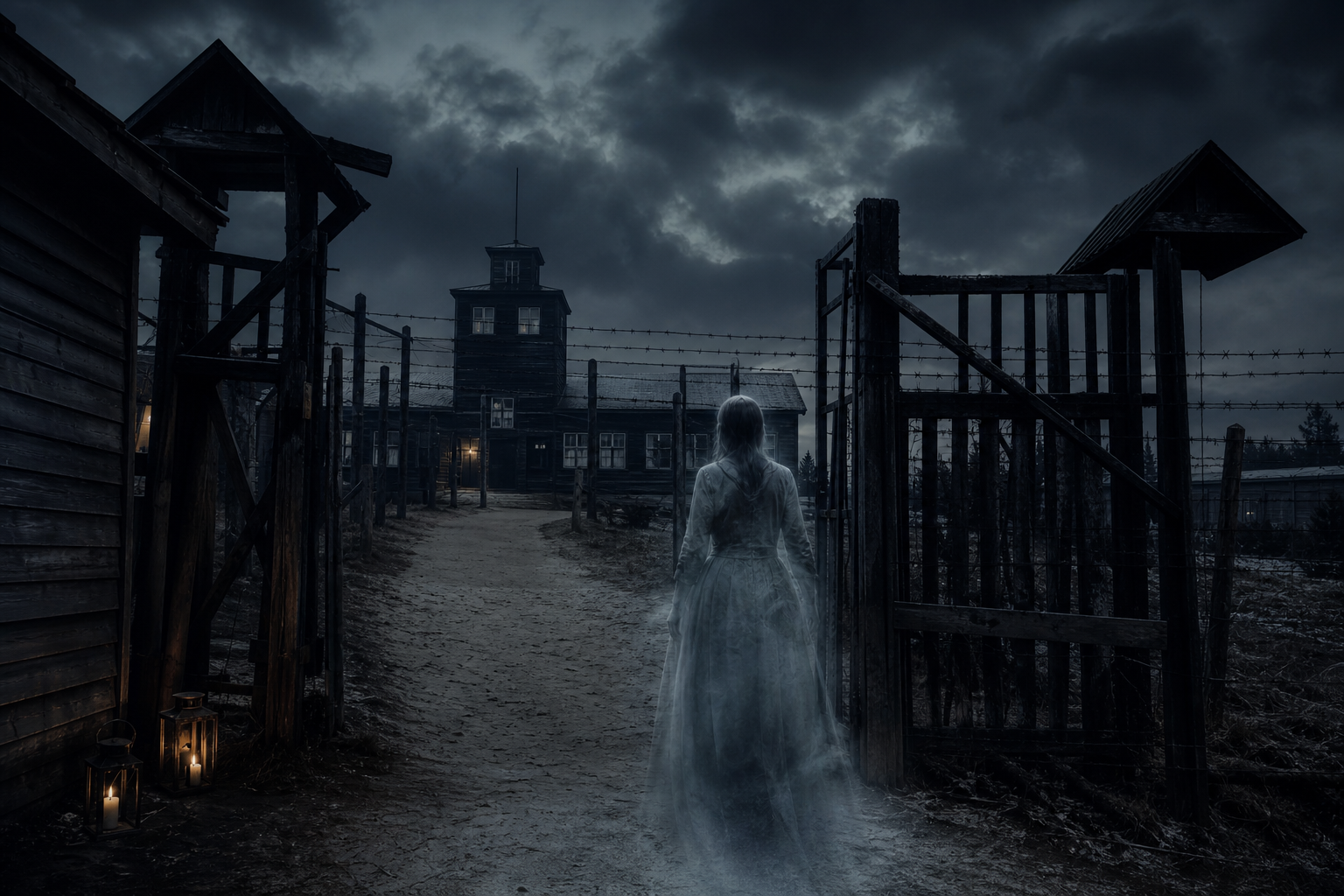
For those who possess a heightened sensitivity to the unseen, a simple school field trip can transform into a profound encounter with the past. In the historic region of Alsace, France, one student discovered that the echoes of history are not always confined to textbooks, but can sometimes be felt as a physical weight upon the soul. This is the story of a chilling encounter at one of Europe’s most somber historical sites, where the veil between the living and the dead grew impossibly thin.
The Legacy of the Invisible
The witness, an Alsatian native, grew up in a family where paranormal experiences were not just campfire stories, but a lived reality. From a young age, she and her relatives displayed a natural aptitude for sensing presences and interpreting energies that others might overlook. This family trait, often described as a form of clairvoyance or spiritual empathy, allowed them to navigate a world filled with invisible imprints.
Growing up with such a gift requires a certain level of spiritual protection and mental fortitude. By the time she reached her final year of high school, she was well-accustomed to the occasional strange sensation or unexplained “vibe.” However, nothing in her previous experience could have prepared her for the heavy atmosphere of the Natzweiler-Struthof concentration camp, a place where the air itself seems to hold its breath.
Alsace is a region steeped in complex history, having changed hands between nations multiple times. This turbulent past has left behind a landscape dotted with haunted locations and sites of significant emotional trauma. Struthof stands as the most harrowing of these, serving as the only concentration camp established by the Nazis on what is now French soil during World War II.
A Sudden Weight at the Gallows
The day of the visit began like any other educational excursion. As the class passed through the gates of the camp, the somber reality of the site began to set in. For most students, the sight of the potence (the gallows) standing to the left of the entrance was a grim reminder of the atrocities committed there. But for our witness, the visual horror was immediately accompanied by a startling physical manifestation.
Without warning, she felt a crushing sensation across her shoulders and back. It wasn’t the sharp sting of a muscle cramp or the dull ache of exhaustion; it was the unmistakable feeling of carrying a person. The weight was specific, localized, and undeniably human in its proportions. Despite having slept well and avoided any strenuous activity the day before, she was suddenly burdened by an invisible passenger.
As she walked through the camp, the sensation intensified. She began to perceive the nature of the entity she was carrying. It felt like a man—someone incredibly emaciated and weak. There was no malice in the presence, no sense of demonic intent or poltergeist aggression. Instead, there was a profound sense of weariness and a desperate need for support, as if a soul from the past was simply too tired to stand on its own.
Residual Energy and the Architecture of Suffering
Paranormal investigators often speak of residual hauntings, a phenomenon where intense emotional events are “recorded” into the environment. Sites of mass tragedy, such as concentration camps or battlefields, are frequently cited as hotspots for this type of activity. The theory suggests that the sheer volume of suffering creates a psychic imprint that sensitive individuals can interact with decades later.
In this case, the experience seems to transcend a mere “recording.” The physical interaction suggests a spirit attachment or a temporary manifestation fueled by the witness’s own natural sensitivity. While many visitors to Struthof report feelings of intense sadness or nausea, few describe such a literal, physical burden. It raises the question of whether some spirits remain tethered to the site of their greatest suffering, seeking a moment of human connection to ease their eternal transit.
The witness noted that the presence didn’t feel “scary” in the traditional sense. Rather, it was a heavy, somber communion with a victim of history. This type of empathic haunting is common among those who claim to be “sensitives,” where the primary sensation is one of shared emotion rather than fear. It serves as a haunting reminder that the victims of the past are more than just numbers on a plaque; they are lingering echoes of lives cut short.
As the tour concluded and she eventually left the grounds, the weight began to lift, leaving behind a lingering sense of awe and melancholy. The experience served as a powerful validation of her family’s beliefs and a sobering encounter with the afterlife. It highlights the thin line between historical remembrance and spiritual interaction, suggesting that sometimes, to truly understand history, one must be willing to carry its weight.
Have you ever visited a historical site and felt a physical sensation that you couldn’t explain, or do you believe that certain locations are permanently “charged” with the energy of the past?
Recommended Resources
- 🤖 Viktor AI — The autonomous AI platform we use to run our marketing operations. Hire Viktor to handle blogging, lead research, audits, and more.
- 💳 Greenlight — The money app and debit card for kids and teens. Teach your kids to earn, save, and invest. Earn $30 when you sign up.
- ⛏️ GoMining — Earn Bitcoin through cloud mining without the hardware hassle. A passive way to get into crypto.
- 🏦 Mercury — The business banking account built for startups and small businesses. No fees, powerful tools, and easy to set up.
Leave a Reply