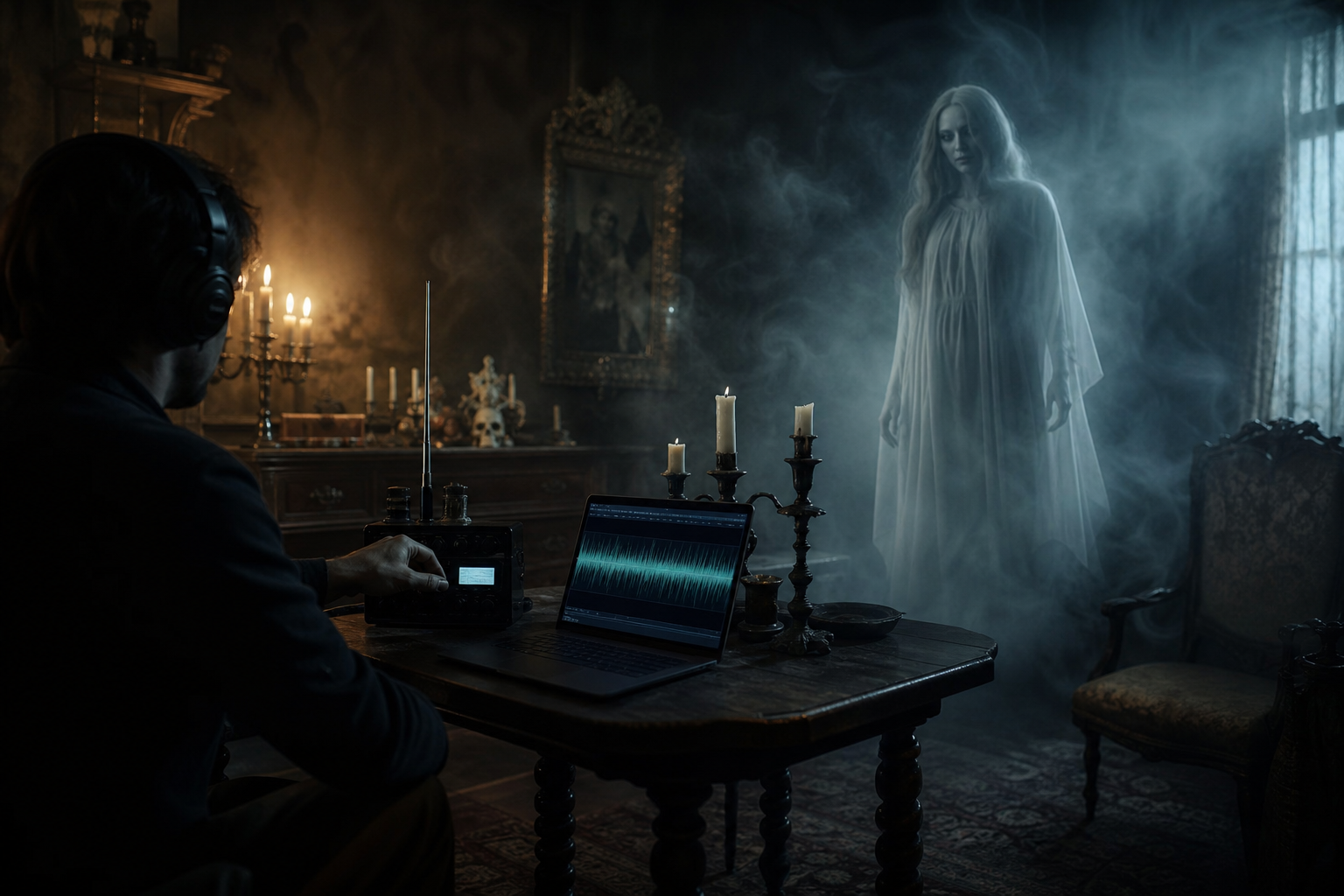
For decades, paranormal investigators have relied on a blend of intuition and analog technology to bridge the gap between our world and the next. From the early days of grainy photographs to the modern era of thermal imaging, the quest for definitive proof of the afterlife has always been driven by the latest scientific advancements. Now, a provocative new theory is emerging from the digital frontier: the use of Artificial Intelligence to decode and interpret the chaotic transmissions of the spirit world.
The Evolution of the Spirit Box
To understand the potential of AI in ghost hunting, one must first look at the history of the Spirit Box, also known as a Ghost Box. Originally pioneered by Frank Sumption in the early 2000s, these devices work by rapidly scanning through AM and FM radio frequencies. The theory suggests that spirits can manipulate the high-frequency white noise and radio fragments to form coherent words and sentences, a phenomenon closely related to Electronic Voice Phenomena (EVP).
Critics of the Spirit Box often point to Pareidolia—the human tendency to perceive meaningful patterns in random noise—as the primary reason people hear “voices” in the static. However, seasoned investigators argue that when a device spits out a specific name, a date, or a relevant description of a location’s history, it transcends mere coincidence. The challenge has always been filtering the signal from the noise in real-time, a task that human ears are notoriously biased toward performing incorrectly.
AI Agents: The New Digital Mediums
A groundbreaking concept recently gained traction within the paranormal community, suggesting that AI Agents—advanced programs like Pi, ChatGPT, or specialized voice-recognition models—could serve as a more objective “listener” during investigations. Instead of a human trying to make sense of the rapid-fire radio sweeps, an AI could run in the background, utilizing Pattern Recognition algorithms to identify linguistic structures that the human ear might miss or misinterpret.
The idea is to have a non-human entity (the AI) communicate with another non-human entity (the spirit). By feeding the audio output of a Spirit Box directly into an AI’s voice-processing module, researchers hope to eliminate human bias. The AI doesn’t have the emotional baggage or the “expectancy effect” that a ghost hunter might have while standing in a dark, reputedly haunted basement. It simply looks for data that matches the syntax and phonetics of human speech.
Bridging the Gap with Machine Learning
This approach utilizes Machine Learning to distinguish between random atmospheric interference and intentional communication. While a human might hear a “hello” because they want to hear one, an AI can analyze the waveform to determine if the sound possesses the specific characteristics of a vocal cord vibration. This adds a layer of scientific rigor to a field that is often criticized for its subjectivity.
Furthermore, the integration of Large Language Models (LLMs) allows the AI to provide context. If a Spirit Box produces the word “Blackwood” and the AI is aware of the local history of the site, it could theoretically facilitate a more complex dialogue. This “Digital Medium” could act as a translator, taking the fragmented, staccato bursts of a traditional Spirit Box and weaving them into a coherent stream of information, potentially unlocking secrets that have remained buried for centuries.
The Risks of Digital Hallucination
However, the marriage of the paranormal and AI is not without its skeptics. One of the primary concerns is AI Hallucination, a phenomenon where an artificial intelligence perceives patterns or facts that do not actually exist. If an AI is programmed to find speech in noise, it may become “too good” at its job, creating sentences out of pure static and leading investigators down a rabbit hole of false positives.
There is also the philosophical question of the “ghost in the machine.” If an AI begins to hold a conversation through a Spirit Box, are we talking to a spirit, or are we simply witnessing two complex algorithms—one biological and one digital—colliding in a sea of radio waves? Despite these concerns, the potential for a breakthrough is undeniable. As we move further into the 21st century, the tools of the Paranormal Researcher are becoming as sophisticated as the mysteries they seek to solve.
The integration of AI into ghost hunting represents a bold step toward a more data-driven approach to the supernatural. Whether it will provide the “smoking gun” evidence the community has sought for over a century remains to be seen, but the experiment itself is a testament to human ingenuity. We are no longer just shouting into the dark; we are teaching the dark how to speak our language.
Do you believe that Artificial Intelligence can remain objective enough to decode messages from the afterlife, or is it just another way for us to see patterns where none exist?
Recommended Resources
- 🤖 Viktor AI — The autonomous AI platform we use to run our marketing operations. Hire Viktor to handle blogging, lead research, audits, and more.
- 💳 Greenlight — The money app and debit card for kids and teens. Teach your kids to earn, save, and invest. Earn $30 when you sign up.
- ⛏️ GoMining — Earn Bitcoin through cloud mining without the hardware hassle. A passive way to get into crypto.
- 🏦 Mercury — The business banking account built for startups and small businesses. No fees, powerful tools, and easy to set up.
Leave a Reply