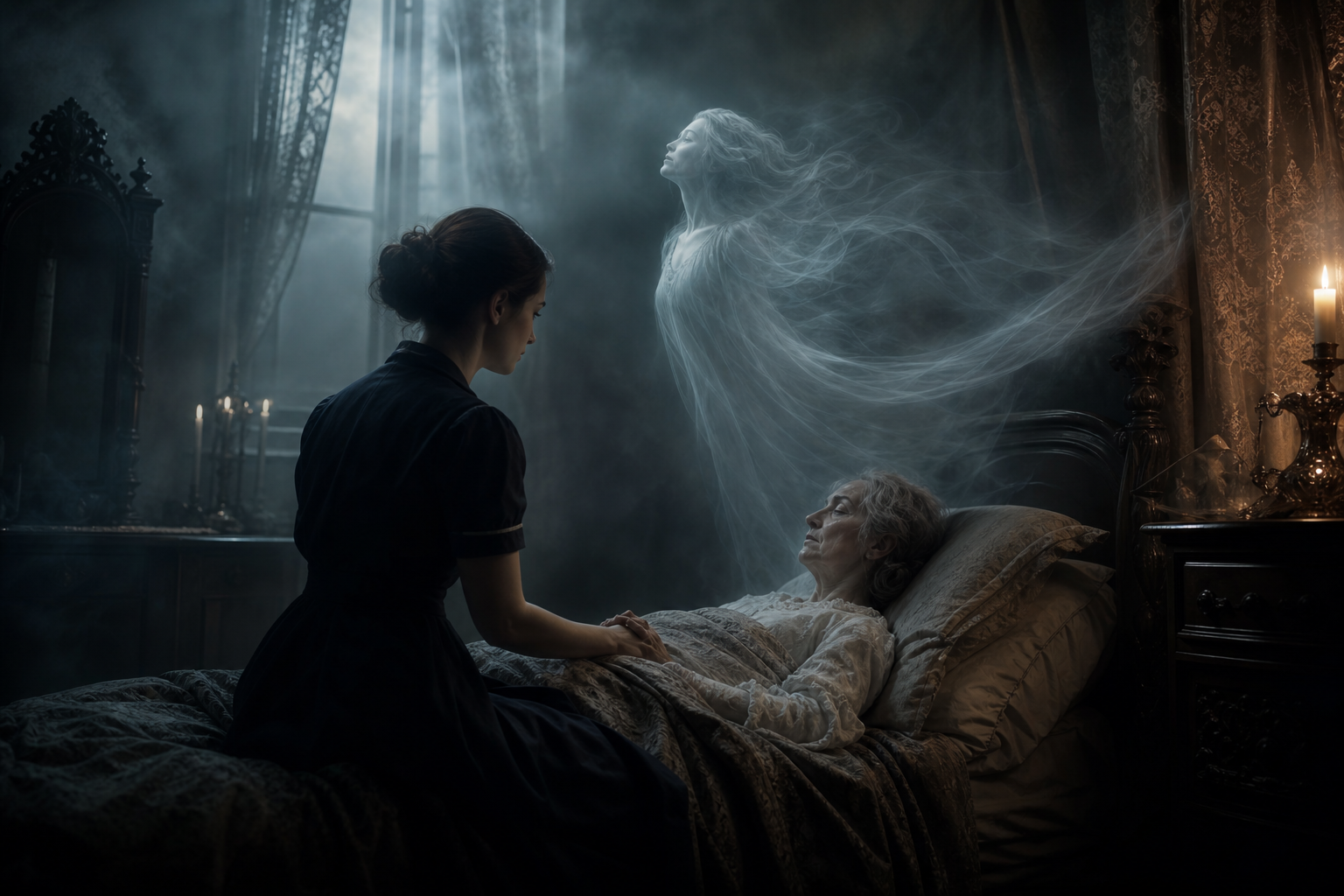
In the quiet, sterile hallways of a hospice ward, the veil between this world and the next often grows thin. For those who spend their lives caring for the terminally ill, the transition from life to death is not always a silent departure, but sometimes a profound revelation. One veteran nurse, with nearly five decades of experience, recently shared a chilling yet beautiful encounter that challenges our understanding of the human soul and what happens when the body finally fails.
A Lifetime of Service on the Edge of Eternity
The witness, a dedicated Hospice Registered Nurse with 46 years of experience, has spent her career navigating the heavy waters of grief and transition. Her journey into hospice care was born from personal tragedy—the loss of her two sons—which fueled a lifelong mission to provide the comfort and pain relief to others that she couldn’t provide for her own children. From the height of the AIDS crisis in the 1980s to her current work with pediatric patients, she has stood sentinel at the bedside of countless individuals taking their final breaths.
While many medical professionals maintain a strictly clinical view of death, those in the hospice field frequently report paranormal phenomena that defy conventional science. These “deathbed visions” or “end-of-life experiences” often involve patients speaking to deceased relatives or seeing lights. However, what this nurse experienced in a 10-bed adult inpatient unit was something far more visceral: a physical manifestation of a patient’s spirit in its most vibrant form.
The Radiant Apparition in Room 10
The incident occurred during a standard 12-hour shift. Among the new admissions was an elderly woman, likely in her late 70s or 80s, who was completely non-responsive. She required total care, unable to move, speak, or even acknowledge her surroundings. The nurse had performed her routine duties—cleaning the patient, repositioning her for comfort, and administering pain medication—before moving on to her other charges.
Later in the shift, as the nurse walked down the hallway, she performed a routine visual check on each room. As she passed the elderly woman’s doorway, she froze. The woman, who moments ago had been a frail, immobile figure bound to her bed, was now sitting upright on the edge of the mattress. The side rails were down, her feet were firmly on the floor, and she looked remarkably different. She appeared young, healthy, and radiant, wearing a smile that seemed to transcend the physical suffering of her illness.
The nurse, stunned, walked a few steps past the door before her brain could process the impossibility of the sight. She immediately backed up to look again. In the few seconds it took to return to the doorway, the scene had vanished. The patient was back in her bed, the side rails were securely up, and she was once again non-responsive in the exact position the nurse had left her. The spectral projection of the woman’s younger self had disappeared as quickly as it had appeared.
The Phenomenon of the ‘Peak in Darien’
This account mirrors a phenomenon known as the “Peak in Darien” experience, a term used to describe instances where a dying person sees or manifests as a healthy version of themselves, or recognizes deceased individuals that they had no way of knowing were dead. In many cultures, this is seen as the soul preparing to shed the “heavy coat” of the physical body. The fact that the nurse saw the woman as “young and radiant” suggests that the spirit does not age or suffer the same decay as the flesh.
Paranormal researchers often categorize these events as crisis apparitions or “bilocation” of the soul. In this case, the patient’s consciousness or “astral body” may have been testing its freedom from the failing physical form. For the nurse, it wasn’t a frightening ghost story, but a moment of profound beauty—a confirmation that the person she was caring for was still vibrant and whole beneath the surface of a broken body.
Bridging the Gap Between Science and Spirit
While skeptics might point to exhaustion or “hallucinations” brought on by the high-stress environment of a hospice ward, the consistency of these reports among medical staff is staggering. Nurses often speak of “the hovering,” a period shortly before death where the patient’s energy seems to fill the room, or the “terminal lucidity” where a non-responsive patient suddenly becomes clear-headed and energetic just before passing away.
This nurse’s story adds a compelling layer to the mystery of the afterlife. It suggests that our final form is not the one ravaged by time or disease, but a perfected version of our essence. As she continues her work with infants and children in pediatric hospice, she carries with her the knowledge that the end of the body is not necessarily the end of the person.
Do you believe that our souls return to a “prime” state after death, or was this a trick of the light in a high-stress environment? Have you ever witnessed a loved one appear healthy and vibrant shortly before or after their passing?
Recommended Resources
- 🤖 Viktor AI — The autonomous AI platform we use to run our marketing operations. Hire Viktor to handle blogging, lead research, audits, and more.
- 💳 Greenlight — The money app and debit card for kids and teens. Teach your kids to earn, save, and invest. Earn $30 when you sign up.
- ⛏️ GoMining — Earn Bitcoin through cloud mining without the hardware hassle. A passive way to get into crypto.
- 🏦 Mercury — The business banking account built for startups and small businesses. No fees, powerful tools, and easy to set up.
Leave a Reply