Out-of-Body Experiences Linked to a Brain State Between Sleep and Waking
A sleep-lab study logged 36 'unusual bodily experiences,' 10 of them out-of-body episodes. Brain signals during them mixed features of sleep and waking.
Science: research findings and proposed natural explanations
Floating above your own bed. Feeling your body spin or lose its shape. Lying paralyzed, feeling pressure or a touch from nothing at all. People report episodes like these, and some describe them as the mind leaving the body to wander without it (opens in a new tab). A study from a Dutch sleep lab recorded brain activity while volunteers had such experiences, and found a pattern that sits between sleeping and waking.
The study
The paper, by Teresa Campillo-Ferrer, Robert Oostenveld and colleagues, appears in Consciousness and Cognition (volume 139, article 104002) (opens in a new tab), and its full text is open access through Radboud University's repository. The authors are based at Radboud University's Donders Institute in the Netherlands and at the University of Genoa and the Giannina Gaslini Institute in Italy, among others. The work drew fresh attention this month after ScienceAlert (opens in a new tab) covered it on November 12 and VICE (opens in a new tab) followed on November 14.
The researchers call the episodes "unusual bodily experiences," or UBEs: illusory bodily perceptions (opens in a new tab) that don't fit ordinary waking experience, including flying or floating sensations, body distortions and out-of-body experiences.
How it worked
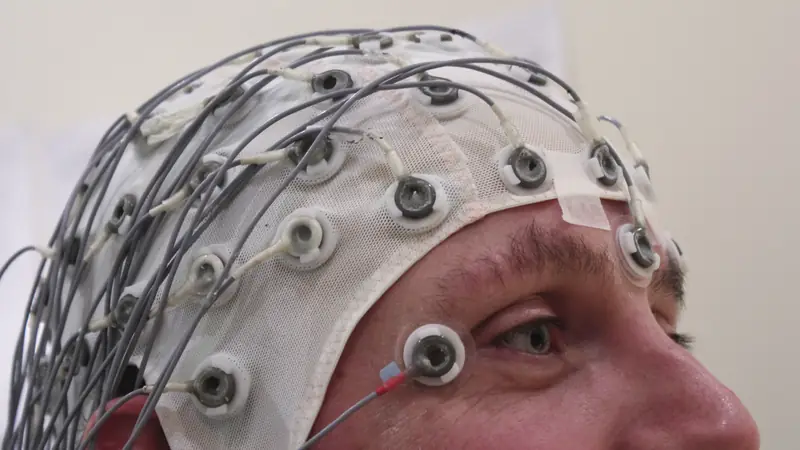
According to the paper (opens in a new tab), 35 healthy volunteers (26 women and 9 men, average age about 26) took part between June 2023 and May 2024. Each had either had at least one lucid dream or had some meditation experience. They wore high-density EEG caps, plus sensors for muscle activity, eye movements and heart rhythm.
In a single morning session, participants practiced breathing and body-scan meditation in bed, then had the chance to sleep for three hours. Light cues were flashed during wakefulness and sleep to encourage unusual experiences, the authors write (opens in a new tab).
The tricky part was getting a signal from someone who might be asleep. Volunteers were told to move their eyes left-right-left-right whenever something unusual happened. As ScienceAlert explains (opens in a new tab), eye movements can be detected even during sleep, so the signal marked the moment in the EEG. Afterward, researchers interviewed each person in detail about what they had felt.
What people reported
Volunteers made 99 eye signals in total. After checking signals against interviews, the team kept 36 verified UBEs from 20 of the 35 participants (opens in a new tab). Ten of them were out-of-body experiences or a sense of being elevated above the body.
The most common feature, present in 58% of the episodes (opens in a new tab), was a sense of movement while the body stayed still, such as rising, falling or spinning. Tactile sensations came next (53%), followed by distorted body boundaries (36%). Out-of-body or elevated experiences appeared in 28%, and sleep paralysis, tension or immobility in 25%. Participants described floating, falling or spinning, vibrations, pressure, or feeling touched by something that wasn't there (opens in a new tab), ScienceAlert reported.
The episodes did not belong to one state. The largest share, 36%, happened while people were awake and meditating (opens in a new tab). Another 20% came just after waking from the lightest stage of sleep, 17% during REM (dreaming) sleep and 11% during that lightest stage itself. None happened in deep sleep.
The brain pattern
Compared with ordinary meditation or sleep, the episodes came with less slow-wave activity (delta and theta) and more fast activity (beta and gamma) (opens in a new tab), the paper reports. The effect was strongest over the temporal regions, which the authors note have traditionally been tied to processing bodily sensations and combining the senses. In other words, brain activity shifted partway back toward a waking pattern during the experiences, whether the person had started out asleep or awake.
"Taken together, our findings suggest that UBEs may not depend on a specific sleep stage or waking condition, but rather on a state of consciousness that blurs the boundaries between them," the authors write (opens in a new tab). They suggest this could explain why such episodes often mix dream-like content with the real room around the person, as when someone sees their bedroom during frightening sleep paralysis hallucinations.
Not every prediction held. The team expected a brain rhythm called alpha to sit midway between sleep and waking during the episodes. It didn't: alpha activity looked more like the baseline sleep or meditation state (opens in a new tab), which the authors called surprising.
The limits
The authors list several caveats in the paper (opens in a new tab). The findings are correlational, so they don't show that the brain pattern causes the experiences. The light cues may have fragmented participants' sleep, and some of the pattern could reflect that. Some episodes lasted only 2 to 3 seconds, so the 5-second analysis windows may also capture ordinary brain activity. More than 70% of the episodes also came with "lucid insight," an awareness of one's own state, so some of the signal may reflect lucidity rather than the bodily experience itself. Only six episodes happened in REM sleep, limiting some comparisons.
The volunteers were also a specific group: healthy, with an average age of about 26, and each with lucid-dreaming or meditation experience.
What it means for the paranormal
This study didn't test whether anything actually leaves the body during an out-of-body experience, and it can't rule that out. What it adds is a measurable brain signature that shows up during these episodes in a lab. VICE's take (opens in a new tab) was that such an episode "probably isn't a spiritual experience" so much as a brain caught between two states. The researchers are more cautious. According to ScienceAlert (opens in a new tab), more work is needed to learn exactly how the brain produces sensations that feel so real.
Sources
- Facilitating unusual bodily experiences and out-of-body experiences across wakefulness and sleep: A high-density EEG and neurophenomenology study (Campillo-Ferrer et al.), Consciousness and Cognition 139, article 104002 (open-access full text) (opens in a new tab), Radboud Repository, Radboud University, published 2026. Accessed 2026-11-18.
- Scientists Recorded Brain Activity During Out-of-Body Experiences. A Strange Pattern Emerged. (opens in a new tab), ScienceAlert, published 2026-11-12. Accessed 2026-11-18.
- Scientists Watched People Have Out-of-Body Experiences. Here's What They Saw. (opens in a new tab), VICE, published 2026-11-14. Accessed 2026-11-18.
This article is an original summary written from the sources above. Quotes are short and attributed. Paranormal claims are reported as claims and have not been independently verified. Spotted an error? See our contact page.
Keep reading

6 in 10 Medical Students in Guinea Report Sleep Paralysis, Study Finds
A survey of 320 future doctors in Conakry found most reported sleep paralysis, and many explained it with both brain science and spirits.
4 sources · 5 min read

Faith Without Church: UK Study Links Religious Belief to the Paranormal
A new survey study of 2,100 UK adults finds belief in angels and demons goes with paranormal belief, while regular churchgoing goes the other way.
4 sources · 5 min read

Mirror-Gazing 'Ghost' Study: 24 of 30 Volunteers Sensed a Presence
In a small new study, 30 people gazed into a tilted mirror after recalling someone who died. Most sensed a presence. What the paper does and doesn't show.
4 sources · 5 min read