Maryland's 'Swinging Sailor' Legend Meets the Archaeologists
Legend says John Clark Monk hangs by chains in his Maryland tomb. A Towson University team that helped exhume him found a different story.
History & folklore: legends and reported experiences, not verified fact
This article is about a local legend. The story of the "Swinging Sailor" is folklore, not a documented event. We link to where each detail comes from, including what archaeologists actually found.
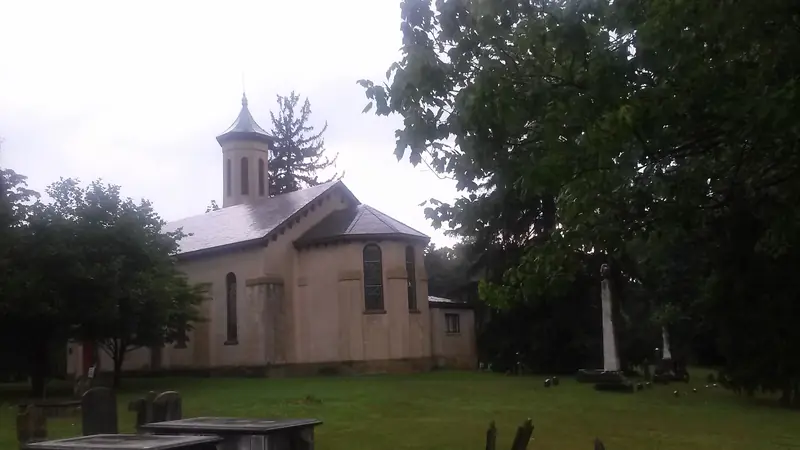
Harford County, Maryland, has a strange urban legend (opens in a new tab) about a grave in Perryman. A man who loved the sea, the legend goes, refused to let his body touch dry land even in death, so he was hung by chains inside his tomb. Now a Towson University archaeologist and her students have had a rare look inside. What they found keeps part of the tale and quietly retires the rest.
The legend
The man at the center of it is John Clark Monk. According to Towson University (opens in a new tab), he was born near Bristol, England, in 1760 and became well known in Abingdon, Maryland, where his family owned more than 300 acres, including the popular Abingdon Store. He died on December 9, 1827.
The legend, as the university summarizes it, says Monk's family and friends soaked his body in rum, wrapped it in a lead shroud and suspended it by chains inside an underground vault at Spesutia Church of St. George's Parish. Other tellings add a boat. A 2016 Cecil Whig feature (opens in a new tab) noted that some say his "loyal crew" placed his rum-soaked body in a boat-shaped wooden casket and carried it to the churchyard, and Patch (opens in a new tab) describes the legend the same way, with a boat-shaped coffin hanging from chains.
The story spread well beyond the churchyard. The Cecil Whig piece says it appeared in Matt Lake's book Weird Maryland and drew tourists "seeking the paranormal or just plain odd." Visitors peering through the slates over the grave, it said, mostly saw rotting leaves, debris and rusted flashlights left by earlier visitors. There is even a song. According to the Whig, a local band, the Captain Quint, recorded "The Swinging Sailor of Perryman" in 2005.
The churchyard itself is old. A National Register of Historic Places nomination (opens in a new tab) for the parish's Vestry House says the cemetery was established in 1718 and that the present church was built in 1851.
Why the tomb was opened
The opening was not a ghost hunt. Towson University (opens in a new tab) says that after the grave fell into disrepair, the Episcopal Diocese of Maryland contacted A.R. Marani Builders and Contractors to repair it. Katherine Ahlrichs, an associate professor at Towson who directs the Baltimore Community Archaeology Lab, helped exhume the remains with her students.
The team took care that Monk's remains did not touch the ground as they were removed, the university says. It then examined each exposed area of the tomb, screened the silt at the bottom of the crypt, and secured the human remains it found until they could be returned. The remains and artifacts were to go back into the grave later this fall.
Ahlrichs told the university that exhumations are uncommon, and that this one was done for preservation with the diocese's support. "Human remains should not be disturbed unless necessary," she said.
What the archaeologists found
The chains were a myth. According to Towson University (opens in a new tab), Monk was not suspended at all. His remains had been placed on two stone supports above the ground. In a sense, the core wish in the legend held up: as Patch put it (opens in a new tab), the supports kept him off the ground. The team did find evidence that he had been wrapped in a lead shroud, one detail of the tale that survived.
The tomb also corrected the family story. The legend says the vault held two women believed to be his wives, and some accounts, including the 2016 Whig article (opens in a new tab), said he was interred with both of his wives. According to the inscriptions on the crypt, the university says, it actually holds his second wife, Sarah Rebecca Lewis; her daughter, Mary Minerva Monk; and Mary Minerva's infant son, William Young. Monk's first wife, Mary Taylor, is buried in a different area of the cemetery.
Even the title "captain" looks shaky. The inscriptions on the tomb do not call Monk a captain, the university says, and Ahlrichs said that so far she has no evidence he was a ship captain.
Why legends like this last
Ahlrichs said part of the appeal of the project was the people the legend had pushed to the side. "The wives are people too," she told the university, adding that the story had been "all really revolving around this legend of Capt. Monk."
She also seemed to enjoy how the facts complicated the folklore. "It's almost never what you expect, and I love changing the story that we know," she said. Her verdict on the old song was lighter: "We might need to add a verse to the song," she said.
Set side by side, the legend and the dig line up in an interesting way. A man really was laid to rest off the ground, in a lead shroud, in a vault visitors could peer into. The retellings added chains, a boat, a crew and a sea captain. The archaeology does not end the legend. It just gives the people buried in that vault their names back.
For more on how real history and folklore get tangled, see our look at the Bell Witch.
Sources
- Uncovering the 'Swinging Sailor of Perryman' (opens in a new tab), Towson University, published 2026-11-18. Accessed 2026-11-26.
- Towson University Archaeologists Exhume Maryland's 'Swinging Sailor' (opens in a new tab), Patch, published 2026-11-20. Accessed 2026-11-26.
- A 'Bell' of a ghost and the hanging sailor (opens in a new tab), Cecil Whig, published 2016-10-29. Accessed 2026-11-26.
- National Register of Historic Places nomination: Vestry House, St. George's Parish (opens in a new tab), National Park Service. Accessed 2026-11-26.
This article is an original summary written from the sources above. Quotes are short and attributed. Paranormal claims are reported as claims and have not been independently verified. Spotted an error? See our contact page.
Keep reading
Connecticut's New Haunted History Trail Puts Its Witch Trials on the Map
Connecticut's 130-stop Haunted History Trail mixes ghost legends with a real record: the colonies' first witchcraft execution, in Hartford in 1647.
4 sources · 5 min read
Eastern State Penitentiary: The History Behind One of America's Most 'Haunted' Prisons
Philadelphia's Eastern State Penitentiary has a ghostly reputation built on 140 years of hard history. Here's what visitors report and what the site itself says.
3 sources · 3 min read

Canadian MPs Vote 11-0 to Study Ottawa's Own UFO Report
A House of Commons committee will hold four meetings on the Sky Canada Project, the 2025 report that urged Canada to set up a service for UAP sighting reports.
5 sources · 5 min read