Where Are Britain's Prehistoric Ghosts? An Archaeologist Goes Looking
Britain is full of ghost stories, but few feature prehistoric people. An archaeologist says that gap may reveal how ghost stories are made.
History & folklore: legends and reported experiences, not verified fact
This article is about legends and folklore. The ghost stories below are traditional tales and reported experiences, not verified events. The archaeology is documented, and we link where each detail comes from.
Britain has no shortage of ghosts: white ladies, headless horsemen, Anne Boleyn. But one kind is almost missing. Ghosts of the people who built the country's barrows and hillforts rarely turn up, and one archaeologist notes (opens in a new tab) that traditional British ghosts rarely go back more than a few hundred years.
That gap is the subject of a new essay from the University of Winchester (opens in a new tab), published on November 3 by Dr Katy Soar, a senior lecturer in classical archaeology who has written about archaeology, folk horror and the supernatural. Her question is simple: given Britain's strong tradition of ghost belief, where are the prehistoric ghosts?
Haunted sites, but not prehistoric ghosts
Soar points out that ancient sites are often said to be haunted, just not by ancient people. In 1946 Sir Charles Oman wrote that he had "never come across an apparition of a woad-painted Briton," she notes (opens in a new tab).
Take Wandlebury, in the Gog Magog Hills. According to the charity that manages it, Cambridge Past, Present & Future (opens in a new tab), an ancient British tribe, the Iceni, lived there around 2,300 years ago and built a hillfort on the hilltop. Its ghost is far younger. The same page says Gervase of Tilbury told in 1219 of a dark night-rider whom challengers summoned on a moonlit night by crying "knight to knight, come forth!" Soar describes that phantom as a spectral knight placed there by medieval tradition. In Cornwall, she writes, Bronze Age barrows are said to be haunted by a headless horseman. Nothing about either ghost marks it as prehistoric.
The rare exceptions
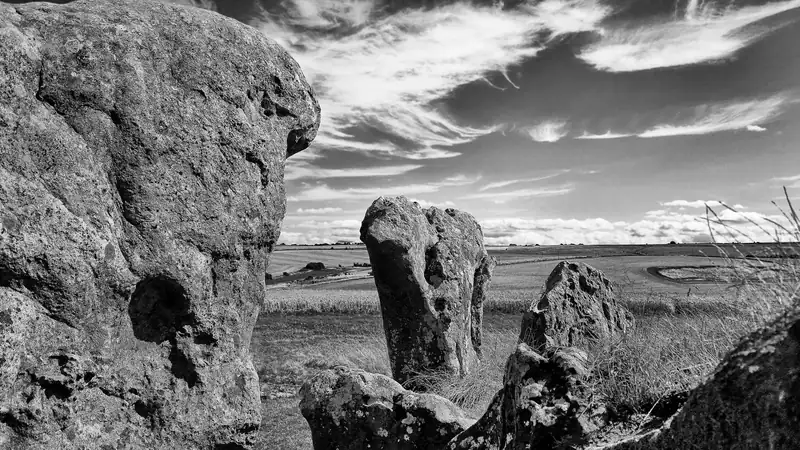
There are a few. At West Kennet Long Barrow (opens in a new tab) at Avebury, shown above, English Heritage says the tomb was built around 3650 BC, used for at least 1,000 years and closed around 2000 BC. The partial remains of at least 46 people were found inside. Legend has it, according to Soar (opens in a new tab), that a white-robed figure with a white dog with red ears appears there at dawn on the summer solstice.
Another account comes from an archaeologist. Soar writes that Dr R. C. Clay reported seeing a Bronze Age horseman riding across Bottlebush Down in Dorset in the winter of 1927, a rider who vanished at the site of a round barrow. Tales of druids haunting ancient monuments also exist, but she calls them "particularly anachronistic," because druids belong to the Iron Age, long after the Neolithic and Bronze Age monuments they are said to haunt.
Why the ancient dead stay quiet
Soar sets out several possible explanations. One is the "stone tape" idea associated with T. C. Lethbridge, an archaeologist turned parapsychologist, which holds that intense experiences can be impressed on a place and later "replayed." On that view, she suggests, the physical traces of prehistoric people may simply have disappeared. It may be significant, she adds, that the apparent prehistoric ghosts tend to cluster around surviving monuments such as barrows. Other options are that ghosts fade over time, or that whatever unfinished business prehistoric people had no longer means anything to us.
Her preferred angle treats ghosts as folklore. Ghost stories, she writes, reflect the knowledge, values and expectations of the people who tell them. "Ghost stories are as much about the living as the dead."
The Roman soldiers in the cellar
Roman ghosts are her test case. The most famous is at Treasurer's House in York (opens in a new tab), which the National Trust itself calls "this popular urban myth." According to the Trust, in February 1953 a young apprentice heating engineer, Harry Martindale, was working in the cellar on a boiler installation when he heard a trumpet and saw a Roman soldier's helmet come through a solid wall. A soldier on horseback and more soldiers followed, 20 in total, the Trust says, each visible only from the knees up because they were walking on the old Roman ground level, below the cellar floor. When the warden found him, the Trust says, the warden remarked: "By the look of you, you’ve seen the Roman soldiers." Little attention was paid to the story until excavations uncovered the Roman headquarters building in 1969.
Soar's point is about timing. Citing Jeremy Harte, she writes (opens in a new tab) that Roman ghosts emerge largely in the 20th century and are missing from the 19th, when "ghosts were being recorded as never before." Owen Davies, she adds, found no reports earlier than 1904. Her explanation is that Romans became familiar through education and popular culture, and the ghosts people describe are overwhelmingly soldiers, the Romans that culture taught them to expect. Prehistoric Britons are far harder to picture.
A call for stories
Soar and Professor Kenny Brophy of the University of Glasgow are now building a data set of reported pre-Roman ghosts in the UK, and of ghostly experiences at prehistoric sites, and they are asking the public to send in accounts, according to the essay (opens in a new tab). She notes that a fuller version appears in the British Fantasy Society Journal's Winter 2026 issue.
She ends with a prediction rooted in her argument: if prehistoric people become more visible in popular culture, such as the character Rogh in the BBC series Ghosts, they may start turning up in ghost reports too. If we have to learn what a ghost looks like before we can see it, she writes, "perhaps Britain’s prehistoric dead may yet start walking the landscape again."
For more on why places feel haunted, see our explainers on why houses seem haunted and on the 19 Hz "ghost in the machine".
Sources
- Where are all the prehistoric ghosts? (Dr Katy Soar) (opens in a new tab), University of Winchester, published 2026-11-03. Accessed 2026-11-25.
- Ghosts of Treasurer's House (opens in a new tab), National Trust. Accessed 2026-11-25.
- History of Wandlebury (opens in a new tab), Cambridge Past, Present & Future. Accessed 2026-11-25.
- History of West Kennet Long Barrow (opens in a new tab), English Heritage. Accessed 2026-11-25.
This article is an original summary written from the sources above. Quotes are short and attributed. Paranormal claims are reported as claims and have not been independently verified. Spotted an error? See our contact page.
Keep reading
Study of 2,000 Ghost Accounts Finds Faceless Shadows Replacing the Classic Ghost
A comparison of 1,000 early-internet ghost stories with 1,000 recent Reddit posts found reports of shadow figures more than doubled, from 6% to 14%.
3 sources · 5 min read
The Bell Witch: Tennessee's Most Famous Haunting, and How Much of It Is True
Around 1817, a spirit is said to have tormented the Bell family of Robertson County, Tennessee. What the record supports, and where the legend may be later fiction.
2 sources · 3 min read
Canadian MPs Vote 11-0 to Study Ottawa's Own UFO Report
A House of Commons committee will hold four meetings on the Sky Canada Project, the 2025 report that urged Canada to set up a service for UAP sighting reports.
5 sources · 5 min read